
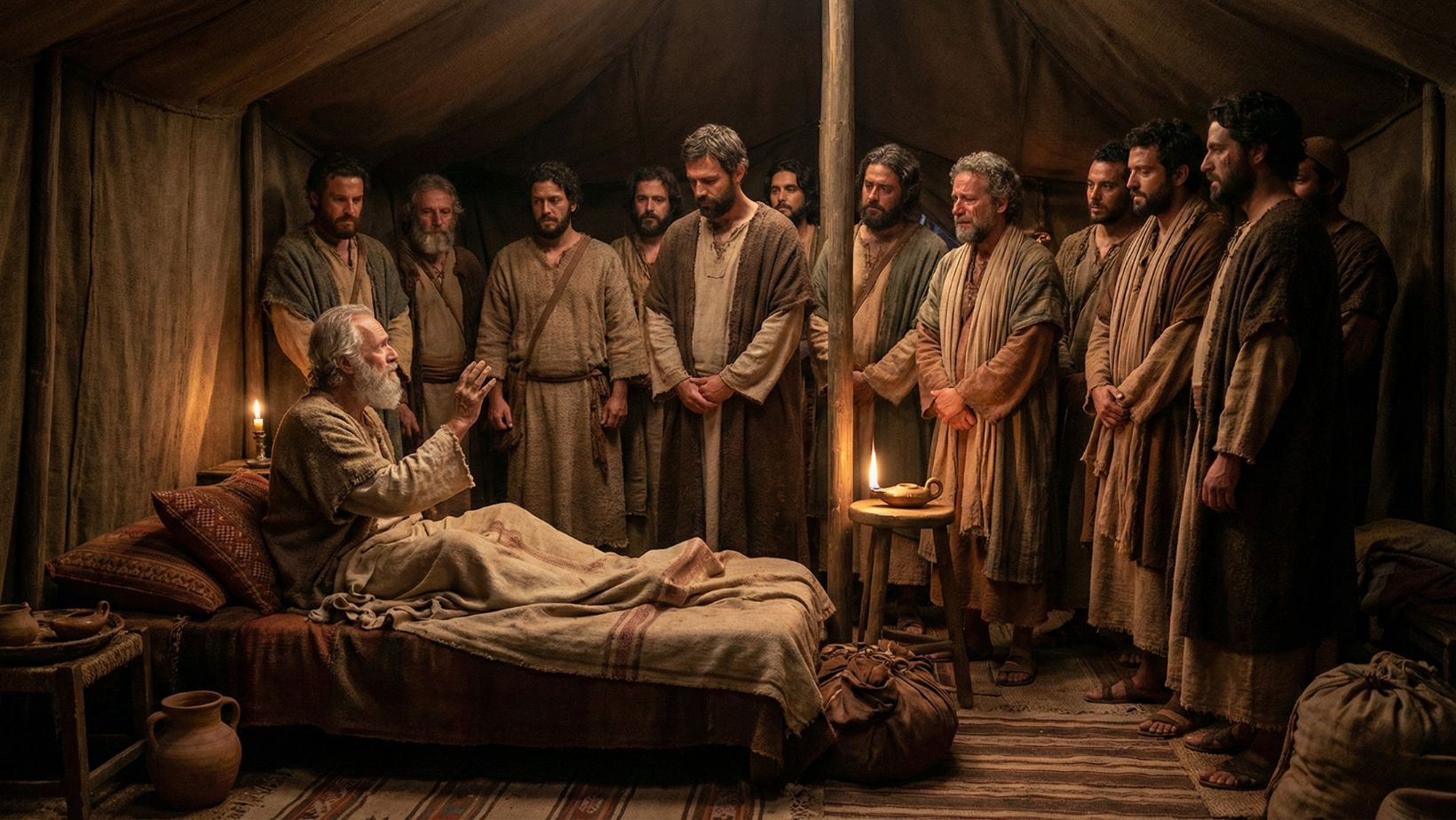
Genesis 49 is one of the most prophetic and consequential chapters in the entire Bible. It records the final words of Jacob (Israel) to his twelve sons. Unlike the previous chapter where he adopted Joseph’s sons, here Jacob acts as a seer, predicting the “days to come” for each tribe. These are not merely blessings; they are judgments and character assessments that determine the future history of the nation of Israel. The chapter famously disqualifies the first three sons (Reuben, Simeon, Levi) due to their moral failures and elevates Judah to the position of royal leadership, containing a clear Messianic prophecy. It concludes with the death of the last patriarch, marking the end of the Patriarchal Age and the beginning of the tribal history of Israel.
1. The Disqualified Firstborns (Genesis 49:1–7 NLT)
1 Then Jacob called for his sons and said, “Gather around so I can tell you what will happen to you in days to come. 2 “Come and listen, you sons of Jacob; listen to Israel, your father. 3 “Reuben, you are my firstborn, my strength, the child of my vigorous youth. You are first in rank and first in power. 4 But you are as unruly as a flood, and you will be no longer first. For you went to bed with my wife; you defiled my marriage couch. 5 “Simeon and Levi are two of a kind; their weapons are instruments of violence. 6 May I never join in their meetings; may I never be a party to their plans. For in their anger they murdered men, and they crippled oxen just for fun. 7 Cursed be their anger, for it is fierce; cursed be their wrath, for it is cruel. I will scatter them among Jacob; I will disperse them throughout Israel.
Commentary:
- The Prophetic Gathering (v. 1): Jacob summons them not just for a farewell, but to reveal “what will happen to you in days to come.” This phrase often introduces Messianic or eschatological prophecies in the OT (Num 24:14; Dan 10:14).
- Reuben’s Demotion (v. 3-4):
- The Potential: Reuben had everything—dignity, power, and the rights of the firstborn.
- The Failure: He is described as “unruly as a flood” (literally: unstable as water). This refers to his lack of self-control when he slept with Bilhah, his father’s concubine (Gen 35:22).
- The Consequence: “You will be no longer first.” Historically, the tribe of Reuben never produced a judge, a king, or a prophet of note. They dwindled in significance.
- Simeon and Levi’s Violence (v. 5-7):
- The Crime: Jacob recalls the massacre at Shechem (Gen 34) where they used the sacred rite of circumcision as a trap to slaughter an entire town. He calls their swords “instruments of violence.”
- The Curse: Note that Jacob curses their anger, not the sons themselves.
- The Dispersion: The consequence is scattering.
- Simeon: Eventually absorbed into the territory of Judah (Joshua 19:1-9) and effectively ceased to be an independent power.
- Levi: Also scattered, but God later redeemed this curse. Because of their faithfulness during the Golden Calf incident (Exodus 32), their “scattering” was transformed into a priestly ministry. They were dispersed to teach the law, not to fade away.
2. The Royal Line: Judah (Genesis 49:8–12 NLT)
8 “Judah, your brothers will praise you. You will grasp your enemies by the neck. All your relatives will bow before you. 9 Judah, my son, is a young lion that has finished eating its prey. Like a lion he crouches and lies down; like a lioness—who dares to rouse him? 10 The scepter will not depart from Judah, nor the ruler’s staff from his descendants, until the coming of the one to whom it belongs, the one whom all nations will honor. 11 He ties his foal to a grapevine, the colt of his donkey to a choice vine. He washes his clothes in wine, his robes in the blood of grapes. 12 His eyes are darker than wine, and his teeth are whiter than milk.
Commentary:
- The Shift to Judah: With the first three brothers disqualified, the mantle of leadership falls to the fourth son, Judah.
- The Lion of Judah (v. 9): Jacob uses the imagery of a lion—the king of beasts—to describe Judah’s military prowess and regal nature. This image is later applied to Jesus in Revelation 5:5 (“The Lion of the tribe of Judah”).
- The Scepter Prophecy (v. 10): This is the theological core of the chapter.
- The Promise: Political and royal authority (“the scepter”) will remain with Judah. King David came from this line, as did the Kings of Judah.
- Shiloh / The One: The phrase “until the coming of the one to whom it belongs” (often translated Shiloh in KJV/NASB) is universally recognized by Christians and ancient Jewish commentators as a Messianic title. It predicts that the ultimate King (Messiah) will come from Judah and command the obedience of “all nations.”
- Abundance (v. 11-12): The imagery of tying a donkey to a “choice vine” and washing clothes in “wine” implies an era of such extreme prosperity that precious commodities (wine/vines) are treated as common. This foreshadows the Millennial Kingdom or the abundance of the Messianic age.
3. The Maritime and Agricultural Tribes (Genesis 49:13–15 NLT)
13 “Zebulun will settle by the seashore and will be a harbor for ships; his borders will extend to Sidon. 14 “Issachar is a sturdy donkey, resting between two saddlepacks. 15 When he sees how good the countryside is and how pleasant the land, he will bend his shoulder to the load and submit himself to hard labor.
Commentary:
- Zebulun (v. 13): Predicted to be involved in commerce and maritime trade. While their territory didn’t directly touch the Mediterranean Sea (it was slightly inland), they were situated on the major trade route (Via Maris) between the sea and the interior, profiting from the trade of Sidon (Phoenicia).
- Issachar (v. 14-15): Compared to a “sturdy donkey.” This is not an insult but a picture of strength and docility. Issachar’s land (the Jezreel Valley) was incredibly fertile. The prophecy suggests they would become wealthy farmers who loved comfort (“saw how good the countryside is”) so much that they were willing to submit to political servitude (“hard labor”) rather than fight for dominance.
4. The Sons of the Concubines (Genesis 49:16–21 NLT)
16 “Dan will govern his people, like any other tribe in Israel. 17 Dan will be a snake beside the road, a poisonous viper along the path that bites the horse’s hooves so its rider is thrown off. 18 (I trust in you for salvation, O Lord!) 19 “Gad will be attacked by marauding bands, but he will attack them when they retreat. 20 “Asher will dine on rich foods and produce food fit for kings. 21 “Naphtali is a doe set free that bears beautiful fawns.
Commentary:
- Dan (v. 16-17):
- The Judge: Dan produced Samson, one of Israel’s most famous judges.
- The Snake: This describes Dan’s method of warfare—guerrilla tactics and ambush rather than open confrontation. However, historically, Dan was the first tribe to turn to idolatry (Judges 18), acting as a “poison” to the nation.
- Jacob’s Prayer (v. 18): Jacob suddenly interrupts the prophecy with “I trust in you for salvation, O Lord!” Seeing the darkness in Dan’s future (or perhaps feeling his own death approaching), he cries out for Yahweh’s deliverance (Yeshua).
- Gad (v. 19): A play on words (Gad sounds like “troop” or “attack”). Gad settled on the east side of the Jordan, a frontier land exposed to enemy raiders (Ammonites/Moabites). They became fierce warriors.
- Asher (v. 20): Located on the fertile coast of Carmel. They produced olive oil and delicacies “fit for kings.”
- Naphtali (v. 21): Compared to a “doe set free,” implying speed and agility. They were known for swift warriors (Barak in Judges 4 was from Naphtali).
5. The Fruitful Bough: Joseph (Genesis 49:22–26 NLT)
22 “Joseph is a fruitful vine, a fruitful vine near a spring. Its branches climb over a wall. 23 The archers attacked him savagely; they shot at him and harassed him. 24 But his bow remained taut, and his arms were strengthened by the hands of the Mighty One of Jacob, by the Shepherd, the Rock of Israel. 25 May the God of your father help you; may the Almighty bless you with the blessings of the heavens above, and blessings of the watery depths below, and blessings of the breasts and womb. 26 May my fatherly blessings on you surpass the blessings of my ancestors, reaching to the heights of the eternal hills. May these blessings rest on the head of Joseph, who is a prince among his brothers.
Commentary:
- The Double Portion: Joseph receives the longest blessing. He is the “fruitful vine” whose branches climb over the wall—symbolizing how his two sons (Ephraim and Manasseh) would grow into two large tribes that dominated northern Israel.
- Retrospective (v. 23-24): Jacob retells Joseph’s story poetically. The “archers” (his brothers, Potiphar’s wife) attacked him, but his “bow remained taut” (he did not break).
- Titles of God (v. 24): This verse contains a dense cluster of divine titles:
- Total Blessing (v. 25): The blessing covers all spheres: rain (heaven), springs (deep), and fertility (breasts/womb).
- Prince Among Brothers (v. 26): Joseph is recognized as the “prince” (or nazir – one separated/consecrated). While Judah got the throne, Joseph got the birthright (prosperity and double portion).
6. Benjamin and the Death of Jacob (Genesis 49:27–33 NLT)
27 “Benjamin is a ravenous wolf, devouring his enemies in the morning and dividing his plunder in the evening.” 28 These are the twelve tribes of Israel, and this is what their father said as he told his last words to them. He blessed each one with the blessing appropriate to him. 29 Then Jacob instructed them, “Soon I will die and join my ancestors. Bury me with my father and grandfather in the cave in the field of Ephron the Hittite. 30 This is the cave in the field of Machpelah, near Mamre in Canaan, that Abraham bought from Ephron the Hittite as a permanent burial place. 31 There Abraham and his wife Sarah are buried. There Isaac and his wife, Rebekah, are buried. And there I buried Leah. 32 It is the plot of land and the cave that were purchased from the Hittites.” 33 When Jacob had finished this charge to his sons, he drew his feet into the bed, breathed his last, and joined his ancestors in death.
Commentary:
- Benjamin (v. 27): The “ravenous wolf” depicts the warlike nature of the Benjaminites. They were famous for being ambidextrous slingers and fierce fighters (Judges 20). King Saul and the Apostle Paul were both from this “wolf-like” tribe.
- The Final Instruction (v. 29-32): Jacob reiterates his command to be buried in Canaan. He recites the “deed” to the Cave of Machpelah, listing exactly who is inside (Abraham, Sarah, Isaac, Rebekah, Leah).
- The Death (v. 33): “Drew his feet into the bed.” This signifies a peaceful, voluntary submission to death. He did not die in a panic; he finished his task and yielded his spirit.
Theological Significance of Genesis 49
- The Sovereignty of Character: The prophecies show that character has multi-generational consequences. Reuben’s lust and Simeon’s anger cost them their standing. Judah’s transformation led to kingship.
- Messianic Hope: Verse 10 is one of the pivotal verses of the Old Testament. It narrows the “Seed of the Woman” (Gen 3:15) and the “Seed of Abraham” (Gen 12:3) down to the specific lineage of Judah. The scepter would wait for Jesus.
- Transformation of Curses: The story of Levi shows that a curse (scattering) can be turned into a blessing (priesthood) through repentance and zeal for God.
Practical Applications
- Instability vs. Reliability: Reuben warns us that talent (“first in power”) without character (“unstable as water”) leads to disqualification.
- Finishing Well: Jacob’s life was full of deceit and struggle, but he ended it as a prophet and a worshiper. It matters less how we start than how we finish.
- The Long View: Jacob blessed his sons based on their future, not just their present. We should parent and lead with an eye toward the long-term spiritual destiny of those under our care.
Possible Sermon Titles
- The Scepter Shall Not Depart.
- Unstable as Water: The Tragedy of Wasted Potential.
- Joseph: The Fruitful Vine.
- The Lion of Judah Roars.
- Dying with Your Feet in the Bed (A Good Death).







Leave a Reply