
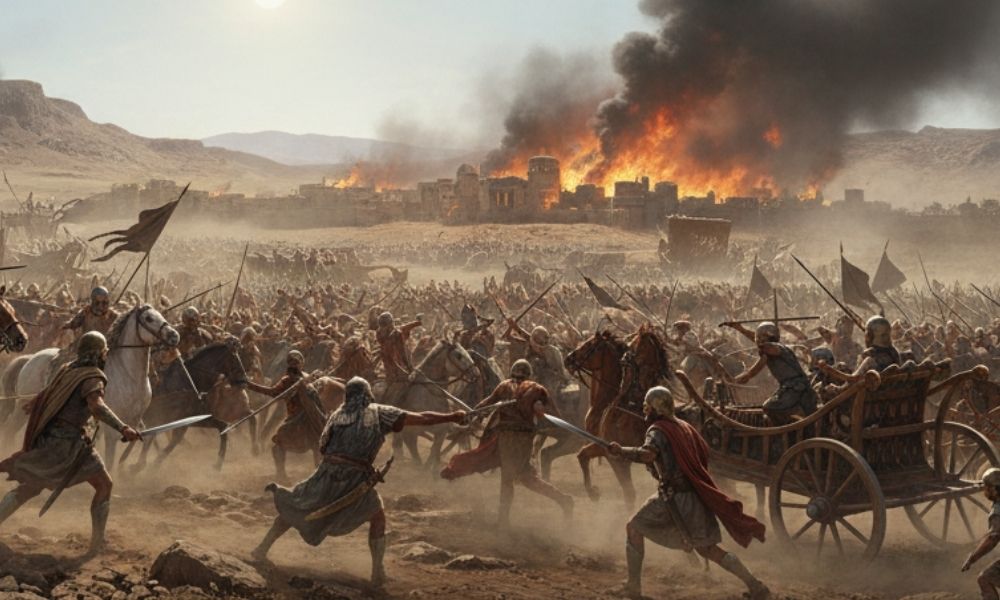
Joshua 11 recounts Israel’s conquest of northern Canaan. King Jabin of Hazor forms a vast alliance of northern kings to fight Israel. The armies gather by the waters of Merom with horses and chariots, but God tells Joshua not to fear. Israel attacks suddenly, defeats them completely, and burns Hazor — the leading city of those kingdoms. Joshua obeys God’s command fully, taking all the land from Mount Halak to Baal-gad and destroying the Canaanite kings. The chapter concludes that Joshua fought many battles, left nothing undone that the Lord had commanded, and the land finally had rest from war.
1. The Northern Coalition (11:1–5)
“When Jabin, king of Hazor, heard of this, he sent to Jobab king of Madon, and to the king of Shimron, and to the king of Achshaph, and to the kings who were in the northern hill country, and in the Arabah south of Chinneroth, and in the lowland, and in Naphoth-dor on the west, to the Canaanites in the east and the west, the Amorites, the Hittites, the Perizzites, and the Jebusites in the hill country, and the Hivites under Hermon in the land of Mizpah. And they came out with all their troops, a great horde, in number like the sand that is on the seashore, with very many horses and chariots. And all these kings joined their forces and came and encamped together at the waters of Merom to fight against Israel.” (Joshua 11:1–5, ESV)
Commentary:
- Jabin, king of Hazor, leads another large coalition to resist Israel. Hazor was the most powerful Canaanite city in the north.
- The alliance includes diverse tribes from across the northern region—showing unity in opposition to God’s will.
- The enemy’s army is vast, “like the sand on the seashore,” and equipped with advanced weapons—horses and chariots.
- This is the largest and best-armed opposition Israel has faced so far.
- The gathering at the waters of Merom sets the stage for another decisive intervention by God.
Insight:
Evil may appear organized and powerful, but no force can prevail against God’s purpose. Unity against God only hastens defeat.
2. God’s Assurance and Israel’s Surprise Attack (11:6–9)
“And the Lord said to Joshua, ‘Do not be afraid of them, for tomorrow at this time I will give over all of them, slain, to Israel. You shall hamstring their horses and burn their chariots with fire.’ So Joshua and all his warriors came suddenly against them by the waters of Merom and fell upon them. And the Lord gave them into the hand of Israel, who struck them and chased them as far as Great Sidon and Misrephoth-maim, and eastward as far as the Valley of Mizpeh. And they struck them until he left none remaining. And Joshua did to them just as the Lord said to him: he hamstrung their horses and burned their chariots with fire.” (Joshua 11:6–9, ESV)
Commentary:
- God once again reassures Joshua: “Do not be afraid.” His promise precedes every major victory.
- The command to hamstring the horses and burn the chariots prevents Israel from relying on military technology instead of divine strength.
- Joshua launches a surprise attack, demonstrating speed, strategy, and faith.
- The Lord delivers total victory—Israel pursues enemies far across northern Canaan.
- Joshua’s obedience in disabling the horses and destroying the chariots shows submission to God’s will over human logic.
Insight:
Trust in divine power must replace dependence on human resources. Obedience, even when it defies strategy, ensures victory.
3. The Destruction of Hazor (11:10–15)
“And Joshua turned back at that time and captured Hazor and struck its king with the sword, for Hazor formerly was the head of all those kingdoms. And they struck with the sword all who were in it, devoting them to destruction; there was none left that breathed. And he burned Hazor with fire. And all the cities of those kings, and all their kings, Joshua took, and struck them with the edge of the sword, devoting them to destruction, just as Moses the servant of the Lord had commanded. But none of the cities that stood on mounds did Israel burn, except Hazor alone; that Joshua burned. And all the spoil of these cities and the livestock the people of Israel took for their plunder. But every person they struck with the edge of the sword until they had destroyed them. They did not leave any who breathed. Just as the Lord had commanded Moses his servant, so Moses commanded Joshua, and so Joshua did. He left nothing undone of all that the Lord had commanded Moses.” (Joshua 11:10–15, ESV)
Commentary:
- Hazor, being the “head of all those kingdoms,” represents the political and military heart of Canaan’s resistance.
- Joshua’s destruction of Hazor symbolizes the collapse of Canaanite power in the north.
- Only Hazor is burned—perhaps to signify the complete end of its influence.
- Israel is allowed to take livestock and goods, indicating divine provision through conquest.
- The text highlights Joshua’s complete obedience: “He left nothing undone of all that the Lord commanded.”
Insight:
True leadership means carrying out God’s commands fully, without compromise or delay. Success in God’s mission flows from complete obedience.
4. Summary of Joshua’s Victories (11:16–23)
“So Joshua took all that land, the hill country and all the Negeb and all the land of Goshen and the lowland and the Arabah and the hill country of Israel and its lowland from Mount Halak, which rises toward Seir, as far as Baal-gad in the Valley of Lebanon below Mount Hermon. And he captured all their kings and struck them and put them to death. Joshua made war a long time with all those kings. There was not a city that made peace with the people of Israel except the Hivites, the inhabitants of Gibeon. They took them all in battle. For it was the Lord’s doing to harden their hearts that they should come against Israel in battle, in order that they should be devoted to destruction and should receive no mercy but be destroyed, just as the Lord commanded Moses.” (Joshua 11:16–20, ESV)
Commentary:
- These verses summarize the vast extent of Joshua’s conquests—from the southern Negev to Mount Hermon in the far north.
- The campaign lasted “a long time,” possibly several years, showing that divine promises require perseverance.
- Only Gibeon made peace; all others chose war.
- Verse 20 reveals a deep truth: “It was the Lord’s doing to harden their hearts.” Like Pharaoh, the Canaanite kings resisted repentance and sealed their judgment.
- God’s justice is expressed through their destruction—He gave them over to their hardened rebellion.
Insight:
When people persistently resist God’s will, He allows their hardness to lead to judgment. Obedience softens the heart; rebellion hardens it.
5. The Annihilation of the Anakim and Rest in the Land (11:21–23)
“And Joshua came at that time and cut off the Anakim from the hill country, from Hebron, from Debir, from Anab, and from all the hill country of Judah, and from all the hill country of Israel. Joshua devoted them to destruction with their cities. There was none of the Anakim left in the land of the people of Israel. Only in Gaza, in Gath, and in Ashdod did some remain. So Joshua took the whole land, according to all that the Lord had spoken to Moses. And Joshua gave it for an inheritance to Israel according to their tribal allotments. And the land had rest from war.” (Joshua 11:21–23, ESV)
Commentary:
- The Anakim, giants feared since the days of the spies (Numbers 13:28–33), are finally defeated.
- This victory fulfills a long-standing promise—God removes the very obstacle that once caused Israel’s ancestors to doubt.
- A few survivors remain in Philistine cities (Gaza, Gath, Ashdod)—foreshadowing later conflicts (e.g., Goliath from Gath).
- The conquest is declared complete: Joshua “took the whole land.”
- The chapter ends with a beautiful phrase—“the land had rest from war.”
- This rest signifies God’s faithfulness in giving His people victory and security in the promised inheritance.
Insight:
God’s promises may take time, but He fulfills them completely. What once seemed impossible—defeating the giants—becomes reality when we trust Him fully.
Theological Significance of Joshua 11
- God’s Sovereignty in History: Even the resistance of nations serves His ultimate plan.
- Complete Obedience: Joshua’s thorough execution of God’s commands models faithful leadership.
- Divine Justice: The hardening of Canaanite hearts shows God’s righteous judgment on persistent sin.
- Faith Over Fear: The defeat of the Anakim proves that faith can overcome long-standing fears.
- Covenant Fulfillment: God fulfills every word promised to Moses through Joshua’s obedience.
Practical Applications
- Stay faithful over time. God’s promises may require patience and endurance.
- Don’t fear powerful opposition. What seems overwhelming is small before God.
- Obey fully, not partially. Incomplete obedience leads to future trouble.
- Trust God with the giants. What terrified the previous generation can be conquered through faith.
- Rest in God’s victory. True peace comes only when God’s work is complete in our lives.
Final Insight:
Joshua 11 marks the end of Israel’s military conquest—a story of faith, obedience, and divine triumph. The giants fell, the kings were defeated, and the land finally rested. When God’s people believe and obey, He brings them into both victory and peace.







Leave a Reply