
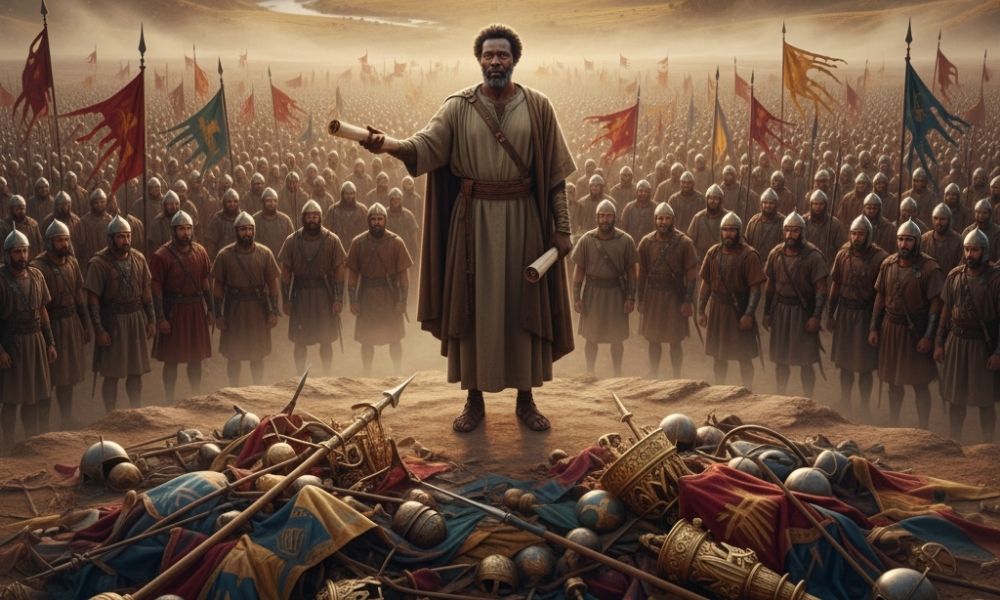
Joshua 12 lists the kings defeated by Israel under Moses and Joshua. East of the Jordan, Moses conquered Sihon king of the Amorites and Og king of Bashan, giving their lands to the tribes of Reuben, Gad, and half of Manasseh. West of the Jordan, Joshua defeated thirty-one kings across Canaan—from Jericho to the hill country, the Negev, and the western foothills. This chapter serves as a record of God’s faithfulness in fulfilling His promise to give Israel the land, showing that no enemy could stand against the Lord’s power working through His people.
1. The Kings Defeated East of the Jordan (12:1–6)
“Now these are the kings of the land whom the people of Israel defeated and took possession of their land beyond the Jordan toward the sunrise, from the Valley of the Arnon to Mount Hermon, with all the Arabah eastward: Sihon king of the Amorites, who lived at Heshbon and ruled from Aroer, which is on the edge of the Valley of the Arnon, and from the middle of the valley as far as the river Jabbok, the boundary of the Ammonites, that is, half of Gilead, and the Arabah to the Sea of Chinneroth eastward, and in the direction of Beth-jeshimoth, to the Sea of the Arabah, the Salt Sea, southward to the foot of the slopes of Pisgah; and Og king of Bashan, one of the remnant of the Rephaim, who lived at Ashtaroth and at Edrei and ruled over Mount Hermon and Salecah and all Bashan to the boundary of the Geshurites and the Maacathites, and over half of Gilead to the boundary of Sihon king of Heshbon. Moses, the servant of the Lord, and the people of Israel defeated them. And Moses the servant of the Lord gave their land for a possession to the Reubenites and the Gadites and the half-tribe of Manasseh.” (Joshua 12:1–6, ESV)
Commentary:
- This section recalls victories east of the Jordan River, achieved under Moses’ leadership before Israel entered Canaan.
- Two powerful kings are highlighted:
- These lands stretched from the Arnon River in the south to Mount Hermon in the north—forming the eastern frontier of Israel’s future territory.
- Moses’ conquest shows God’s faithfulness before Joshua’s campaign even began.
- The land was already divided among Reuben, Gad, and the half-tribe of Manasseh, showing early fulfillment of promise and organized inheritance.
Insight:
Before Joshua’s victories, God had already begun granting triumph through Moses. Every victory builds on God’s past faithfulness.
2. The Kings Defeated West of the Jordan (12:7–24)
“And these are the kings of the land whom Joshua and the people of Israel defeated on the west side of the Jordan, from Baal-gad in the Valley of Lebanon to Mount Halak, that rises toward Seir (and Joshua gave their land to the tribes of Israel as a possession according to their allotments), in the hill country, in the lowland, in the Arabah, in the slopes, in the wilderness, and in the Negeb, the land of the Hittites, the Amorites, the Canaanites, the Perizzites, the Hivites, and the Jebusites: the king of Jericho, one; the king of Ai, which is beside Bethel, one; the king of Jerusalem, one; the king of Hebron, one; the king of Jarmuth, one; the king of Lachish, one; the king of Eglon, one; the king of Gezer, one; the king of Debir, one; the king of Geder, one; the king of Hormah, one; the king of Arad, one; the king of Libnah, one; the king of Adullam, one; the king of Makkedah, one; the king of Bethel, one; the king of Tappuah, one; the king of Hepher, one; the king of Aphek, one; the king of Lasharon, one; the king of Madon, one; the king of Hazor, one; the king of Shimron-meron, one; the king of Achshaph, one; the king of Taanach, one; the king of Megiddo, one; the king of Kedesh, one; the king of Jokneam in Carmel, one; the king of Dor in Naphath-dor, one; the king of Goiim in Galilee, one; the king of Tirzah, one: in all, thirty-one kings.” (Joshua 12:7–24, ESV)
Commentary:
- The passage lists thirty-one kings conquered by Joshua in western Canaan.
- It represents victories from the Valley of Lebanon (north) to Mount Halak (south), covering every major region—hill country, plains, desert, and lowlands.
- The list begins with Jericho (the first conquest) and ends with Tirzah (a future capital in the northern kingdom, 1 Kings 14:17).
- Each city and king is named individually, underlining the completeness and precision of Israel’s victories.
- The repetition of “one” after each king emphasizes that each victory was distinct and divinely secured.
- The variety of locations (Jerusalem, Hebron, Hazor, Megiddo) shows that no power—political, military, or spiritual—could withstand God’s advancing people.
Insight:
What God begins, He completes. Every enemy defeated, every city taken, and every promise fulfilled displays His perfect record of faithfulness.
Theological Significance of Joshua 12
- God’s Faithfulness Remembered: The chapter serves as a record of divine victories—proof that God kept His promise to Abraham (Genesis 15:18–21).
- Continuity of Leadership: Moses’ and Joshua’s conquests together show God’s unbroken plan through successive generations.
- Historical Witness: Listing each king turns history into worship—it acknowledges God as the true Warrior of Israel.
- Total Dominion: The enumeration of both eastern and western conquests demonstrates God’s absolute sovereignty over the land.
- Spiritual Legacy: These physical victories prefigure spiritual triumphs—believers are called to “possess” the promises of God completely.
Practical Applications
- Celebrate God’s victories. Keep records—spiritual or written—of what God has done; remembrance strengthens faith.
- Acknowledge past leadership. God’s work continues through faithful servants like Moses and Joshua; honor continuity in ministry.
- Be thorough in conquest. Partial obedience leaves enemies behind; total victory comes from full submission to God’s will.
- Recognize every triumph as God’s. Each “one” in the list reminds us that every success belongs to Him.
- Live in gratitude. Every victory, big or small, points back to the faithfulness of a covenant-keeping God.
Final Insight:
Joshua 12 is more than a list—it’s a testimony of fulfilled promises. Each name, each king, and each region stands as evidence that God never fails. The land was subdued, the enemies defeated, and Israel stood in the reality of what God had long promised. Every believer can draw hope: what God begins in His people, He will surely bring to completion.







Leave a Reply