
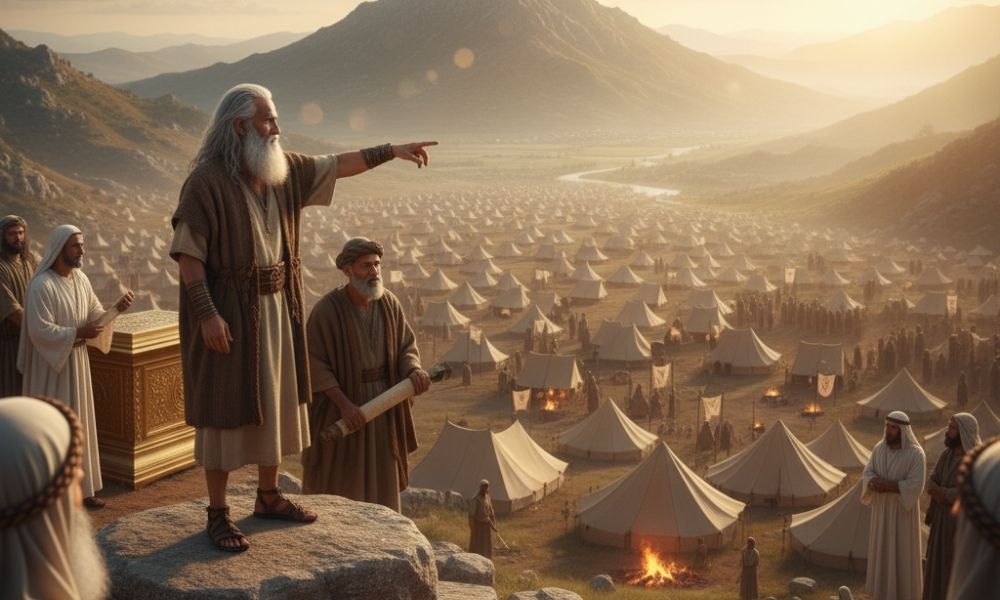
Joshua 14 focuses on the division of the land among the tribes and Caleb’s special inheritance. The Israelites gather at Gilgal, where Eleazar the priest, Joshua, and tribal leaders oversee the allotment. The Levites receive no land, only towns, while Joseph’s descendants receive two portions through Ephraim and Manasseh. Caleb, now eighty-five years old, reminds Joshua of God’s promise to him forty-five years earlier, when he brought back a faithful report from spying out the land. He boldly asks for the hill country of Hebron, where the Anakim (giants) lived. Joshua blesses Caleb, granting him Hebron as his inheritance because he wholly followed the Lord.
1. The Distribution of the Land Begins (14:1–5)
“These are the inheritances that the people of Israel received in the land of Canaan, which Eleazar the priest and Joshua the son of Nun and the heads of the fathers’ houses of the tribes of the people of Israel gave them to inherit. Their inheritance was by lot, just as the Lord had commanded by the hand of Moses for the nine and one-half tribes. For Moses had given an inheritance to the two and one-half tribes beyond the Jordan, but to the Levites he gave no inheritance among them. For the people of Joseph were two tribes, Manasseh and Ephraim. And no portion was given to the Levites in the land, but only cities to dwell in, with their pasturelands for their livestock and their substance. The people of Israel did as the Lord commanded Moses; they allotted the land.” (Joshua 14:1–5, ESV)
Commentary:
- This section introduces the official division of Canaan among the nine and a half tribes west of the Jordan.
- Eleazar the priest, Joshua, and the tribal heads oversee the process, ensuring spiritual and administrative fairness.
- The land is distributed by lot, meaning under divine guidance—not human preference (Proverbs 16:33).
- The Levites again receive no territory, emphasizing their unique calling to serve the Lord rather than own land.
- The tribes of Joseph (Ephraim and Manasseh) count as two, maintaining the total of twelve tribal inheritances.
- Israel’s obedience in following “as the Lord commanded Moses” reflects continuity of covenant faithfulness.
Insight:
When leadership honors God’s order and follows His Word, peace and fairness prevail. Divine order brings unity in distribution and blessing.
2. Caleb’s Request at Gilgal (14:6–9)
“Then the people of Judah came to Joshua at Gilgal. And Caleb the son of Jephunneh the Kenizzite said to him, ‘You know what the Lord said to Moses the man of God in Kadesh-barnea concerning you and me. I was forty years old when Moses the servant of the Lord sent me from Kadesh-barnea to spy out the land, and I brought him word again as it was in my heart. But my brothers who went up with me made the heart of the people melt; yet I wholly followed the Lord my God. And Moses swore on that day, saying, “Surely the land on which your foot has trodden shall be an inheritance for you and your children forever, because you have wholly followed the Lord my God.”’” (Joshua 14:6–9, ESV)
Commentary:
- The focus shifts from general allotment to Caleb, a symbol of enduring faith.
- He reminds Joshua of the promise made 45 years earlier at Kadesh-barnea (Numbers 13–14).
- While others doubted, Caleb’s report was full of faith—he “wholly followed the Lord.”
- Moses promised him personal inheritance for his faithfulness.
- Caleb’s tone is respectful yet confident, showing how faith remembers God’s promises even decades later.
Insight:
Faith has a long memory. What God promised years ago remains secure for those who hold fast without wavering.
3. Caleb’s Testimony of God’s Faithfulness (14:10–12)
“And now, behold, the Lord has kept me alive, just as he said, these forty-five years since the time that the Lord spoke this word to Moses, while Israel walked in the wilderness. And now, behold, I am this day eighty-five years old. I am still as strong today as I was in the day that Moses sent me; my strength now is as my strength was then, for war and for going and coming. So now give me this hill country of which the Lord spoke on that day, for you heard on that day how the Anakim were there, with great fortified cities. It may be that the Lord will be with me, and I shall drive them out just as the Lord said.” (Joshua 14:10–12, ESV)
Commentary:
- Caleb attributes his long life and strength directly to God’s faithfulness: “The Lord has kept me alive.”
- At 85 years old, his zeal for conquest is undiminished—proof that faith, not age, determines spiritual vitality.
- His request for the hill country (Hebron) shows courage—this was land inhabited by the Anakim (giants) and fortified cities.
- He does not demand ease but asks for a challenge, trusting that “the Lord will be with me.”
- Caleb’s faith is active, not passive; he expects to participate in the fulfillment of God’s promise.
Insight:
True faith doesn’t retire—it remains ready to fight God’s battles even in old age. The faithful never outgrow courage or trust.
4. Joshua Grants Hebron to Caleb (14:13–15)
“Then Joshua blessed him, and he gave Hebron to Caleb the son of Jephunneh for an inheritance. Therefore Hebron became the inheritance of Caleb the son of Jephunneh the Kenizzite to this day, because he wholly followed the Lord, the God of Israel. Now the name of Hebron formerly was Kiriath-arba. (Arba was the greatest man among the Anakim.) And the land had rest from war.” (Joshua 14:13–15, ESV)
Commentary:
- Joshua blesses Caleb—formal confirmation that faith and obedience bring reward.
- Hebron, formerly Kiriath-arba, was one of the most formidable Canaanite strongholds.
- By granting this land to Caleb, Joshua honors both divine promise and personal integrity.
- The repeated phrase “he wholly followed the Lord” highlights the key to Caleb’s success.
- The chapter closes with “the land had rest from war,” a sign that obedience leads to peace.
Insight:
Faithful perseverance ends in peace and inheritance. When we wholly follow the Lord, He fulfills His Word completely.
Theological Significance of Joshua 14
- Faith’s Reward: Caleb’s inheritance demonstrates that steadfast trust in God brings tangible blessing.
- God’s Faithfulness Over Time: Decades did not erode God’s promises or His servant’s faith.
- Leadership in Harmony: Joshua and Caleb, the two faithful spies, now together witness the fulfillment of what they once believed.
- Divine Distribution: The land was given not by human decision but by divine guidance through the lot.
- Courageous Faith: Caleb’s example embodies the courage that comes from remembering God’s Word.
Practical Applications
- Hold fast to God’s promises. Even if fulfillment delays, His Word never expires.
- Serve faithfully at every age. Spiritual strength does not diminish with years when fueled by faith.
- Desire challenges that glorify God. Like Caleb, seek victories that display His power, not personal comfort.
- Be wholehearted. To “wholly follow the Lord” is the secret to lasting fruit and fulfillment.
- Celebrate faithfulness. God honors those who remain true through the seasons of testing.
Final Insight:
Joshua 14 captures the heart of faith through Caleb’s life—a man whose confidence in God outlasted forty years of delay and forty-five years of waiting. While others feared giants, Caleb saw opportunities for God’s glory. His inheritance of Hebron stands as a living monument to enduring faith: those who wholly follow the Lord will, in time, receive all that He has promised.







Leave a Reply