
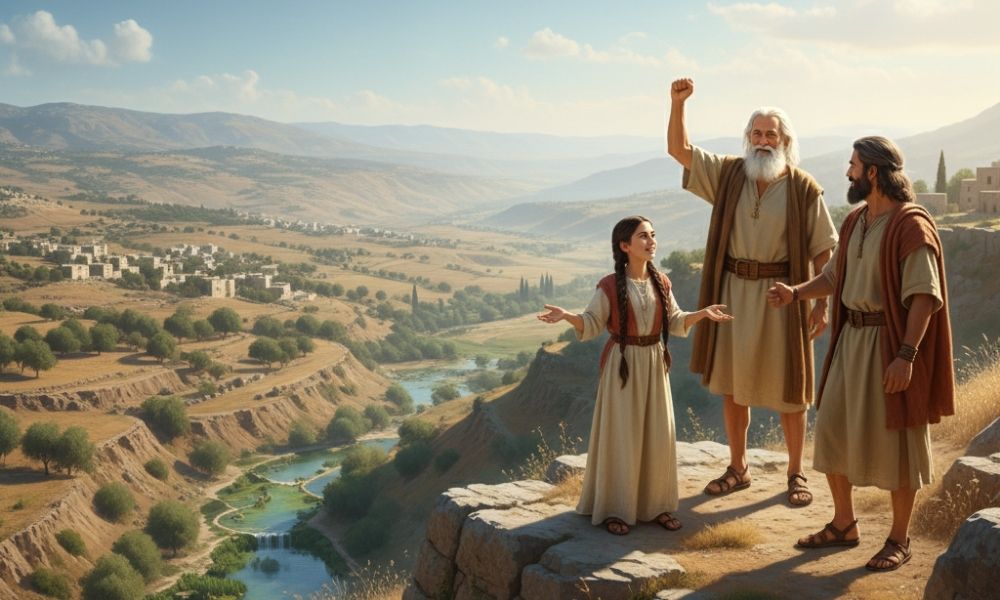
Joshua 15 details the boundaries and cities of the tribe of Judah. The southern border stretches from the Dead Sea to the Negev, and the western border reaches the Mediterranean Sea. The northern boundary includes Jerusalem and surrounding areas. Caleb, from the tribe of Judah, receives Hebron as his inheritance and drives out the Anakim (giants). He promises his daughter Achsah in marriage to whoever captures Kiriath-sepher; Othniel, his nephew, wins the city and marries her. Achsah asks her father for springs of water, and Caleb grants her both upper and lower springs. The chapter then lists Judah’s many towns, showing the tribe’s vast and diverse inheritance.
1. Judah’s Territorial Boundaries (15:1–12)
“The lot for the tribe of the people of Judah according to their clans reached southward to the boundary of Edom, to the wilderness of Zin at the farthest south. And their south boundary ran from the end of the Salt Sea, from the bay that faces southward. It goes out southward of the ascent of Akrabbim, passes along to Zin, and goes up by the south of Kadesh-barnea… And the east boundary is the Salt Sea, to the mouth of the Jordan. And the boundary on the north side runs from the bay of the sea at the mouth of the Jordan… And the western boundary was the Great Sea with its coastline. This is the boundary around the people of Judah according to their clans.” (Joshua 15:1–12, ESV)
Commentary:
- Judah’s inheritance, the first and largest allotment, reflects the tribe’s leadership prominence.
- The boundaries stretch:
- South: toward Edom and the wilderness of Zin (near Kadesh-barnea).
- East: along the Dead Sea.
- North: up to Jericho and Jerusalem’s region.
- West: the Mediterranean Sea (“Great Sea”).
- The tribe of Judah occupies a vast and varied land—mountains, desert, fertile valleys, and coastline.
- This land would later include key biblical sites: Bethlehem, Hebron, Beersheba, and Jerusalem’s area (though Jerusalem itself would later be shared).
- The detailed borders emphasize God’s precision in fulfilling promises.
Insight:
God’s blessings are not vague—they are defined and specific. His promises include clear boundaries of inheritance and responsibility.
2. Caleb’s Conquest and Family Blessing (15:13–19)
“According to the commandment of the Lord to Joshua, he gave to Caleb the son of Jephunneh a portion among the people of Judah, Kiriath-arba (that is, Hebron). And Caleb drove out from there the three sons of Anak, Sheshai and Ahiman and Talmai, the descendants of Anak. And he went up from there against the inhabitants of Debir… And Caleb said, ‘Whoever strikes Kiriath-sepher and captures it, to him will I give Achsah my daughter as wife.’ And Othniel the son of Kenaz, the brother of Caleb, captured it; and he gave him Achsah his daughter as wife. When she came to him, she urged him to ask her father for a field. And she got off her donkey, and Caleb said to her, ‘What do you want?’ She said to him, ‘Give me a blessing. Since you have given me the land of the Negeb, give me also springs of water.’ And he gave her the upper springs and the lower springs.” (Joshua 15:13–19, ESV)
Commentary:
- Caleb’s inheritance in Hebron fulfills the promise of Joshua 14.
- His faith turns to action—he drives out the Anakim, once feared giants (Numbers 13:33).
- Caleb’s family displays the same courage and faith:
- Caleb’s generosity and Achsah’s discernment model faith-filled stewardship.
- The “upper and lower springs” represent provision and prosperity through godly initiative.
Insight:
Faith inspires courage, wisdom, and generosity within families. Spiritual inheritance is multiplied when families walk in the same trust and obedience.
3. Cities of Judah in the South (15:20–32)
“This is the inheritance of the tribe of the people of Judah according to their clans. The cities belonging to the tribe of the people of Judah in the extreme south, toward the boundary of Edom, were Kabzeel, Eder, Jagur, Kinah, Dimonah, Adadah… in all twenty-nine cities with their villages.” (Joshua 15:20–32, ESV)
Commentary:
- Judah’s southern region bordered Edom and contained cities in the Negeb desert.
- The list of 29 towns underscores the completeness of the inheritance.
- These towns formed a defensive and agricultural zone—guarding the southern frontier and providing space for flocks.
- Though dry, the Negeb was crucial for trade and defense routes between Canaan and Egypt.
Insight:
Even seemingly barren places have purpose in God’s plan. Every part of His inheritance—fertile or dry—carries value and responsibility.
4. Cities in the Lowland (Shephelah) and Coastal Areas (15:33–47)
“In the lowland: Eshtaol, Zorah, Ashnah, Zanoah, Engannim, Tappuah… Ekron, with its towns and villages; from Ekron to the sea, all that were by the side of Ashdod, with their villages; Ashdod, its towns and villages; Gaza, its towns and villages, to the Brook of Egypt, and the Great Sea with its coastline.” (Joshua 15:33–47, ESV)
Commentary:
- The Shephelah (lowlands) was a fertile region between Judah’s hills and the coast.
- Many of these towns—Zorah, Eshtaol, Ashdod, Gaza—became significant in later Israelite history.
- The Philistines would later dominate this coastal strip, leading to repeated conflicts with Israel (Judges and Samuel).
- The cities reflect Judah’s geographic diversity—hill country, valleys, plains, and coastline.
- The repetition of “with its towns and villages” emphasizes God’s thorough provision and organization.
Insight:
God entrusts His people with diverse territories and challenges. Faith must adapt—whether in mountain warfare or coastal confrontation.
5. Cities in the Hill Country (15:48–60)
“In the hill country: Shamir, Jattir, Socoh, Dannah, Kiriath-sannah (that is, Debir), Anab, Eshtemoh, Anim… Maon, Carmel, Ziph, Juttah, Jezreel, Jokdeam, Zanoah, Kain, Gibeah, and Timnah; ten cities with their villages.” (Joshua 15:48–60, ESV)
Commentary:
- These hill country towns formed Judah’s spiritual and military heartland.
- Hebron, Debir, Carmel, and Ziph later became key centers in David’s early reign and refuge.
- The terrain required perseverance and strength—mirroring Judah’s calling as a tribe of leadership and endurance.
- The variety of names indicates flourishing life and settlement in previously hostile territory.
Insight:
Where faith has conquered, stability and growth follow. The hills once held giants; now they hold families and cities.
6. Cities in the Wilderness (15:61–62)
“In the wilderness: Beth-arabah, Middin, Secacah, Nibshan, the City of Salt, and Engedi; six cities with their villages.” (Joshua 15:61–62, ESV)
Commentary:
- Judah’s portion even extends into the Judean wilderness by the Dead Sea.
- Engedi, an oasis, would later be David’s hideout from Saul (1 Samuel 24).
- These desert towns symbolize life and refuge amid desolation, showing God’s provision even in barren places.
Insight:
God’s inheritance includes both the lush and the dry. His presence turns wilderness into refuge and resource.
7. The Jebusites in Jerusalem (15:63)
“But the Jebusites, the inhabitants of Jerusalem, the people of Judah could not drive out, so the Jebusites dwell with the people of Judah at Jerusalem to this day.” (Joshua 15:63, ESV)
Commentary:
- Despite Judah’s vast success, Jerusalem remained unconquered at this time.
- The Jebusites continued to occupy the city until David captured it centuries later (2 Samuel 5:6–9).
- This verse highlights a sober truth: incomplete conquest leads to lasting compromise.
- The presence of the Jebusites among Judah foreshadows future struggles and spiritual tension.
Insight:
Leaving remnants of disobedience or compromise today can become strongholds tomorrow. Obedience must be full to ensure lasting peace.
Theological Significance of Joshua 15
- God’s Faithfulness in Detail: The precision of boundaries and lists testifies to the completeness of His promises.
- Faith and Family Legacy: Caleb’s household models multigenerational faith and courage.
- Diversity of Inheritance: Judah’s land included mountains, valleys, deserts, and coastlines—symbolizing the broadness of God’s blessings and responsibilities.
- Partial Obedience Warned: The Jebusite presence reminds believers that unfinished obedience leads to long-term consequences.
- Preparation for Kingship: Judah’s territory lays the foundation for Israel’s future monarchy through David and ultimately Christ.
Practical Applications
- Be precise in stewardship. Define and guard what God has entrusted to you.
- Raise faith-filled families. Pass courage and devotion to the next generation.
- See purpose in every season. Fertile plains and dry deserts alike serve divine plans.
- Finish the mission. Do not leave “Jebusites” of compromise within your boundaries.
- Look beyond the land to the Lord. Every inheritance points to the greater promise of God’s kingdom.
Final Insight:
Joshua 15 reveals Judah’s rich and varied inheritance, anchored by faith and fulfilled promise. From Caleb’s victory at Hebron to the wilderness of Engedi, every part of the land tells a story of God’s faithfulness and man’s responsibility. Yet one lesson stands above all—obedience brings possession, and wholehearted faith secures every promise.







Leave a Reply