
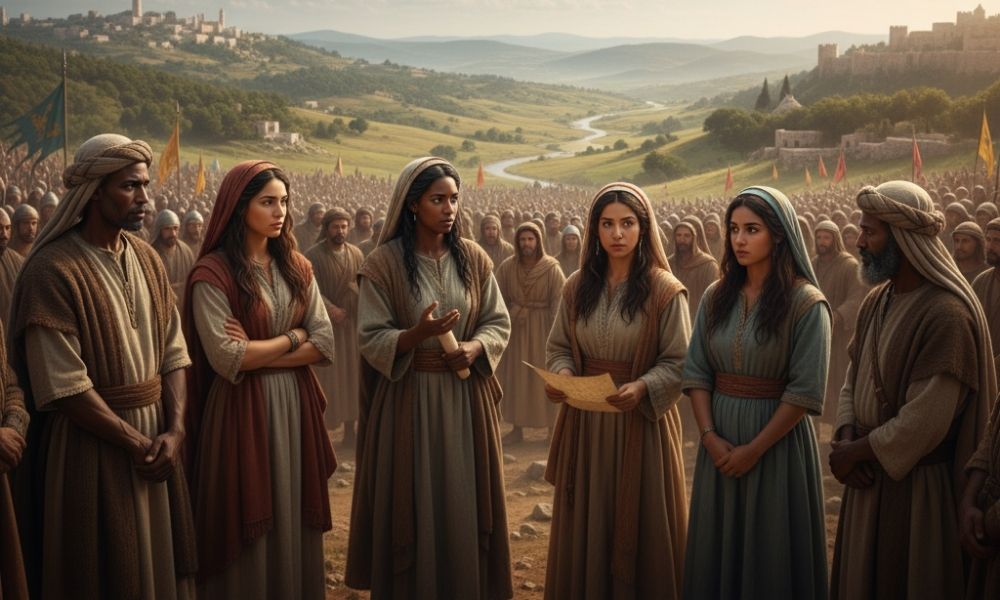
Joshua 17 continues describing the inheritance of the tribe of Manasseh, the other half of Joseph’s descendants. The chapter lists Manasseh’s clans, including the daughters of Zelophehad—Mahlah, Noah, Hoglah, Milcah, and Tirzah—who boldly claim the inheritance promised by Moses, and Joshua honors it. The land allotted to Manasseh includes both sides of the Jordan, reaching from Asher to Issachar. However, like Ephraim, Manasseh fails to drive out the Canaanites from several cities, forcing them into labor instead. When the people of Joseph complain that their territory is too small, Joshua challenges them to clear the forested hill country and drive out the Canaanites, trusting in God’s strength.
1. The Allotment for Manasseh (17:1–6)
“Then allotment was made to the people of Manasseh, for he was the firstborn of Joseph. To Machir the firstborn of Manasseh, the father of Gilead, were allotted Gilead and Bashan, because he was a man of war. And allotments were made to the rest of the people of Manasseh by their clans… These were the male descendants of Manasseh the son of Joseph, by their clans.” (Joshua 17:1–2, ESV)
“Now Zelophehad the son of Hepher, son of Gilead, son of Machir, son of Manasseh, had no sons, but only daughters. And these are the names of his daughters: Mahlah, Noah, Hoglah, Milcah, and Tirzah. They approached Eleazar the priest and Joshua the son of Nun and the leaders and said, ‘The Lord commanded Moses to give us an inheritance along with our brothers.’ So according to the mouth of the Lord he gave them an inheritance among the brothers of their father.” (Joshua 17:3–4, ESV)
Commentary:
- Manasseh, the firstborn of Joseph, receives his inheritance next to Ephraim’s territory.
- The tribe is divided between its eastern half (already settled in Bashan and Gilead, Joshua 13:29–31) and the western half (receiving land west of the Jordan).
- Machir, Manasseh’s oldest son, had already received the land east of the Jordan for his military valor.
- The rest of Manasseh’s descendants now inherit land west of the Jordan by family divisions.
- Verses 3–6 introduce the remarkable story of Zelophehad’s daughters—Mahlah, Noah, Hoglah, Milcah, and Tirzah—who claimed their father’s inheritance because he had no sons (Numbers 27:1–11).
- Their bold appeal was rooted in God’s justice, not human tradition, and their request is honored again under Joshua’s leadership.
- This act ensured their father’s name was preserved and confirmed that God’s covenant includes women equally in His promises.
Insight:
Faith honors God’s word above cultural limits. Zelophehad’s daughters remind us that divine inheritance is for all who trust and obey, regardless of gender or status.
2. The Territory of Manasseh West of the Jordan (17:7–13)
“The territory of Manasseh reached from Asher to Michmethath, which is east of Shechem. Then the boundary goes along southward to the inhabitants of En-tappuah. The land of Tappuah belonged to Manasseh, but the town of Tappuah on the boundary of Manasseh belonged to the people of Ephraim. Then the boundary went down to the brook Kanah… The people of Manasseh could not take possession of those cities, but the Canaanites persisted in dwelling in that land. Now when the people of Israel grew strong, they put the Canaanites to forced labor, but did not utterly drive them out.” (Joshua 17:7–13, ESV)
Commentary:
- Manasseh’s western portion bordered Asher in the north, Ephraim in the south, and extended toward the Mediterranean Sea.
- Several boundary towns—such as Shechem, En-tappuah, and the Brook Kanah—mark a rich and fertile region.
- Verse 10 shows the intertwining of Manasseh and Ephraim’s borders, signifying their close kinship as sons of Joseph.
- However, verse 12 repeats a familiar problem: incomplete conquest.
- The Canaanites remained in certain cities, subdued by forced labor but not destroyed as God commanded.
- This compromise foreshadows future idolatry and conflict.
Insight:
Partial victory is not full obedience. Tolerating what God says to remove eventually leads to spiritual bondage.
3. The Complaint of the Joseph Tribes (17:14–18)
“Then the people of Joseph spoke to Joshua, saying, ‘Why have you given me but one lot and one portion as an inheritance, although I am a numerous people, since all along the Lord has blessed me?’ And Joshua said to them, ‘If you are a numerous people, go up by yourselves to the forest, and there clear ground for yourselves in the land of the Perizzites and the Rephaim, since the hill country of Ephraim is too narrow for you.’ The people of Joseph said, ‘The hill country is not enough for us. Yet all the Canaanites who dwell in the plain have chariots of iron, both those in Beth-shean and its villages and those in the Valley of Jezreel.’ Then Joshua said to the house of Joseph, to Ephraim and Manasseh, ‘You are a numerous people and have great power. You shall not have one allotment only, but the hill country shall be yours, for though it is a forest, you shall clear it and possess it to its farthest borders. For you shall drive out the Canaanites, though they have chariots of iron, and though they are strong.’” (Joshua 17:14–18, ESV)
Commentary:
- The people of Joseph (Ephraim and Manasseh) approach Joshua, complaining that their inheritance is too small for their growing population.
- They acknowledge that God has “blessed” them, but they use this blessing as a basis for discontent, not gratitude.
- Joshua’s response is practical and spiritual:
- He challenges them to clear forested land in the hill country and take initiative.
- He reminds them that strength and potential must be matched by faith and hard work.
- The tribes hesitate, citing the iron chariots of the Canaanites—a symbol of fear and excuses.
- Joshua counters their complaint with courage: “You shall drive out the Canaanites, though they are strong.”
- The exchange reveals a contrast between faith that acts and faith that complains.
Insight:
Blessing is not an excuse for laziness or fear. God gives potential, but we must possess it through effort, courage, and trust in His power.
Theological Significance of Joshua 17
- Inheritance by Faith: God’s promises extend to all who believe, including Zelophehad’s daughters—a testimony of divine fairness and inclusion.
- Responsibility with Blessing: The tribes of Joseph illustrate that divine favor requires human diligence.
- Faith Over Fear: Iron chariots symbolize modern obstacles—what seems impossible to overcome—but God’s power remains greater.
- Unity with Diversity: Ephraim and Manasseh, though distinct, share a joint destiny under God’s promise to Joseph.
- Obedience Completes Possession: The failure to expel the Canaanites reminds believers that God’s blessings require continued spiritual warfare.
Practical Applications
- Act on God’s promises. Faith takes initiative—don’t wait for God to do what He has empowered you to accomplish.
- Refuse fear-based excuses. “Iron chariots” are no match for God’s strength.
- Work your inheritance. Blessings may come as raw potential—clear the forest, cultivate the land, build what God has given.
- Honor God’s justice. Like Zelophehad’s daughters, stand on His Word with confidence, knowing He is fair and faithful.
- Pursue full obedience. Never settle for partial victories; God’s promises are fully realized through faith and perseverance.
Final Insight:
Joshua 17 reveals both the faith of pioneers and the weakness of complainers. Zelophehad’s daughters secured their inheritance through faith and courage, while the Joseph tribes hesitated despite strength and blessing. The lesson is timeless: God gives, but we must take. True inheritance belongs to those who believe enough to act—who face their “iron chariots” and move forward in faith until every promise is fulfilled.







Leave a Reply