
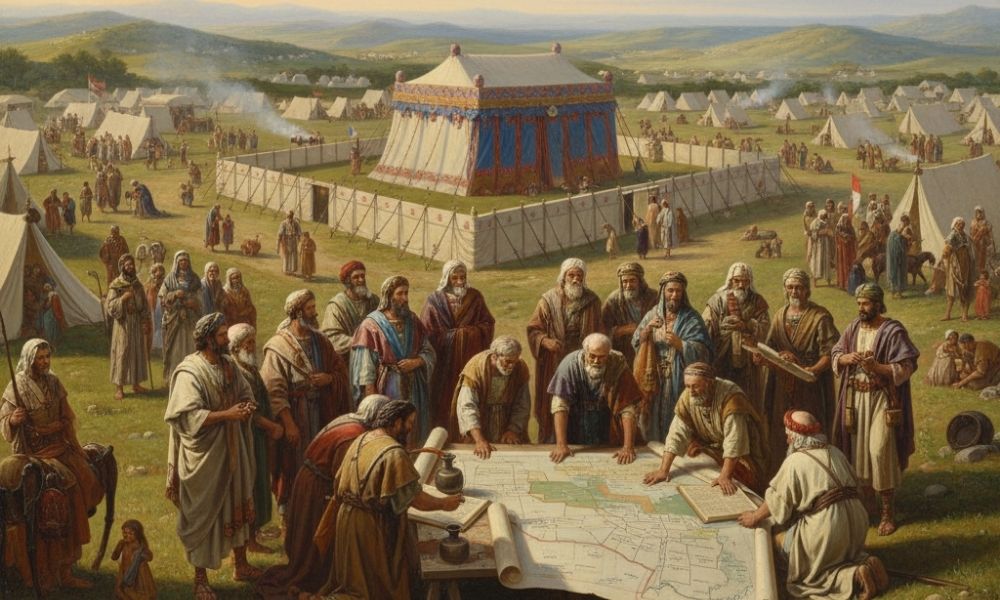
Joshua 18 describes how the remaining land of Canaan is divided among the seven tribes yet to receive their inheritance. The Israelites set up the tabernacle at Shiloh, marking it as the new center of worship. Joshua rebukes the people for delaying to possess the land and sends three men from each tribe to survey it. They map the regions and return with descriptions written on scrolls. Joshua then casts lots before the Lord at Shiloh to assign territories. The chapter concludes with the boundaries of Benjamin’s inheritance, located between Judah and Joseph, including the city of Jerusalem.
1. The Assembly at Shiloh (18:1)
“Then the whole congregation of the people of Israel assembled at Shiloh and set up the tent of meeting there. The land lay subdued before them.” (Joshua 18:1, ESV)
Commentary:
- Israel gathers at Shiloh, now the spiritual center of the nation.
- The tabernacle (tent of meeting) is set up there—signifying God’s presence among His people in the Promised Land.
- Shiloh, located in Ephraim’s territory, would serve as Israel’s worship center for about 300 years (until the time of Samuel).
- The statement “the land lay subdued before them” marks a key transition: major wars are over; now comes the organization and occupation of the inheritance.
- Worship precedes settlement—Israel’s first act is to establish God’s throne before securing their homes.
Insight:
Victory is complete only when God is enthroned. Worship must remain central even after success.
2. Joshua’s Rebuke to the Remaining Tribes (18:2–7)
“There remained among the people of Israel seven tribes whose inheritance had not yet been apportioned. So Joshua said to the people of Israel, ‘How long will you put off going in to take possession of the land which the Lord, the God of your fathers, has given you? Provide three men from each tribe, and I will send them out that they may set out and go up and down the land. They shall write a description of it with a view to their inheritances, and then come to me.’” (Joshua 18:2–4, ESV)
Commentary:
- Seven tribes still had not claimed their inheritance—possibly due to hesitation, fear, or complacency.
- Joshua’s question—“How long will you put off?”—is both a rebuke and a challenge.
- Though God had given the land, the tribes had to possess it actively.
- Joshua orders three men from each tribe (21 men total) to survey and map the land for division.
- Verses 5–6 show Joshua’s fairness: Judah and Joseph (Ephraim & Manasseh) already have their territory; the rest will receive theirs by lot before the Lord.
- Verse 7 reminds them that the Levites receive no land portion—the Lord Himself is their inheritance.
Insight:
God’s promises must be possessed, not just admired. Delay in obedience can cost the fullness of blessing.
3. The Survey of the Land (18:8–10)
“So the men rose and went, and Joshua charged those who went to write the description of the land, saying, ‘Go up and down in the land and write a description and return to me, and I will cast lots for you here before the Lord in Shiloh.’ So the men went and passed up and down in the land and wrote in a book a description of it by towns in seven divisions. Then they came to Joshua to the camp at Shiloh, and Joshua cast lots for them in Shiloh before the Lord. And there Joshua apportioned the land to the people of Israel, to each his portion.” (Joshua 18:8–10, ESV)
Commentary:
- The surveyors travel the land, recording its cities and regions into seven sections.
- This was an organized, faith-driven task—practical preparation guided by spiritual order.
- The casting of lots occurred “before the Lord” at Shiloh, ensuring divine direction.
- This process reflects God’s balance between faith and diligence: human effort serves under divine sovereignty.
- The lot was not chance—it was God’s decision made visible (Proverbs 16:33).
Insight:
Preparation honors God’s promise. Faith plans, acts, and trusts God to direct the outcome.
4. The Inheritance of Benjamin (18:11–28)
“The lot of the tribe of the people of Benjamin came up according to its clans. And the territory allotted to it fell between the people of Judah and the people of Joseph… Now the cities of the tribe of Benjamin according to their clans were Jericho, Beth-hoglah, Emek-keziz, Beth-arabah, Zemaraim, Bethel, Avvim, Parah, Ophrah, Chephar-ammoni, Ophni, Geba—twelve cities with their villages; Gibeon, Ramah, Beeroth, Mizpeh, Chephirah, Mozah, Rekem, Irpeel, Taralah, Zela, Haeleph, Jebus (that is, Jerusalem), Gibeah, and Kiriath-jearim—fourteen cities with their villages. This is the inheritance of the people of Benjamin according to its clans.” (Joshua 18:11, 21–28, ESV)
Commentary:
- Benjamin’s territory lies between Judah (south) and Ephraim (north)—strategically in the heart of Israel.
- This location later made Benjamin a buffer tribe between the two great houses of Judah and Joseph.
- Its cities include Jericho, Bethel, Gibeon, Mizpeh, and Jerusalem (Jebus).
- The inclusion of Jerusalem shows that the city’s borders straddled Judah and Benjamin’s line—later significant when it became Israel’s united capital under David.
- Many key biblical events occurred in Benjamin’s territory—e.g., Saul’s kingship (1 Samuel 9), the Good Samaritan parable (Luke 10:30, “going down from Jerusalem to Jericho”), and Paul’s heritage (Philippians 3:5).
Insight:
Benjamin’s small but central territory illustrates how God positions people for influence beyond their size. Faithfulness, not prominence, defines significance.
Theological Significance of Joshua 18
- God’s Presence Centered in the Land: Shiloh symbolizes worship and divine guidance at the heart of national life.
- Faith Requires Action: Even after victory, there’s work to do—possessing the land fully through obedience.
- Divine Order in Distribution: Casting lots before the Lord ensured justice, unity, and trust in God’s will.
- Every Tribe Matters: Benjamin’s small portion shows that no tribe is forgotten in God’s plan.
- Transition from War to Worship: Israel shifts from conquering the land to cultivating it under God’s presence.
Practical Applications
- Do not delay obedience. When God gives a promise, act on it—don’t linger in comfort or fear.
- Put worship first. Set up your “Shiloh” before pursuing possessions—God’s presence orders life.
- Prepare and plan faithfully. God blesses careful stewardship aligned with trust in Him.
- Find peace in your portion. Each inheritance is God-designed; comparison only breeds discontent.
- Live centered in God’s presence. True security and fruitfulness flow from where He dwells.
Final Insight:
Joshua 18 bridges conquest and settlement—faith becomes stewardship. The tribes must move from receiving victory to living responsibly in it. As Shiloh becomes the nation’s center, God reminds His people that the real inheritance is not land, but His presence among them. When worship governs possession, every tribe, no matter how delayed, finds its place in His perfect plan.







Leave a Reply