
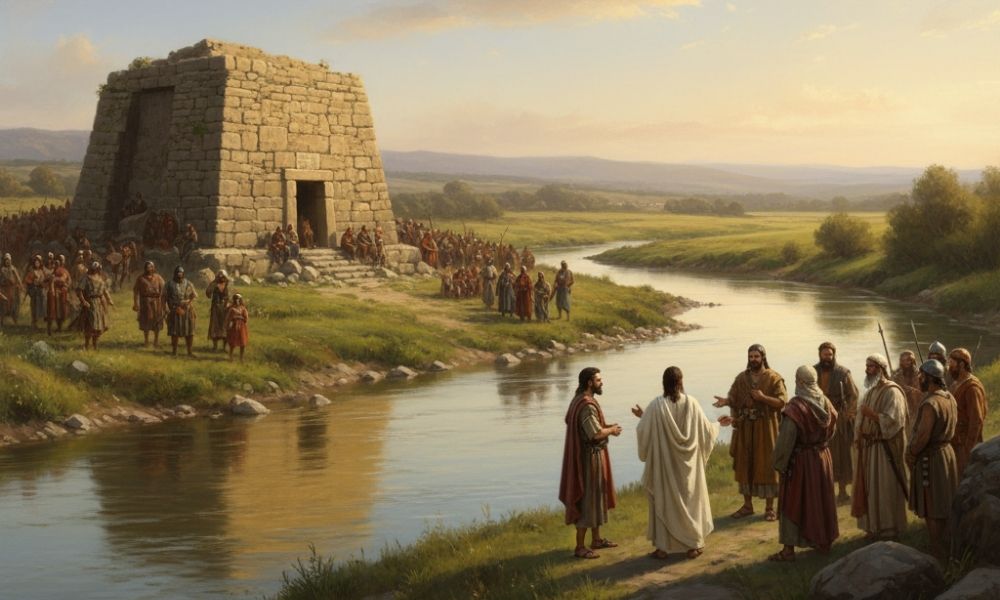
Joshua 22 recounts the return of the tribes of Reuben, Gad, and the half-tribe of Manasseh to their land east of the Jordan. Having faithfully helped their brothers conquer Canaan, Joshua blesses them and sends them home with riches and livestock. On their way, they build a large altar by the Jordan, which alarms the other tribes, who fear rebellion against the Lord. A delegation led by Phinehas confronts them at Gilead. The eastern tribes explain that the altar is not for sacrifices but as a witness — a reminder that they too share in the worship of the Lord. Satisfied with their explanation, Israel praises God, and peace is restored among the tribes.
1. The Eastern Tribes Sent Home (Joshua 22:1–9)
At that time Joshua summoned the Reubenites and the Gadites and the half-tribe of Manasseh, and said to them, “You have kept all that Moses the servant of the Lord commanded you and have obeyed my voice in all that I have commanded you. You have not forsaken your brothers these many days, down to this day, but have been careful to keep the charge of the Lord your God. And now the Lord your God has given rest to your brothers, as he promised them. Therefore turn and go to your tents in the land where your possession lies, which Moses the servant of the Lord gave you on the other side of the Jordan. Only be very careful to observe the commandment and the law that Moses the servant of the Lord commanded you, to love the Lord your God, and to walk in all his ways and to keep his commandments and to cling to him and to serve him with all your heart and with all your soul.” So Joshua blessed them and sent them away, and they went to their tents.
Now to the one half of the tribe of Manasseh Moses had given a possession in Bashan, but to the other half Joshua had given a possession beside their brothers in the land west of the Jordan. And when Joshua sent them away to their homes and blessed them, he said to them, “Return to your tents with much wealth and with very much livestock, with silver, gold, bronze, and iron, and with much clothing. Divide the spoil of your enemies with your brothers.” So the people of Reuben and the people of Gad and the half-tribe of Manasseh returned home, parting from the people of Israel at Shiloh, which is in the land of Canaan, to go to the land of Gilead, their own land of which they had possessed themselves by command of the Lord through Moses.
Commentary:
- The war is over, and Joshua commends the eastern tribes (Reuben, Gad, and half-Manasseh) for faithfulness in helping their brothers conquer Canaan.
- They are released with Joshua’s blessing and great riches, a symbol of reward for obedience.
- Joshua reminds them that prosperity is meaningless without faithfulness to God’s commands—love, obedience, and wholehearted service.
- This marks a moment of unity, showing the strength of covenant faithfulness.
Insight: True victory is not only in conquest but in faithfulness to God even after success.
2. The Altar of Witness (Joshua 22:10–14)
And when they came to the region of the Jordan that is in the land of Canaan, the people of Reuben and the people of Gad and the half-tribe of Manasseh built there an altar by the Jordan, an altar of imposing size. And the people of Israel heard it said, “Behold, the people of Reuben and the people of Gad and the half-tribe of Manasseh have built the altar at the frontier of the land of Canaan, in the region about the Jordan, on the side that belongs to the people of Israel.” And when the people of Israel heard of it, the whole assembly of the people of Israel gathered at Shiloh to make war against them.
Then the people of Israel sent to the people of Reuben and the people of Gad and the half-tribe of Manasseh, in the land of Gilead, Phinehas the son of Eleazar the priest, and with him ten chiefs, one from each of the tribal families of Israel, every one of them the head of a family among the clans of Israel.
Commentary:
- The eastern tribes build a large altar near the Jordan River, which quickly causes alarm.
- The western tribes interpret it as rebellion—a rival altar violating the law that worship should be centered in one place.
- Their immediate response is to prepare for war, showing their passion for national purity but also their quickness to judge.
- They wisely send a delegation led by Phinehas, known for zeal in upholding holiness (Numbers 25).
Insight: Zeal for God must be guided by understanding. Misjudged motives can create unnecessary division.
3. The Misunderstanding Explained (Joshua 22:15–29)
And they came to the people of Reuben, the people of Gad, and the half-tribe of Manasseh, in the land of Gilead, and they said to them, “Thus says the whole congregation of the Lord, ‘What is this breach of faith that you have committed against the God of Israel in turning away this day from following the Lord by building yourselves an altar this day in rebellion against the Lord? Have we not had enough of the sin at Peor from which even yet we have not cleansed ourselves, and for which there came a plague upon the congregation of the Lord, that you too must turn away this day from following the Lord? And if you too rebel against the Lord today then tomorrow he will be angry with the whole congregation of Israel. But now, if the land of your possession is unclean, pass over into the Lord’s land where the Lord’s tabernacle stands, and take for yourselves a possession among us. Only do not rebel against the Lord or make us as rebels by building for yourselves an altar other than the altar of the Lord our God.’”
Then the people of Reuben, the people of Gad, and the half-tribe of Manasseh said in answer to the heads of the families of Israel, “The Mighty One, God, the Lord! The Mighty One, God, the Lord! He knows; and let Israel itself know! If it was in rebellion or in breach of faith against the Lord, do not spare us today for building an altar to turn away from following the Lord. … No! We did it from fear that in time to come your children might say to our children, ‘What have you to do with the Lord, the God of Israel? For the Lord has made the Jordan a boundary between us and you…’ Therefore we said, ‘Let us now build an altar, not for burnt offering, nor for sacrifice, but to be a witness between us and you.’”
Commentary:
- Phinehas accuses them of rebellion, referencing past sins like Peor, which brought God’s wrath.
- The eastern tribes defend themselves sincerely, proclaiming God as their witness.
- The altar was not for sacrifice but as a memorial of unity, ensuring future generations would remember they shared the same covenant God.
- This shows humility and concern for the next generation’s faithfulness.
Insight: Misunderstandings are healed when both sides listen and explain in truth and humility.
4. Reconciliation and Peace (Joshua 22:30–34)
When Phinehas the priest and the chiefs of the congregation, the heads of the families of Israel who were with him, heard the words that the people of Reuben and the people of Gad and the people of Manasseh spoke, it was good in their eyes. And Phinehas the son of Eleazar the priest said to the people of Reuben and the people of Gad and the people of Manasseh, “Today we know that the Lord is in our midst, because you have not committed this breach of faith against the Lord. Now you have delivered the people of Israel from the hand of the Lord.” Then Phinehas the son of Eleazar the priest and the chiefs returned… And the report was good in the eyes of the people of Israel. And the people of Israel blessed God and spoke no more of making war… The people of Reuben and the people of Gad called the altar Witness, “For,” they said, “it is a witness between us that the Lord is God.”
Commentary:
- The misunderstanding ends in peace and renewed unity.
- Phinehas and the leaders rejoice, acknowledging God’s presence and mercy.
- The altar is named “Witness” (Ed) — a permanent reminder that all Israel worships one God.
- The potential civil war turns into reconciliation because truth prevailed over assumption.
Insight: God is honored when His people choose peace through understanding rather than conflict through suspicion.
Theological Significance of Joshua 22
- Unity in Diversity: Though separated by geography, the tribes remain one in covenant faith.
- Guarding Worship: Israel’s reaction shows their zeal for pure worship—an essential lesson in fidelity to God.
- Power of Communication: Open dialogue prevents destruction born of misunderstanding.
- God’s Presence: Reconciliation confirms that the Lord dwells among His people when they walk in truth and peace.
Practical Applications
- Seek understanding before judgment—conflict often begins with assumption.
- Faithfulness after victory matters more than victory itself.
- Memorials of faith (like the altar of Witness) remind future generations of shared covenant identity.
- God’s people should be quick to restore peace and slow to condemn.
Final Insight:
Joshua 22 teaches that unity among God’s people depends on truth, communication, and humility. Even when misunderstandings arise, God’s presence brings peace when His people listen, discern, and remember that the Lord is God.







Leave a Reply