
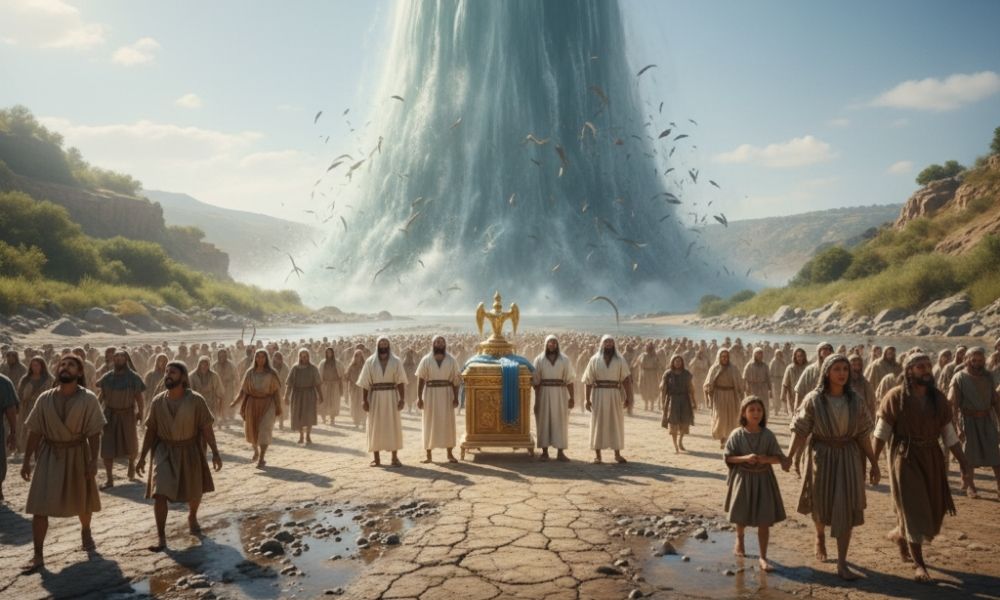
Joshua 3 describes Israel’s miraculous crossing of the Jordan River. Early in the morning, Joshua and the Israelites set out from Shittim and camp by the Jordan before crossing. The priests carrying the Ark of the Covenant lead the way. God tells Joshua that He will exalt him before all Israel, proving that He is with him as He was with Moses. When the priests step into the river, the waters stop flowing and pile up in a heap far upstream, leaving the riverbed dry. The people cross safely to the other side, opposite Jericho. The priests remain standing in the middle of the river until everyone has passed over.
1. Israel Prepares to Cross the Jordan (Joshua 3:1–6)
“Early the next morning Joshua and all the Israelites left Acacia Grove and arrived at the banks of the Jordan River, where they camped before crossing.
Three days later the Israelite officers went through the camp,
giving these instructions to the people: ‘When you see the Levitical priests carrying the Ark of the Covenant of the Lord your God, move out from your positions and follow them.
Since you have never traveled this way before, they will guide you.
Stay about half a mile behind them, keeping a clear distance between you and the Ark. Make sure you don’t come any closer.’
Then Joshua told the people, ‘Purify yourselves, for tomorrow the Lord will do great wonders among you.’
In the morning Joshua said to the priests, ‘Lift up the Ark of the Covenant and lead the people across the river.’ And so they started out and went ahead of the people.” (Joshua 3:1–6, NLT)
Commentary:
- The people move from Acacia Grove to the Jordan, camping three days before crossing—a time of anticipation and preparation.
- The Ark of the Covenant, symbolizing God’s presence, leads the way, showing that God goes before His people.
- The command to keep distance from the Ark shows reverence for God’s holiness.
- Joshua calls the people to purify themselves, emphasizing that spiritual preparation precedes divine miracles.
- God’s wonders are linked to obedience and holiness.
- The priests, carrying the Ark, represent faith in motion—leading God’s people toward promise.
Insight:
Before God does something great, He calls His people to prepare spiritually and follow His presence with reverence and faith.
2. God Promises to Exalt Joshua (Joshua 3:7–13)
“The Lord told Joshua, ‘Today I will begin to make you a great leader in the eyes of all the Israelites. They will know that I am with you, just as I was with Moses.
Give this command to the priests who carry the Ark of the Covenant: “When you reach the banks of the Jordan River, take a few steps into the river and stop there.”’
So Joshua told the Israelites, ‘Come and listen to what the Lord your God says.
Today you will know that the living God is among you. He will surely drive out the Canaanites, Hittites, Hivites, Perizzites, Girgashites, Amorites, and Jebusites ahead of you.
Look, the Ark of the Covenant, which belongs to the Lord of the whole earth, will lead you across the Jordan River!
Now choose twelve men from the tribes of Israel, one from each tribe.
The priests will carry the Ark of the Lord, the Lord of all the earth. As soon as their feet touch the water, the flow of water will be cut off upstream, and the river will stand up like a wall.’” (Joshua 3:7–13, NLT)
Commentary:
- God affirms Joshua’s leadership publicly, confirming His presence as with Moses.
- The command for priests to step into the river before it parts is a call to faith before the miracle.
- Joshua reminds the people that the living God is among them—a declaration of divine reality and power.
- The mention of the seven nations highlights the scope of the promised victory.
- The Ark of the Covenant represents the Lord of all the earth, showing His authority over nature itself.
- The choosing of twelve men anticipates a memorial to remember this miraculous event (fulfilled in chapter 4).
Insight:
God’s power works through faith-filled obedience. Leadership is affirmed when it trusts God’s Word and acts on it.
3. The Miracle at the Jordan (Joshua 3:14–17)
“So the people left their camp to cross the Jordan, and the priests who were carrying the Ark of the Covenant went ahead of them.
It was the harvest season, and the Jordan was overflowing its banks.
But as soon as the feet of the priests who were carrying the Ark touched the water at the river’s edge,
the water above that point began backing up a great distance away at a town called Adam, which is near Zarethan.
And the water below that point flowed on to the Dead Sea until the riverbed was dry.
Then all the people crossed over near the town of Jericho.
Meanwhile, the priests who were carrying the Ark of the Lord’s Covenant stood on dry ground in the middle of the riverbed as the people passed by.
They waited there until the whole nation of Israel had crossed the Jordan on dry ground.” (Joshua 3:14–17, NLT)
Commentary:
- The Jordan River was at flood stage—humanly impossible to cross—yet God chose that moment to display His power.
- The moment the priests’ feet touched the water, the river stopped flowing, proving obedience precedes divine intervention.
- The water piled up far away at Adam, showing that God’s command controlled nature over great distance.
- The riverbed became dry, echoing the miracle of the Red Sea—linking Joshua’s leadership with Moses’.
- The priests stood firm in the middle of the river until everyone crossed, symbolizing steadfast faith that holds ground until the promise is fulfilled.
- The crossing marked a new beginning: Israel moving from wilderness wandering to promise possession.
Insight:
God’s power often manifests at the moment of obedience. Faith steps into the impossible, and God makes a way.
Theological Significance of Joshua 3
- God confirms His covenant faithfulness by repeating a miracle similar to the Red Sea crossing.
- The Ark symbolizes God’s presence leading His people into victory.
- The miracle shows God’s sovereignty over creation and His commitment to fulfill promises.
- The event marks Joshua’s divine endorsement as Moses’ successor.
- The Jordan crossing symbolizes transition—from old to new, wandering to fulfillment, preparation to possession.
Practical Applications
- Faith Requires Action: Miracles follow steps of obedience—faith moves first.
- God’s Presence Leads: When God goes before us, obstacles become opportunities for His glory.
- Spiritual Preparation: Purity and reverence prepare us for divine breakthroughs.
- Leadership by Example: True leaders walk into the waters first, inspiring others to trust God.
- Remember God’s Wonders: Every victory should be remembered as evidence of God’s faithfulness.
Final Insight:
Joshua 3 reveals that God’s promises are realized through obedient faith. When God’s people follow His presence and step into impossible situations with trust, He opens the way and leads them into the fullness of His promise.







Leave a Reply