
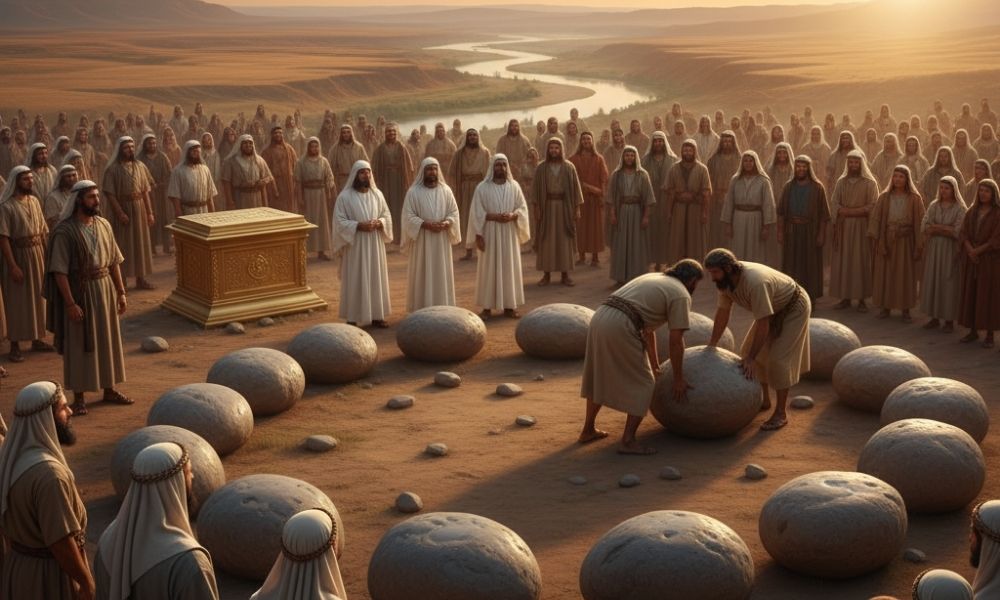
Joshua 4 recounts how Israel memorializes their crossing of the Jordan River. God instructs Joshua to have one man from each of the twelve tribes take a stone from the riverbed where the priests stood and carry it to their camp at Gilgal. These twelve stones serve as a lasting memorial to remind future generations how the Lord stopped the Jordan’s flow so His people could cross on dry ground. Joshua also sets up twelve stones in the middle of the Jordan at the spot where the priests stood. When the priests carrying the Ark come up from the river, the waters return to their normal flow. The people camp at Gilgal, where Joshua sets up the memorial and explains its meaning to the Israelites.
1. Twelve Stones as a Memorial (Joshua 4:1–9)
“When all the people had crossed the Jordan, the Lord said to Joshua,
‘Now choose twelve men, one from each tribe.
Tell them, “Take twelve stones from the very place where the priests are standing in the middle of the Jordan. Carry them out and pile them up at the place where you will camp tonight.”’
So Joshua called together the twelve men he had chosen—one from each of the tribes of Israel.
He told them, ‘Go into the middle of the Jordan, in front of the Ark of the Lord your God. Each of you must pick up one stone and carry it out on your shoulder—twelve stones in all, one for each of the twelve tribes of Israel.
We will use these stones to build a memorial. In the future your children will ask you, “What do these stones mean?”
Then you can tell them, “They remind us that the Jordan River stopped flowing when the Ark of the Lord’s Covenant went across.” These stones will stand as a memorial among the people of Israel forever.’
So the men did as Joshua had commanded them. They took twelve stones from the middle of the Jordan River, one for each tribe, just as the Lord had told Joshua.
They carried them to the place where they camped for the night and constructed the memorial there.
Joshua also set up another pile of twelve stones in the middle of the Jordan, at the place where the priests who carried the Ark of the Covenant were standing. And they are there to this day.” (Joshua 4:1–9, NLT)
Commentary:
- God commands the creation of a memorial of twelve stones, representing unity among the twelve tribes.
- The stones come from the very place of the miracle—the riverbed where God displayed His power.
- The memorial serves to teach future generations about God’s faithfulness and power.
- Joshua also sets up a second pile in the river itself, symbolizing remembrance both in the place of the miracle and the land of promise.
- This act preserves spiritual memory—faith must be remembered, not forgotten.
- The memorial turns a moment of victory into a tool for discipleship and gratitude.
Insight:
God calls His people to remember His mighty works so that future generations will know and trust Him.
2. The Priests Remain Until All Cross Over (Joshua 4:10–14)
“The priests who were carrying the Ark stood in the middle of the river until all of the Lord’s commands that Moses had given to Joshua were carried out.
Meanwhile, the people hurried across the riverbed.
When everyone was safely on the other side, the priests crossed over with the Ark of the Lord as the people watched.
The armed warriors from the tribes of Reuben, Gad, and the half-tribe of Manasseh led the Israelites across, just as Moses had directed.
These armed men—about 40,000 strong—were ready for battle, and the Lord was with them as they crossed over to the plains of Jericho.
That day the Lord made Joshua a great leader in the eyes of all the Israelites, and for the rest of his life they revered him as much as they had revered Moses.” (Joshua 4:10–14, NLT)
Commentary:
- The priests remain in the riverbed until everyone has crossed, symbolizing steadfast service and faithfulness.
- Israel crosses in order and readiness, showing both obedience and preparation for the battles ahead.
- The eastern tribes keep their promise by going first into battle, showing unity and commitment.
- God exalts Joshua in the eyes of the people, confirming him as Moses’ true successor.
- This public recognition strengthens Israel’s confidence in both Joshua and God’s leadership.
Insight:
Faithful obedience and courageous leadership bring honor from God and respect from people.
3. The Jordan Returns to Its Flow (Joshua 4:15–18)
“The Lord had said to Joshua, ‘Command the priests carrying the Ark of the Covenant to come up out of the riverbed.’
So Joshua gave the command.
As soon as the priests carrying the Ark of the Lord’s Covenant came up out of the riverbed, and their feet were on high ground, the water of the Jordan returned and overflowed its banks as before.” (Joshua 4:15–18, NLT)
Commentary:
- The return of the river’s flow marks the completion of the miracle and the end of God’s suspension of nature.
- The timing shows that the miracle was fully under divine control—from start to finish.
- The Ark’s presence and withdrawal symbolize that God’s power governs creation itself.
- This event reaffirms that the crossing was not coincidence, but God’s direct intervention.
Insight:
When God’s purpose is complete, He restores the natural order, reminding us that all power belongs to Him.
4. The Memorial Set Up at Gilgal (Joshua 4:19–24)
“The people crossed the Jordan on the tenth day of the first month. Then they camped at Gilgal, just east of Jericho.
It was there at Gilgal that Joshua piled up the twelve stones taken from the Jordan River.
Then Joshua said to the Israelites, ‘In the future your children will ask, “What do these stones mean?”
Then you can tell them, “This is where the Israelites crossed the Jordan on dry ground.”
For the Lord your God dried up the river right before your eyes, and he kept it dry until you were all across, just as he did at the Red Sea when he dried it up until we had all crossed over.
He did this so all the nations of the earth might know that the Lord’s hand is powerful, and so you might fear the Lord your God forever.’” (Joshua 4:19–24, NLT)
Commentary:
- Israel camps at Gilgal, meaning “circle” or “rolling,” marking a new beginning in the land of promise.
- The twelve stones become a teaching tool for children and a testimony to other nations.
- Joshua connects this miracle with the Red Sea, showing that the same God who delivered Israel from Egypt now leads them into Canaan.
- The purpose is twofold: for nations to know God’s power and for Israel to revere Him continually.
- The memorial links past, present, and future faith—it tells a story of covenant continuity and divine might.
Insight:
God’s wonders are not only for the moment—they are lasting testimonies meant to inspire faith across generations.
Theological Significance of Joshua 4
- Memorials of faith remind God’s people of His covenant and power.
- The crossing of the Jordan parallels salvation—moving from death to life, promise to fulfillment.
- God exalts faithful leadership and unites His people under His purpose.
- The stones serve as a witness to Israel and the nations that God’s hand is mighty.
- Remembering God’s past faithfulness strengthens confidence for future challenges.
Practical Applications
- Remember God’s Works: Create spiritual “memorials” in your life to recall God’s faithfulness.
- Teach the Next Generation: Share testimonies of God’s goodness so faith endures beyond your lifetime.
- Follow God’s Timing: Wait until His work is complete before moving forward.
- Honor God’s Leaders: Support and respect godly leadership that follows His Word.
- Live as Witnesses: Let your life testify that the Lord’s hand is powerful and worthy of reverence.
Final Insight:
Joshua 4 reminds us that God’s miracles must be remembered, not forgotten. The twelve stones at Gilgal stand as a timeless call to faith, gratitude, and witness—declaring to every generation that the Lord’s power delivers, guides, and deserves our awe forever.







Leave a Reply