
Judges 1 marks the transitional period immediately following the death of Joshua. It describes the continued military campaigns of the Israelite tribes to conquer the land of Canaan. The chapter begins with success, as the tribe of Judah, accompanied by Simeon, wins significant victories. However, the narrative quickly shifts from conquest to compromise. While some territories are taken, the chapter ends with a repetitive and disheartening list of the tribes failing to drive out the Canaanite inhabitants completely. Instead of removing them as commanded, Israel subjects them to forced labor or simply settles among them. This chapter sets the stage for the cycle of apostasy and judgment that characterizes the rest of the book.
1. The Campaign of Judah and Simeon (Judges 1:1–7)
After the death of Joshua, the people of Israel inquired of the Lord, “Who shall go up first for us against the Canaanites, to fight against them?” The Lord said, “Judah shall go up; behold, I have given the land into his hand.” And Judah said to Simeon his brother, “Come up with me into the territory allotted to me, that we may fight against the Canaanites. And I likewise will go with you into the territory allotted to you.” So Simeon went with him. Then Judah went up and the Lord gave the Canaanites and the Perizzites into their hand, and they defeated 10,000 of them at Bezek. They found Adoni-bezek at Bezek and fought against him and defeated the Canaanites and the Perizzites. Adoni-bezek fled, but they pursued him and caught him and cut off his thumbs and his big toes. And Adoni-bezek said, “Seventy kings with their thumbs and their big toes cut off used to pick up scraps under my table. As I have done, so God has repaid me.” And they brought him to Jerusalem, and he died there.
Commentary:
- Transition of Leadership: The phrase “After the death of Joshua” signals a crisis of leadership. Unlike Moses, who appointed Joshua, Joshua left no single successor. The tribes must now rely on direct inquiry of the Lord (likely through the Urim and Thummim held by the High Priest).
- Judah’s Primacy: God selects Judah to lead. This foreshadows the rise of the Davidic monarchy and the Messianic line.
- Tribal Alliance: Judah invites Simeon to join forces. This makes geographical sense, as Simeon’s inheritance was effectively an enclave within Judah’s territory (Joshua 19:1).
- Divine Sovereignty: The text explicitly states, “The Lord gave the Canaanites… into their hand.” Victory is attributed to God’s enablement.
- Retributive Justice: The mutilation of Adoni-bezek (cutting off thumbs and big toes) incapacitates him militarily (he can no longer wield a weapon or balance effectively). Adoni-bezek acknowledges this as divine justice (lex talionis) for his own cruelty to seventy other kings.
Insight:
- The chapter begins with spiritual health: the people inquire of God, God answers, and the people obey. However, the brutal nature of the warfare reflects the harsh reality of the ancient Near East and the specific judgment pronounced on Canaanite culture.
2. Caleb, Othniel, and Achsah (Judges 1:8–15)
Now the men of Judah fought against Jerusalem and captured it and struck it with the edge of the sword and set the city on fire. And afterward the men of Judah went down to fight against the Canaanites who lived in the hill country, in the Negeb, and in the lowland. And Judah went against the Canaanites who lived in Hebron (now the name of Hebron was formerly Kiriath-arba), and they defeated Sheshai and Ahiman and Talmai. From there he went against the inhabitants of Debir. The name of Debir was formerly Kiriath-sepher. And Caleb said, “He who attacks Kiriath-sepher and captures it, I will give him Achsah my daughter for a wife.” And Othniel the son of Kenaz, Caleb’s younger brother, captured it. And he gave him Achsah his daughter for a wife. When she came to him, she urged him to ask her father for a field. And she dismounted from her donkey, and Caleb said to her, “What do you want?” She said to him, “Give me a blessing. Since you have set me in the land of the Negeb, give me also springs of water.” And Caleb gave her the upper springs and the lower springs.
Commentary:
- Review of Victory: Some scholars view these verses as a flashback or a summary of the conquest of Hebron mentioned in Joshua 15. It highlights the faithfulness of the older generation represented by Caleb.
- Caleb’s Legacy: Caleb, one of the two faithful spies (Numbers 13–14), continues to demonstrate vigorous faith in his old age. He incentivizes bravery to secure the land.
- Othniel: He is introduced here as a hero; he will later become the first “Judge” of Israel (Judges 3:9).
- Achsah’s Wisdom: Achsah is portrayed as a woman of insight. She realizes that land in the Negeb (the south) is arid and of little value without water. She boldly asks for “springs of water,” securing the livelihood of her future family.
Insight:
- In the midst of war, this domestic interlude highlights the importance of stewardship. Conquering the land is not enough; one must have the resources (water) to sustain life within it. Achsah is a model of asking the Father for what is necessary for flourishing.
3. Partial Victories and the Iron Chariots (Judges 1:16–21)
And the descendants of the Kenite, Moses’ father-in-law, went up with the people of Judah from the city of palms into the wilderness of Judah, which lies in the Negeb near Arad, and they went and settled with the people. And Judah went with Simeon his brother, and they defeated the Canaanites who inhabited Zephath and devoted it to destruction. So the name of the city was called Hormah. Judah also captured Gaza with its territory, and Ashkelon with its territory, and Ekron with its territory. And the Lord was with Judah, and he took possession of the hill country, but he could not drive out the inhabitants of the plain because they had chariots of iron. And they gave Hebron to Caleb, as Moses had said. And he drove out from there the three sons of Anak. But the people of Benjamin did not drive out the Jebusites who lived in Jerusalem, so the Jebusites have lived with the people of Benjamin in Jerusalem to this day.
Commentary:
- The Kenites: This group, related to Moses by marriage, aligns with Israel. This shows that inclusion in God’s people was based on faith and alliance, not just genetics.
- Hormah: Meaning “Destruction” or “Ban,” signifying the city was totally devoted to the Lord.
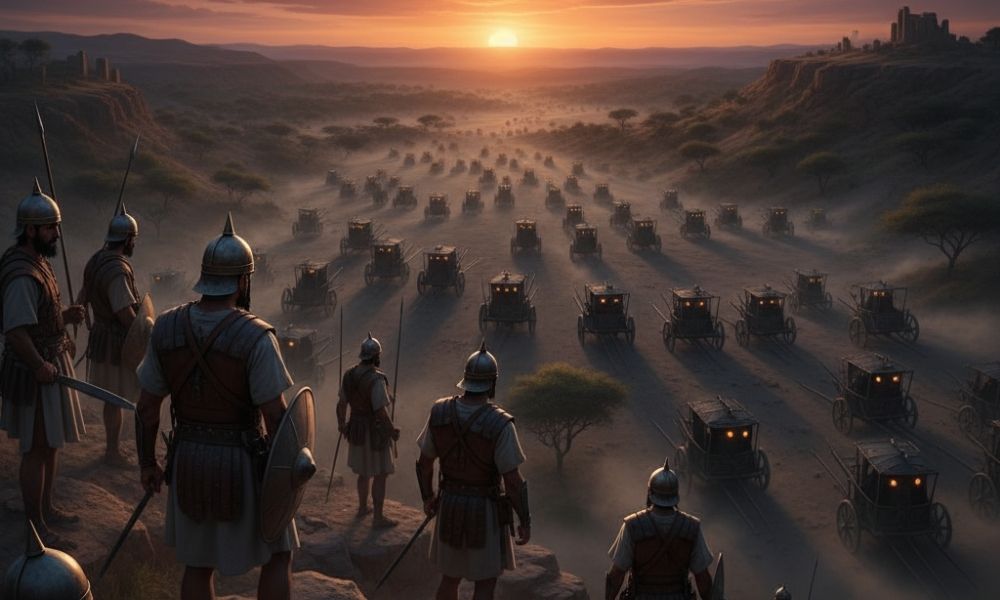
- The Iron Chariots (v. 19): This is a pivotal verse. “The Lord was with Judah… but he could not drive out the inhabitants of the plain because they had chariots of iron.” This does not mean God was weaker than iron technology. It implies a failure of faith on Judah’s part. When the military challenge seemed insurmountable (advanced technology), their trust in God faltered, and they stopped the campaign.
- Benjamin’s Failure: While Judah captured Jerusalem temporarily (v. 8), they evidently did not hold it. Benjamin, responsible for that area, failed to dislodge the Jebusites, leading to long-term coexistence with pagan neighbors.
Insight:
- “Iron chariots” represent the obstacles in life that seem technically or physically impossible to overcome. When Scripture says they “could not” drive them out, it reflects a limitation of their faith, not God’s power.
4. The House of Joseph at Bethel (Judges 1:22–26)
The house of Joseph also went up against Bethel, and the Lord was with them. And the house of Joseph scouted out Bethel. (Now the name of the city was formerly Luz.) And the spies saw a man coming out of the city, and they said to him, “Please show us the way into the city, and we will deal kindly with you.” And he showed them the way into the city. And they struck the city with the edge of the sword, but they let the man and all his family go. And the man went to the land of the Hittites and built a city and called its name Luz. That is its name to this day.
Commentary:
- House of Joseph: Refers to the tribes of Ephraim and Manasseh.
- Echoes of Jericho: The tactic resembles the spies at Jericho (Rahab), but there is a notable difference. Rahab confessed faith in Yahweh; this man in Bethel is merely a collaborator saving his own life.
- Transactional Mercy: The Israelites make a deal with the man. While they succeed in taking the city, the man goes on to rebuild a pagan city (“Luz”) elsewhere. They destroyed the location but not the influence.
Insight:
- This victory is ambiguous. It succeeds militarily, but it lacks the clear moral imperative found in earlier conquests. It hints at pragmatism replacing divine command.
5. The Failure to Drive Them Out (Judges 1:27–36)
Manasseh did not drive out the inhabitants of Beth-shean and its villages, or Taanach and its villages, or the inhabitants of Dor and its villages, or the inhabitants of Ibleam and its villages, or the inhabitants of Megiddo and its villages, for the Canaanites persisted in dwelling in that land. When Israel grew strong, they put the Canaanites to forced labor, but did not drive them out completely. And Ephraim did not drive out the Canaanites who lived in Gezer, so the Canaanites lived in Gezer among them. Zebulun did not drive out the inhabitants of Kitron, or the inhabitants of Nahalol, so the Canaanites lived among them, but became subject to forced labor. Asher did not drive out the inhabitants of Acco, or the inhabitants of Sidon or of Ahlab or of Achzib or of Helbah or of Aphik or of Rehob, so the Asherites lived among the Canaanites, the inhabitants of the land, for they did not drive them out. Naphtali did not drive out the inhabitants of Beth-shemesh, or the inhabitants of Beth-anath, so they lived among the Canaanites, the inhabitants of the land. Nevertheless, the inhabitants of Beth-shemesh and of Beth-anath became subject to forced labor for them. The Amorites pressed the people of Dan back into the hill country, for they did not allow them to come down to the plain. The Amorites persisted in dwelling in Mount Heres, in Aijalon, and in Shaalbim. But the hand of the house of Joseph rested heavily on them, and they became subject to forced labor. And the border of the Amorites ran from the ascent of Akrabbim, from Sela and upward.
Commentary:
- The Downward Spiral: The repetition of “did not drive out” is the key literary device here. It builds a picture of systemic disobedience.
- From Conquest to Slavery: Instead of removing the idolatrous influence as commanded (Deuteronomy 20:16-18), Israel chose economic exploitation (forced labor). They valued profit over purity.
- Assimilation: By the time we reach Asher and Naphtali (vv. 31-33), the text no longer says the Canaanites lived among Israel, but that the Israelites “lived among the Canaanites.” The distinctiveness of God’s people is being swallowed up.
- The Failure of Dan: The tribe of Dan suffers the worst fate; they are not only unable to conquer but are pushed back into the hills by the Amorites. They lose their allotted inheritance (forcing them to migrate later in Judges 18).
Insight:
- Incomplete obedience is disobedience. By allowing the Canaanites to remain, Israel planted the seeds of their own future corruption. The “thorns in their sides” (judges 2:3) were self-inflicted.
Theological Significance of Judges 1
- The Necessity of Total Obedience: The chapter illustrates that 90% obedience is actually a compromise. God’s command was to purge the land of idolatry; Israel’s choice to enslave the Canaanites instead was a failure of faith and holiness.
- Divine Power vs. Human Fear: The “iron chariots” incident teaches that human perception of difficulty often limits the experience of God’s power.
- Generational Drift: We see a move from the conquering faith of Joshua and Caleb to a pragmatic, compromising generation. Spiritual complacency leads to spiritual defeat.
- God’s Faithfulness: Despite human failure, God remains with those who trust Him (as seen with Caleb and the initial victory of Judah).
Practical Applications
- Identify Your “Iron Chariots”: What problems in your life seem too advanced or strong for God to handle? Do not let the size of the obstacle dictate the size of your faith.
- Beware of Compromise: It is often tempting to “manage” sin (forced labor) rather than “kill” it (drive it out). Just as the Canaanites later ensnared Israel, small sins tolerated today become the strongholds of tomorrow.
- Stewardship of Blessings: Like Achsah, we should be bold in asking God for the resources (springs of water) needed to sustain the spiritual territory He has given us.
- Finish the Task: Starting well (like Judah in verse 1) does not guarantee ending well. The Christian life requires perseverance to the end.
Final Insight
Judges 1 is a tragic prologue. It demonstrates how quickly a people can drift from reliance on God to reliance on human strength and political convenience. It serves as a warning: when the church accommodates the culture rather than transforming it, she loses her power and her peace.







Leave a Reply