
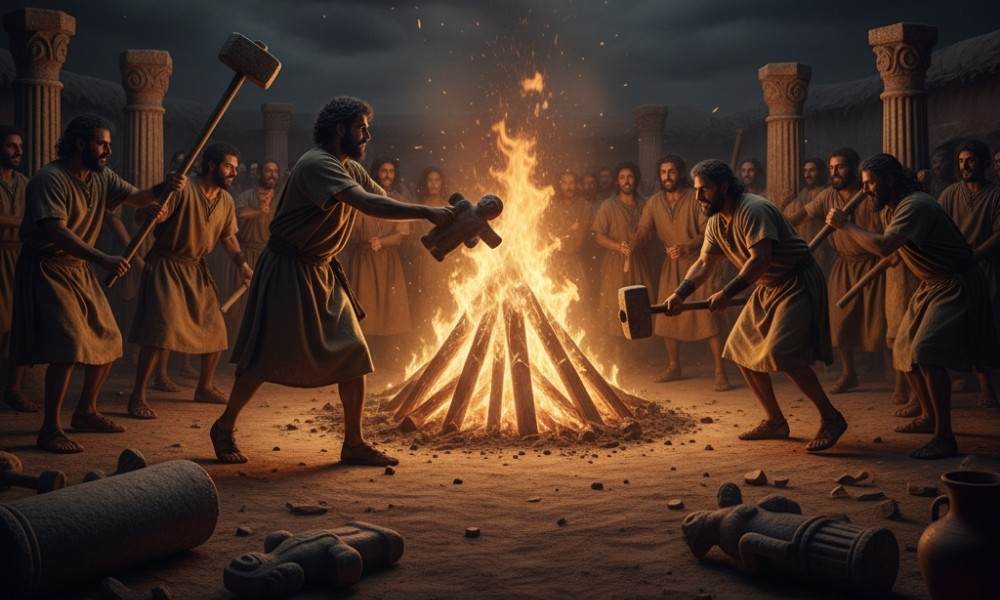
Judges 10 serves as a bridge between the chaotic usurper Abimelech and the tragic judge Jephthah. It begins with a brief record of two “minor” judges, Tola and Jair, who provided 45 years of stability. However, the narrative quickly darkens as Israel falls into its most comprehensive idolatry yet, worshiping the gods of seven surrounding nations. Consequently, God subjects them to a two-front oppression by the Philistines and Ammonites. The chapter is pivotal because when Israel cries out for help, God initially refuses, telling them to ask their idols for salvation. Only after Israel demonstrates genuine repentance—by actually removing their idols—does God’s patience return, setting the stage for the next deliverer.
1. Peace Under Tola and Jair (Judges 10:1–5 ESV)
After Abimelech there arose to save Israel Tola the son of Puah, son of Dodo, a man of Issachar, and he lived at Shamir in the hill country of Ephraim. And he judged Israel twenty-three years. Then he died and was buried at Shamir. After him arose Jair the Gileadite, who judged Israel twenty-two years. And he had thirty sons who rode on thirty donkeys, and they had thirty cities, called Havvoth-jair to this day, which are in the land of Gilead. And Jair died and was buried at Kamon.
Commentary:
- Restoration of Order: After the bloody tyranny of Abimelech (Chapter 9), God provides two judges who are noted not for military exploits, but for stability.
- Tola: His name means “Crimson Worm” (often used for dye). He was from the tribe of Issachar but lived in Ephraim, suggesting he unified the central tribes. His 23 years brought much-needed peace.
- Jair: His rule shifts the focus to the east of the Jordan (Gilead).
- Signs of Prosperity: Jair’s description implies wealth and prestige. Having “thirty sons” riding “thirty donkeys” (the Mercedes-Benz of the ancient world) and governing “thirty cities” indicates a secure, administrative dynasty.
- The Calm Before the Storm: These 45 years of silence in the text represent a grace period of recovery for Israel.
2. Total Apostasy (Judges 10:6–9 ESV)
The people of Israel again did what was evil in the sight of the Lord and served the Baals and the Ashtaroth, the gods of Syria, the gods of Sidon, the gods of Moab, the gods of the Ammonites, and the gods of the Philistines. And they forsook the Lord and did not serve him. So the anger of the Lord was kindled against Israel, and he sold them into the hand of the Philistines and into the hand of the Ammonites… …so that Israel was severely distressed.
Commentary:
- Sevenfold Idolatry: The corruption is total. Israel adopts the pantheons of all their neighbors. The text lists seven specific groups of gods, indicating spiritual completeness in their rebellion.
- “They Forsook the Lord”: It was no longer syncretism (worshiping God and idols); it was total replacement. They stopped serving Yahweh entirely.
- The Pincer Movement: Because they worshiped the gods of the West (Philistines) and the East (Ammon/Moab), God allowed enemies from both sides to crush them.
- The Crisis in Gilead: The Ammonites (descendants of Lot) crushed the tribes east of the Jordan for 18 years and eventually crossed the river to fight Judah and Ephraim. The nation was surrounded.
3. God’s Refusal to Save (Judges 10:10–14 ESV)
And the people of Israel cried out to the Lord, saying, “We have sinned against you, because we have forsaken our God and have served the Baals.” And the Lord said to the people of Israel, “Did I not save you from the Egyptians and from the Amorites, from the Ammonites and from the Philistines? … Yet you have forsaken me and served other gods; therefore I will save you no more. Go and cry out to the gods whom you have chosen; let them save you in the time of your distress.”
Commentary:
- A Hollow Cry: Initially, Israel’s cry is driven by pain, not repentance. They want relief from the punishment, not necessarily a restored relationship with the Punisher.
- God’s History Lesson: God lists seven nations He previously defeated for them (matching their seven idols). He exposes their ingratitude.
- The Divine “No”: For the first time in the book, God refuses to raise a judge. He says, “I will save you no more.”
- Sarcastically Holy: God tells them to go ask their “chosen” gods for help. He forces them to face the reality that their idols are impotent. It is a severe mercy—forcing them to hit rock bottom so they realize the futility of their false worship.
4. True Repentance and Divine Pity (Judges 10:15–16 ESV)
And the people of Israel said to the Lord, “We have sinned; do to us whatever seems good to you. Only please deliver us this day.” So they put away the foreign gods from among them and served the Lord, and his soul could no longer endure the misery of Israel.
Commentary:
- Shift in Attitude: God’s refusal breaks their hearts. They move from “Save us!” to “Do to us whatever seems good.” They accept God’s right to judge them. This is the mark of genuine contrition—unconditional surrender.
- Action follows Confession: They didn’t just pray; they “put away the foreign gods.” Repentance is not just a feeling; it is a behavioral change.
- God’s Heart: The Hebrew phrase “His soul could no longer endure” (literally “His soul became short”) is one of the most poignant descriptions of God in the OT. It suggests God was exasperated by their misery. He is not a robot; He is a Father who cannot bear to watch His children suffer, even when the suffering is self-inflicted.
5. The Leadership Vacuum (Judges 10:17–18 ESV)
Then the Ammonites were called to arms, and they encamped in Gilead. And the people of Israel came together, and they encamped at Mizpah. And the people, the leaders of Gilead, said one to another, “Who is the man who will begin to fight against the Ammonites? He shall be head over all the inhabitants of Gilead.”
Commentary:
- The Standoff: The armies are gathered. The Ammonites are in Gilead; the Israelites are at Mizpah.
- The Missing Leader: Despite their repentance, a leader does not magically appear. The people are desperate.
- The Offer: They offer political power (“head over all inhabitants”) to anyone who can win the war. This sets the stage for Chapter 11, where they will turn to a man they previously rejected: Jephthah.
Theological Significance of Judges 10
- The Empathy of God: This chapter reveals that God is not impassive. He grieves over sin, but He also grieves over the suffering that sin causes. His judgment is real, but His mercy is restless.
- The Nature of Idolatry: Idolatry is described as slavery to things that cannot save. God’s sarcastic command (“Go cry to the gods you chose”) highlights that false gods always fail when life gets hard.
- Lip Service vs. Life Service: God distinguishes between the regret of getting caught (v. 10) and the repentance of changed behavior (v. 16). He waits for the latter before acting.
- The Blessing of Boring: The peaceful reigns of Tola and Jair remind us that God often works through quiet, administrative stability, not just spectacular miracles.
Practical Applications
- Don’t Waste the Quiet Years: If you are in a season of stability (like the days of Tola), use it to build depth and faithfulness. Don’t wait for a crisis to get serious about God.
- Test Your Repentance: If you are asking God for help, check if you have actually “put away the foreign gods” (sins, addictions, distractions). Prayer without life change is often ignored.
- When God Says No: If God seems silent or refuses to remove a difficulty, He may be pressing you to let go of the “idols” you are still clinging to.
- God feels your pain: Even when you are suffering the consequences of your own bad choices, God is not indifferent. “His soul” is distressed by your distress.
Final Insight
Judges 10 teaches that God is not a vending machine for deliverance. He desires a relationship. Sometimes, the most loving thing He can do is let us feel the weight of our false gods until we are willing to smash them and return to Him fully.







Leave a Reply