
Judges 13 introduces the life of Samson, the final major judge in the book. The narrative begins in a dark period where Israel has done evil and has been under Philistine oppression for forty years—interestingly, without crying out to God for help. Despite their silence, God initiates a rescue plan through a barren couple from the tribe of Dan. The Angel of the Lord appears to Manoah’s wife, announcing she will conceive a son who must be a Nazirite from the womb. The chapter details the couple’s interaction with this divine messenger, culminating in a miraculous sign where the Angel ascends in the flame of a burnt offering. The chapter concludes with the birth of Samson and the stirring of the Lord’s Spirit within him.
1. The Divine Annunciation (Judges 13:1–5)
1 And the people of Israel again did what was evil in the sight of the Lord, so the Lord gave them into the hand of the Philistines for forty years. 2 There was a certain man of Zorah, of the tribe of the Danites, whose name was Manoah. And his wife was barren and had no children. 3 And the angel of the Lord appeared to the woman and said to her, “Behold, you are barren and have not borne children, but you shall conceive and bear a son. 4 Therefore be careful and drink no wine or strong drink, and eat nothing unclean, 5 for behold, you shall conceive and bear a son. No razor shall come upon his head, for the child shall be a Nazirite to God from the womb, and he shall begin to save Israel from the hand of the Philistines.”
Commentary:
- The Cycle of Silence: Unlike previous cycles in Judges where oppression led to repentance and a cry for help, here Israel accepts Philistine dominance. God’s intervention is purely an act of sovereign grace, not a response to prayer.
- The Philistine Threat: The forty-year oppression is the longest mentioned in Judges, signifying a deep spiritual and political entrenchment. The Philistines were technologically superior (Iron Age civilization) and geographically close neighbors.
- The Barrenness Motif: As with Sarah, Rebekah, and Hannah, the physical barrenness of Manoah’s wife serves as a theological backdrop. It highlights that deliverance cannot come from human effort; life must come from God.
- The Angel of the Lord: This figure is distinct from a human prophet or a created angel. In Old Testament theology, this is often considered a “theophany” (an appearance of God) or a “Christophany” (the pre-incarnate Christ), evidenced by His authority and acceptance of worship later in the chapter.
- The Nazirite Vow: The instructions reference Numbers 6. A Nazirite (meaning “separated” or “consecrated”) usually took a temporary vow. Samson is unique because:
- Involuntary/Divine appointment: He did not choose this; God chose it for him.
- Prenatal: The restrictions applied to the mother during pregnancy, emphasizing total consecration.
- Lifelong: He was to be a Nazirite “from the womb.”
- “Begin to Save”: The prophecy is specific. Samson will begin the deliverance, but he will not complete it. The Philistine threat was not fully neutralized until the time of King David.
2. The Message Relayed (Judges 13:6–7)
6 Then the woman came and told her husband, “A man of God came to me, and his appearance was like the appearance of the angel of God, very awesome. I did not ask him where he was from, and he did not tell me his name, 7 but he said to me, ‘Behold, you shall conceive and bear a son. So then drink no wine or strong drink, and eat nothing unclean, for the child shall be a Nazirite to God from the womb to the day of his death.’”
Commentary:
- Perception of the Messenger: The woman identifies Him as a “man of God” (prophet) but notes His “awesome” (fear-inspiring, terrible in majesty) appearance, likening Him to an angel. She senses the supernatural immediately.
- The Woman’s Role: In this narrative, the woman is the primary recipient of revelation. She is spiritually sensitive and perceptive, whereas Manoah relies on her report.
- Prophetic Addition: Interestingly, the woman adds the phrase “to the day of his death” (v. 7), which was not explicitly recorded in the Angel’s speech in verse 5. This suggests she understood the permanent nature of this calling—Samson’s identity was bound to this vow until the end of his life.
3. Manoah’s Prayer and the Confirmation (Judges 13:8–14)
8 Then Manoah prayed to the Lord and said, “O Lord, please let the man of God whom you sent come again to us and teach us what we are to do with the child who will be born.” 9 And God listened to the voice of Manoah, and the angel of God came again to the woman as she sat in the field. But Manoah her husband was not with her. 10 So the woman ran quickly and told her husband, “Behold, the man who came to me the other day has appeared to me.” 11 And Manoah arose and went after his wife and came to the man and said to him, “Are you the man who spoke to this woman?” And he said, “I am.” 12 And Manoah said, “Now when your words come true, what is to be the child’s manner of life, and what is his mission?” 13 And the angel of the Lord said to Manoah, “Of all that I said to the woman let her be careful. 14 She may not eat of anything that comes from the vine, neither let her drink wine or strong drink, nor eat any unclean thing. All that I commanded her let her observe.”
Commentary:
- Parental Responsibility: Manoah’s prayer reveals a desire for guidance in parenting. He realizes that a special child requires special upbringing. It is a model prayer for parents seeking divine wisdom.
- Divine Repetition: God answers the prayer, but the Angel appears to the woman again. This subtly underscores that God has already given the necessary information. When Manoah finally speaks to the Angel, the Angel simply reiterates what was told to the wife.
- Manoah’s Doubt vs. Diligence: While his prayer seems pious, there is an undercurrent of needing to verify his wife’s experience. He asks, “Are you the man?” and seeks details on the “manner of life” (rules/lifestyle) and “mission” (work).
- Emphasis on the Mother: The Angel’s response in verses 13-14 focuses entirely on the mother’s diet and obedience. The sanctity of the vessel (the mother) is crucial for the sanctity of the child.
4. The Offering and the Wonder-Working God (Judges 13:15–20)
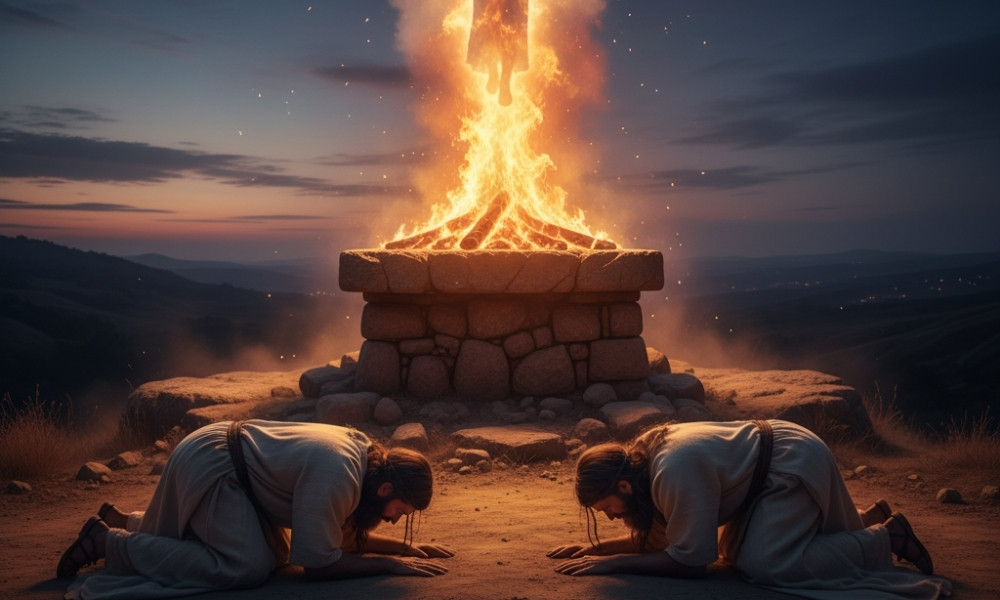
15 Manoah said to the angel of the Lord, “Please let us detain you and prepare a young goat for you.” 16 And the angel of the Lord said to Manoah, “If you detain me, I will not eat of your food. But if you prepare a burnt offering, then offer it to the Lord.” (For Manoah did not know that he was the angel of the Lord.) 17 And Manoah said to the angel of the Lord, “What is your name, so that, when your words come true, we may honor you?” 18 And the angel of the Lord said to him, “Why do you ask my name, seeing it is wonderful?” 19 So Manoah took the young goat with the grain offering, and offered it on the rock to the Lord, to the one who works wonders, and Manoah and his wife were watching. 20 And when the flame went up toward heaven from the altar, the angel of the Lord went up in the flame of the altar. Now Manoah and his wife were watching, and they fell on their faces to the ground.
Commentary:
- Hospitality: Manoah treats the visitor with typical Near Eastern hospitality, offering a meal. He still views the visitor as a human prophet.
- Redirecting Worship: The Angel refuses the meal but permits a “burnt offering” (an act of total dedication/worship) directed to Yahweh.
- The Name “Wonderful”: When asked his name, the Angel replies that it is “Wonderful” (Hebrew: Peli).
- This word conveys the idea of something “incomprehensible,” “extraordinary,” or “beyond understanding.”
- This is the same root word used in Isaiah 9:6 (“his name shall be called Wonderful Counselor”), strongly linking this Angel to the Messiah.
- The Miracle: Verse 19 mentions the Lord “who works wonders.” As the flame consumes the sacrifice, the Angel does not just stand by; He enters the fire and ascends to heaven within it.
- Self-Revelation: The ascension in the flame is the definitive proof of His divinity. He is at home in the holy fire of the altar.
5. The Realization and The Birth (Judges 13:21–25)
21 The angel of the Lord appeared no more to Manoah and to his wife. Then Manoah knew that he was the angel of the Lord. 22 And Manoah said to his wife, “We shall surely die, for we have seen God.” 23 But his wife said to him, “If the Lord had meant to kill us, he would not have accepted a burnt offering and a grain offering at our hands, or shown us all these things, or now announced to us such things as these.” 24 And the woman bore a son and called his name Samson. And the young man grew, and the Lord blessed him. 25 And the Spirit of the Lord began to stir him in Mahaneh-dan, between Zorah and Eshtaol.
Commentary:
- Theological Panic: Manoah realizes he has encountered the divine. His fear (“We shall surely die”) is based on the Old Testament understanding that sinful man cannot see the holy God and live (Exodus 33:20).
- The Wife’s Logic: The wife displays superior theological reasoning. She argues from the evidence of grace:
- Acceptance of the sacrifice.
- Revelation of future events.
- The promise of a child.
- Conclusion: God does not reveal His plan and accept worship only to destroy the worshippers immediately.
- Samson’s Name: She names him Samson (Hebrew: Shimshon), derived from shemesh (sun). It likely means “Little Sun” or “Sun Man.” In a time of darkness, a light has dawned.
- The Stirring of the Spirit: Verse 25 is crucial. Samson’s strength is not genetic; it is pneumatic (spiritual). The Ruach Yahweh (Spirit of the Lord) begins to “impel” or “stir” him at Mahaneh-dan (the Camp of Dan). This marks the beginning of his charismatic leadership.
Theological Significance
- Christology (The Angel of the Lord): This chapter provides one of the clearest appearances of the pre-incarnate Christ. His name is “Wonderful,” He accepts the burnt offering, and He ascends in the flame—acting as the mediator between God and man.
- Sovereign Grace: God initiates salvation for a people who aren’t even asking for it. He breaks the cycle of sin and silence with a gift.
- Sanctification: The Nazirite vow emphasizes that those used by God must be set apart. Holiness involves separation from common things (wine, death) to be consecrated for divine use.
- The Holy Spirit: In Judges, the Spirit comes upon leaders to empower them for war and service. Samson is the prime example of a man whose natural abilities are insufficient; he requires the supernatural stirring of the Spirit.
Practical Applications
- Trusting God in “Barren” Seasons: Just as God visited Manoah’s wife in her barrenness, God often works His greatest miracles in our areas of emptiness and inability.
- Parental Stewardship: Children are a heritage from the Lord. Like Manoah, parents should actively pray, “Teach us what we are to do with the child,” recognizing that raising children requires divine wisdom.
- Perceptive Faith: We should emulate the faith of Manoah’s wife—faith that reasons based on God’s character and grace, rather than succumbing to panic and fear.
- Worship and Awe: True worship acknowledges that God is “Wonderful”—beyond our full comprehension. When we encounter His presence, the appropriate response is humility and awe.
Final Insight
Judges 13 sets the stage for a deliverer who is a study in contrasts: strong in body but often weak in will, dedicated to God yet often flirting with the world. However, the chapter’s focus remains firmly on the God who works wonders. It reminds us that deliverance does not begin with human potential, but with a divine promise and the stirring of the Holy Spirit.







Leave a Reply