
Judges 15 chronicles the escalation of conflict between Samson and the Philistines, moving from personal grievances to national warfare. What begins as a domestic dispute over Samson’s wife evolves into a cycle of vengeance. Samson uses unconventional methods—burning Philistine crops with foxes and slaughtering a thousand men with a donkey’s jawbone—to inflict damage on Israel’s oppressors. The chapter highlights the apathy of the men of Judah, who are content to remain under Philistine rule, and contrasts their cowardice with Samson’s solitary, Spirit-empowered aggression. It concludes with God sustaining His flawed judge through miraculous provision of water.
1. The Failed Reconciliation and Arson (Judges 15:1–5)
1 After some days, at the time of wheat harvest, Samson went to visit his wife with a young goat. And he said, “I will go in to my wife in the chamber.” But her father would not allow him to go in. 2 And her father said, “I really thought that you utterly hated her, so I gave her to your companion. Is not her younger sister more beautiful than she? Please take her instead.” 3 And Samson said to them, “This time I shall be innocent in regard to the Philistines, when I do them harm.” 4 So Samson went and caught 300 foxes and took torches. And he turned them tail to tail and put a torch between each pair of tails. 5 And when he had set fire to the torches, he let the foxes go into the standing grain of the Philistines and set fire to the stacked grain and the standing grain, as well as the olive orchards.
Commentary:
- The Timing: The “time of wheat harvest” is significant (likely May or June). The weather would be dry, making the fields highly flammable, and the economic loss would be maximized as the crop was ready for gathering.
- The Goat: A young goat was a customary gift, serving as a price for marital intimacy. Samson returns expecting to resume life with the woman he married in Chapter 14, unaware she has been given away.
- The Father’s Miscalculation: The father-in-law assumed Samson’s angry departure (Judges 14:19) signaled a divorce. He attempts to appease Samson with the younger sister, treating the women as interchangeable commodities.
- Samson’s Justification: In verse 3, Samson declares himself “innocent” (or blameless). He views his next action not as unprovoked terrorism, but as justified retaliation for a personal breach of contract.
- The Foxes (Jackals): The Hebrew word shu‘al can mean fox or jackal. It is most likely Samson caught jackals, which are pack animals and easier to trap in large numbers (300) than solitary foxes.
- Tactical Genius: Tying the animals tail-to-tail served a specific purpose. A single animal might run to its den and hide. Two animals tied together would pull in opposing directions, moving erratically and slowly enough to ensure the fire spread thoroughly across the fields.
- Economic Devastation: The destruction includes “stacked grain” (already harvested), “standing grain” (yet to be harvested), and “olive orchards.” Olive trees take years to mature; this was a long-term blow to the Philistine economy.
2. The Cycle of Vengeance (Judges 15:6–8)
6 Then the Philistines said, “Who has done this?” And they said, “Samson, the son-in-law of the Timnite, because he has taken his wife and given her to his companion.” And the Philistines came up and burned her and her father with fire. 7 And Samson said to them, “If this is what you do, I swear I will be avenged on you, and after that I will quit.” 8 And he struck them hip and thigh with a great blow, and he went down and stayed in the cleft of the rock of Etam.
Commentary:
- Philistine Brutality: Unable to catch Samson, the Philistines turn on the vulnerable. Ironically, the woman and her father are burned to death—the very fate she tried to avoid by betraying Samson’s riddle in Chapter 14:15.
- Samson’s vow: Verse 7 indicates a shift. Samson is no longer just acting out of petulance; he swears a specific vengeance for the murder of his wife. The phrase “after that I will quit” suggests he intended this to be the final act of this specific feud.
- “Hip and Thigh”: This is a Hebrew idiom (literally “leg upon thigh”). It implies a ferocious, wholesale slaughter, perhaps drawn from wrestling terminology where opponents are hacked down and piled atop one another.
- The Rock of Etam: Samson retreats to a natural fortress. Unlike a military general who marshals an army, Samson acts as a solitary guerilla fighter.
3. The Betrayal by Judah (Judges 15:9–13)
9 Then the Philistines came up and encamped in Judah and made a raid on Lehi. 10 And the men of Judah said, “Why have you come up against us?” They said, “We have come up to bind Samson, to do to him as he did to us.” 11 Then 3,000 men of Judah went down to the cleft of the rock of Etam and said to Samson, “Do you not know that the Philistines are rulers over us? What then is this that you have done to us?” And he said to them, “As they did to me, so have I done to them.” 12 And they said to him, “We have come down to bind you, that we may give you into the hands of the Philistines.” And Samson said to them, “Swear to me that you will not attack me yourselves.” 13 They said to him, “No; we will only bind you and give you into their hands. We will surely not kill you.” So they bound him with two new ropes and brought him up from the rock.
Commentary:
- Judah’s Spiritual State: This is one of the saddest passages in Judges. The tribe of Judah—the tribe of the lion, destined for leadership—is completely subservient. They ask, “Do you not know that the Philistines are rulers over us?” They have accepted their slavery as the status quo.
- The Numbers: 3,000 men of Judah are mobilized not to fight the Philistines, but to capture one of their own brothers. This highlights the absolute isolation of Samson.
- Samson’s Code: Samson allows himself to be bound. He has no quarrel with his own people and refuses to shed Israelite blood, even though they are betraying him. He extracts a promise that they will not kill him themselves, showing he trusts his ability to handle the Philistines if he can just get close to them.
- Lex Talionis: Samson repeats his justification in verse 11: “As they did to me, so have I done to them.” He views his actions as reciprocal justice.
4. The Jawbone Victory (Judges 15:14–17)
14 When he came to Lehi, the Philistines came shouting to meet him. Then the Spirit of the Lord rushed upon him, and the ropes that were on his arms became as flax that has caught fire, and his bonds melted off his hands. 15 And he found a fresh jawbone of a donkey, and put out his hand and took it, and with it he struck 1,000 men. 16 And Samson said, “With the jawbone of a donkey, heaps upon heaps, with the jawbone of a donkey have I struck down a thousand men.” 17 As soon as he had finished speaking, he threw away the jawbone out of his hand. And that place was called Ramath-lehi.
Commentary:
- The Spirit’s Empowerment: The phrase “rushed upon him” (or came mightily) indicates a sudden, supernatural infusion of power. This is the charismatic endowment for war, typical in Judges.
- The Weapon: He finds a “fresh” jawbone. A fresh bone is heavier, tougher, and less brittle than a dry, bleached bone.
- Nazarite Violation: Touching a dead animal (carcass) was a violation of the Nazarite vow (Numbers 6:6). Samson prioritizes immediate military necessity over ritual purity, a recurring theme in his life.
- The Slaughter: Samson fights alone against a battalion. The breaking of the ropes and the subsequent battle happen in close quarters.
- The Poem (Wordplay): Verse 16 contains a Hebrew pun. The word chamor means both “donkey” and “heap.”
- “With the jawbone of a chamor, chamor chamorthaim…”
- Translation nuance: “With the jawbone of a donkey, I have made donkeys of them” or “I have piled them in heaps.”
- Ramath-lehi: He names the place “The Hill of the Jawbone,” memorializing his victory.
5. The Prayer of Thirst (Judges 15:18–20)
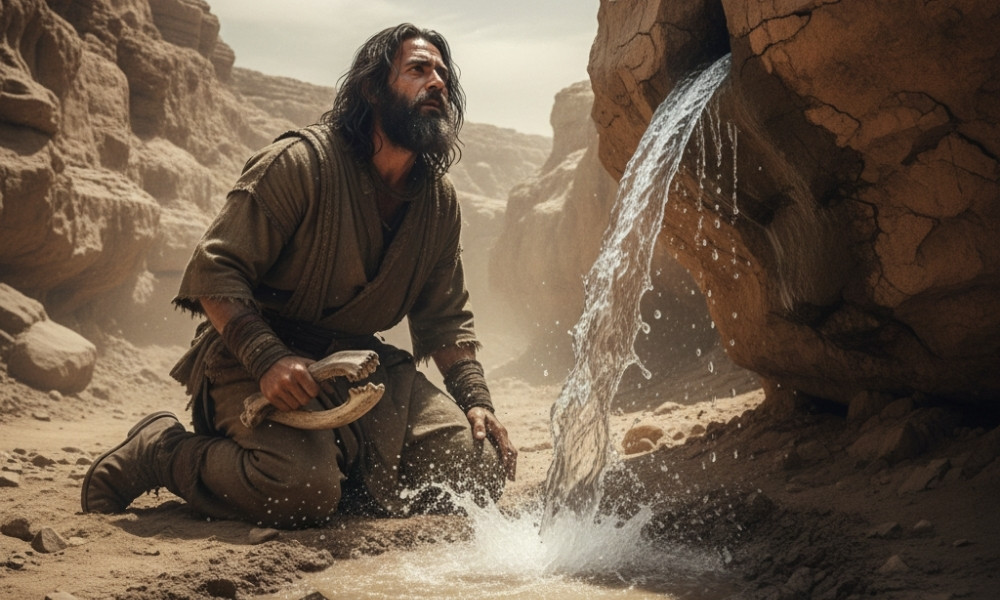
18 And he was very thirsty, and he called upon the Lord and said, “You have granted this great salvation by the hand of your servant, and shall I now die of thirst and fall into the hands of the uncircumcised?” 19 And God split open the hollow place that is at Lehi, and water came out from it. And when he drank, his spirit returned, and he revived. Therefore the name of it was called En-hakkore; it is at Lehi to this day. 20 And he judged Israel in the days of the Philistines twenty years.
Commentary:
- Human Limitation: Immediately after a superhuman feat, Samson is reminded of his mortality. He is dehydrated and on the verge of collapse. Great spiritual victories are often followed by physical or emotional exhaustion (comparable to Elijah in 1 Kings 19).
- Samson’s Prayer: This is the first time Samson explicitly prays. He acknowledges two things:
- God’s Sovereignty: “You have granted this great salvation.” He knows the strength wasn’t his own.
- Covenantal Pride: He fears falling into the hands of the “uncircumcised” (a religious/covenantal distinction), showing he still identifies as God’s champion.
- God’s Provision: God splits the earth (a hollow basin) to provide water. God cares for His servant’s physical needs.
- En-hakkore: Named “The Spring of Him Who Called.” It stands as a monument to answered prayer.
- Editorial Note: Verse 20 serves as a concluding formula for this section of Samson’s life, noting his 20-year tenure.
Theological Significance
- God uses Flawed Instruments: Samson is impulsive, violent, and ritually unclean, yet he is the vessel for God’s Spirit. This demonstrates that God’s power is not limited by human perfection.
- The Disruption of Status Quo: God uses Samson’s personal conflicts to disrupt the comfortable coexistence between Israel and the Philistines. God sometimes creates friction to prevent His people from assimilating into a pagan culture.
- Type of the Messiah (imperfect): Like Jesus, Samson is betrayed by his own people (Judah) to the Gentiles (Philistines). He delivers his people alone, without an army. However, unlike Jesus, Samson’s motivation is often revenge rather than sacrificial love.
- The Reality of Spiritual Warfare: The “Spirit of the Lord” rushing upon Samson reminds us that deliverance is a divine act, not a result of human training or numbers.
Practical Applications
- Avoid the “Judah Mentality”: The men of Judah were so used to oppression they criticized the one trying to free them. We must not become so comfortable with our “sins” or spiritual bondage that we resist liberation.
- Dependence on God in Victory: After great success, we remain fragile humans. Like Samson at En-hakkore, we must turn to God for refreshment, acknowledging that He is the source of our past victory and our present sustenance.
- The Power of Prayer in Extremis: Even if our life has been marked by impulsiveness, God listens when we cry out in genuine need. Samson’s prayer was raw and somewhat complaining, but it was directed to the right Source.
- God’s Creativity in Solutions: Whether using 300 foxes or a donkey’s jawbone, God can use the resources at hand—however unlikely—to achieve His purposes.
Final Insight
Judges 15 presents a stark picture of a “one-man army” empowered by God because the nation had lost its will to fight. It challenges the reader to ask: Are we content living under the rule of the enemy, or are we willing to stand alone, trusting in the Spirit’s power?







Leave a Reply