
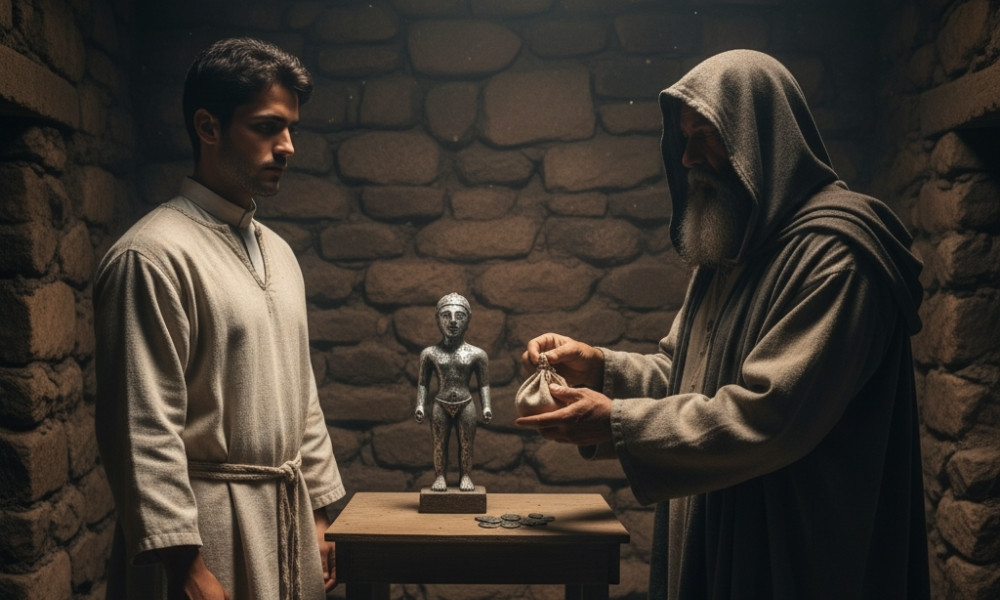
Judges 17 marks a major shift in the book. The narrative moves from “cycles of foreign oppression and deliverance” to a disturbing epilogue (Chapters 17–21) that exposes Israel’s internal corruption. There is no foreign enemy here; the enemy is within. This chapter introduces Micah, an Ephraimite who steals from his mother, returns the money to avoid a curse, and then uses it to establish a private, idolatrous shrine. He hires a wandering Levite to be his personal priest, believing this will purchase God’s favor. The chapter illustrates the spiritual chaos summarized by the recurring refrain: “In those days there was no king in Israel. Everyone did what was right in his own eyes.”
1. The Thief, The Curse, and The Idol (Judges 17:1–4)
1 There was a man of the hill country of Ephraim, whose name was Micah. 2 And he said to his mother, “The 1,100 pieces of silver that were taken from you, about which you uttered a curse, and also spoke it in my ears—behold, the silver is with me; I took it.” And his mother said, “Blessed be my son by the Lord.” 3 And he restored the 1,100 pieces of silver to his mother. And his mother said, “I dedicate the silver to the Lord from my hand for my son, to make a carved image and a metal image. Now therefore I will restore it to you.” 4 So when he restored the money to his mother, his mother took 200 pieces of silver and gave it to the silversmith, who made it into a carved image and a metal image. And it was in the house of Micah.
Commentary:
- The Setting: The story takes place in the “hill country of Ephraim,” a central and influential region. The name “Micah” (or Mikhayehu) means “Who is like Yahweh?” The irony is that Micah’s life is the antithesis of Yahweh’s character.
- The Theft: Micah steals 1,100 shekels of silver from his mother. This is a massive sum—incidentally, it is the exact amount each Philistine lord promised Delilah for betraying Samson (Judges 16:5).
- The Motivation for Confession: Micah does not confess out of guilt or repentance. He confesses because he overheard his mother utter a curse against the thief. He is motivated by superstition and fear of bad luck, not fear of God.
- The Mother’s Reaction: Instead of rebuking her son for violating the Ten Commandments (stealing and dishonoring parents), she immediately blesses him in the name of Yahweh to neutralize the curse.
- Religious Syncretism: This is the core theme of the chapter. The mother dedicates the silver “to the Lord” (Yahweh) specifically to make a “carved image and a metal image.”
- She uses the right name (Yahweh).
- She performs the wrong action (violating the Second Commandment: “You shall not make for yourself a carved image”).
- This shows that Israel had not necessarily abandoned Yahweh for Baal completely; rather, they had dragged Yahweh down to the level of pagan idols, worshipping Him in ways He explicitly forbade.
2. The Homemade Religion (Judges 17:5–6)
5 And the man Micah had a shrine, and he made an ephod and household gods, and ordained one of his sons, who became his priest. 6 In those days there was no king in Israel. Everyone did what was right in his own eyes.
Commentary:
- The Shrine: Micah establishes a “house of gods” (beth elohim). He privatizes religion, setting up a cult center in his own living room to bypass the central sanctuary (Shiloh).
- The Paraphernalia:
- Ephod: A priestly garment usually associated with the High Priest for discerning God’s will. Micah creates a counterfeit.
- Teraphim (Household Gods): These were small idols, often associated with inheritance rights and divination.
- The Illegitimate Priesthood: Micah “ordained” (literally: “filled the hand of”) his own son to be priest. According to the Law of Moses, only Levites of the line of Aaron could be priests. Micah ignores divine order for personal convenience.
- The Editorial Comment (v. 6): This verse is the theological key to the epilogue.
- “No King”: This refers to both a human monarch (to enforce law) and the rejection of Yahweh as their King.
- “Right in his own eyes”: This is the definition of moral relativism. Without an external standard of truth (God’s Law), ethics became entirely subjective. Micah felt “right” about his shrine because it was sincere, even though it was scripturally prohibited.
3. The Wandering Levite (Judges 17:7–8)
7 Now there was a young man of Bethlehem in Judah, of the family of Judah, who was a Levite, and he sojourned there. 8 And the man departed from the town of Bethlehem in Judah to sojourn where he could find a place. And as he journeyed, he came to the hill country of Ephraim to the house of Micah.
Commentary:
- The Levite’s Plight: Levites were supposed to live in designated cities and be supported by the tithes of the people.
- Bethlehem: Bethlehem was not a Levitical city. This young man was likely living there because the designated Levitical cities were neglected or unsafe.
- “Of the family of Judah”: This likely indicates he was living among the tribe of Judah, or perhaps had some maternal connection, further blurring his Levitical distinction.
- Aimlessness: He is described as “sojourning where he could find a place.” This indicts the nation of Israel: the ministers of God were wandering homeless because the people had stopped tithing and caring for the sanctuary.
4. The Hireling Priest (Judges 17:9–13)
9 And Micah said to him, “Where do you come from?” And he said to him, “I am a Levite of Bethlehem in Judah, and I am going to sojourn where I may find a place.” 10 And Micah said to him, “Stay with me, and be to me a father and a priest, and I will give you ten pieces of silver a year and a suit of clothes and your living.” And the Levite went in. 11 And the Levite was content to dwell with the man, and the young man became to him like one of his sons. 12 And Micah ordained the Levite, and the young man became his priest, and was in the house of Micah. 13 Then Micah said, “Now I know that the Lord will prosper me, because I have a Levite as priest.”
Commentary:
- The Offer: Micah sees an opportunity to upgrade his shrine. His son was a lay-priest; a Levite offers “legitimacy.”
- “Father and Priest”: Micah asks a young man to be a “father” (a title of respect/authority), yet treats him like an employee.
- The Wage: Ten shekels a year, clothes, and food. This is a pittance compared to the 1,100 shekels Micah stole. The Levite sells his spiritual heritage for job security.
- The Mercenary Spirit: The Levite agrees to serve in an idolatrous shrine for money. He abandons his duty to teach the Law (which forbids idols) to secure a paycheck.
- Micah’s Delusion (v. 13): “Now I know that the Lord will prosper me.”
- This is the climax of the chapter’s irony. Micah believes that by adding a “correct” ritual element (a Levite) to his pile of sins (theft, idols, private shrine), he can manipulate God into blessing him.
- He treats God as a lucky charm or a vending machine. He mistakes ritual form for spiritual reality.
Theological Significance
- Syncretism is Dangerous: The most dangerous form of idolatry is not the total rejection of God, but the mixing of God’s truth with cultural lies. Micah used God’s name (Yahweh) but practiced paganism.
- The Failure of Leadership: The Levite, who should have corrected Micah’s theology, instead validated it for money. When spiritual leaders compromise for financial gain, the people remain in darkness.
- Moral Relativism: “Right in his own eyes” leads to chaos. When feelings replace Scripture as the standard for behavior, society disintegrates.
- Transactional Religion: Micah illustrates the human tendency to think we can “buy” God’s favor through religious objects or hired professionals, rather than through obedience and a humble heart.
Practical Applications
- Evaluate Your Worship: Are we worshipping the God of the Bible as He revealed Himself, or a “customized” version of God that fits our lifestyle and preferences?
- Integrity in Ministry: Spiritual leaders must guard against the temptation to soften the truth to please the “payer.” Ministry is a calling, not merely a career for “ten shekels and a shirt.”
- Superstition vs. Faith: Faith is trusting God’s character and obeying His Word. Superstition is trusting religious objects or rituals to control outcomes. We must ensure our confidence is in Christ, not in our religious performance.
Final Insight
Judges 17 presents a terrifying picture of a society where religion is flourishing (shrines, priests, blessings) but God is absent. It serves as a warning that religious activity without truth and obedience is nothing more than elaborate idolatry.







Leave a Reply