
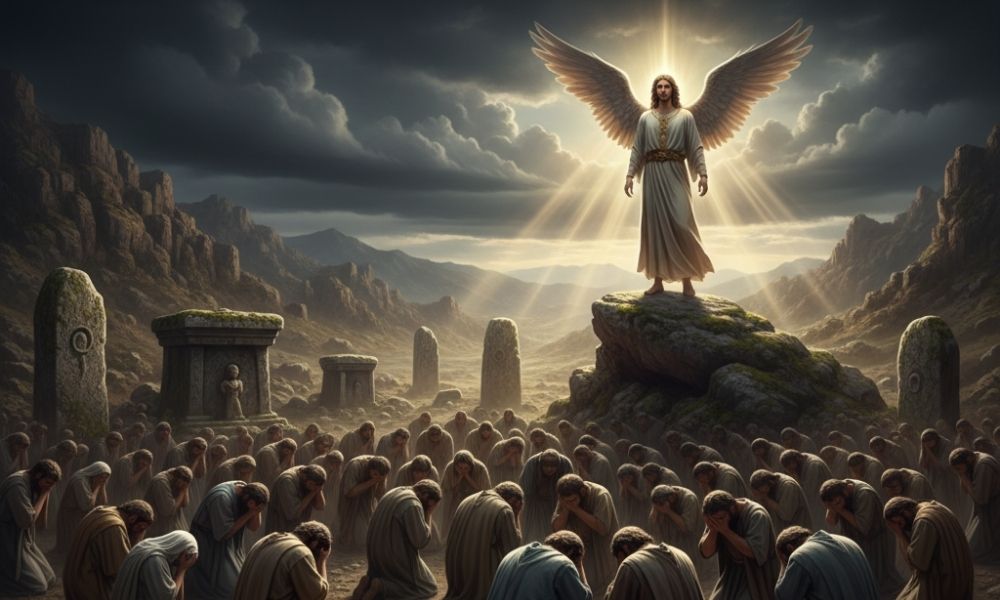
Judges 2 is the theological “heart” and summary of the entire book. While Chapter 1 gave the military history (what happened), Chapter 2 gives the spiritual diagnosis (why it happened). It recounts the appearance of the Angel of the Lord, the death of Joshua, and the rise of a generation that “did not know the Lord.” This chapter introduces the famous “Cycle of Judges”—a recurring spiral of Sin, Servitude, Supplication, and Salvation. It explains that because Israel broke the covenant by worshiping Canaanite gods, Yahweh would no longer drive out their enemies, leaving them instead to test Israel’s faithfulness.
1. The Angel of the Lord at Bochim (Judges 2:1–5)
Now the angel of the Lord went up from Gilgal to Bochim. And he said, “I brought you up from Egypt and brought you into the land that I swore to give to your fathers. I said, ‘I will never break my covenant with you, and you shall make no covenant with the inhabitants of this land; you shall break down their altars.’ But you have not obeyed my voice. What is this that you have done? So now I say, I will not drive them out before you, but they shall become thorns in your sides, and their gods shall be a snare to you.” As soon as the angel of the Lord spoke these words to all the people of Israel, the people lifted up their voices and wept. And they called the name of that place Bochim. And they sacrificed there to the Lord.
Commentary:
- The Identity of the Messenger: The “angel of the Lord” speaks in the first person as God (“I brought you up… I swore”). Most conservative commentators view this as a Christophany—a pre-incarnate appearance of the Son of God.
- From Gilgal to Bochim:
- Gilgal was the place of victory, circumcision, and rolling away the reproach of Egypt (Joshua 5).
- Bochim means “Weepers.”
- The movement signifies a shift from covenant victory to covenant sorrow.
- The Indictment: God outlines the specific breach of contract. He upheld His side (delivering them from Egypt), but they failed their side (making covenants with locals and failing to destroy altars).
- “What is this that you have done?”: A rhetorical question echoing God’s question to Eve in the garden (Gen 3:13). It forces them to confront the magnitude of their failure.
- The Consequence: The promise of driving out enemies was conditional on obedience. Now, the enemies will remain as “thorns” and “snares.”
- Sorrow vs. Repentance: The people weep and sacrifice, but their behavior does not change. This is “worldly sorrow” (regret over consequences) rather than “godly sorrow” (repentance leading to a change of life, see 2 Cor 7:10).
2. The Death of a Generation (Judges 2:6–10)
When Joshua dismissed the people, the people of Israel went each to his inheritance to take possession of the land. And the people served the Lord all the days of Joshua, and all the days of the elders who outlived Joshua, who had seen all the great work that the Lord had done for Israel. … And all that generation also were gathered to their fathers. And there arose another generation after them who did not know the Lord or the work that he had done for Israel.
Commentary:
- Review of History: Verses 6–9 recap the end of Joshua (paralleling Joshua 24) to set the context for the apostasy.
- The Restraining Influence: As long as Joshua and the eyewitness elders were alive, the nation remained faithful. Leadership acts as a seawall against the tide of cultural corruption.
- The Second Generation: This is one of the saddest verses in Scripture: “arose another generation… who did not know the Lord.”
- “Did not know”: This does not mean they were intellectually unaware of Yahweh’s existence. In Hebrew, yada (to know) implies relational experience and covenantal acknowledgment. They knew about Him, but they did not worship Him or experience His power personally.
- Failure of Discipleship: The elders failed to transmit the faith effectively (Deuteronomy 6:7 commanded them to teach their children diligently). Faith is always one generation away from extinction.
3. The Cycle of Apostasy (Judges 2:11–15)
And the people of Israel did what was evil in the sight of the Lord and served the Baals. And they abandoned the Lord, the God of their fathers, who had brought them out of the land of Egypt. They went after other gods, from among the gods of the peoples who were around them, and bowed down to them. And they provoked the Lord to anger. They abandoned the Lord and served the Baals and the Ashtaroth. So the anger of the Lord was kindled against Israel, and he gave them over to plunderers, who plundered them. And he sold them into the hand of their surrounding enemies… Whenever they marched out, the hand of the Lord was against them for harm, as the Lord had warned… and they were in terrible distress.
Commentary:
- “Did What Was Evil”: This phrase becomes a refrain throughout Judges. The “evil” is specifically idolatry.
- Baals and Ashtaroth:
- Baal: The Canaanite storm god, believed to control rain and fertility.
- Ashtaroth (Astarte): The goddess of war and sexuality.
- Worshiping them involved ritual prostitution and sometimes child sacrifice. Israel traded the Holy One of Israel for the fertility cults of their neighbors to ensure agricultural success.
- Divine Jealousy: God is not a passive observer. He is a jealous husband. “Provoked the Lord to anger” uses heat terminology (His nose burned with anger).
- The Hand of the Lord: Previously, God’s hand fought for them (Joshua). Now, His hand fights against them. The defeats are not accidents; they are divine discipline.
4. The LORD Raises Up Judges (Judges 2:16–19)
Then the Lord raised up judges, who saved them out of the hand of those who plundered them. Yet they did not listen to their judges, for they whored after other gods and bowed down to them. … Whenever the Lord raised up judges for them, the Lord was with the judge, and he saved them from the hand of their enemies all the days of the judge. For the Lord was moved to pity by their groaning because of those who afflicted and oppressed them. But whenever the judge died, they turned back and were more corrupt than their fathers…
Commentary:
- Definition of a “Judge” (Shophet): These were not courtroom judges wearing wigs. They were charismatic military leaders and deliverers empowered by the Holy Spirit to rescue the nation and restore order.
- God’s Pity: Despite their rebellion, God is “moved to pity” by their suffering. This highlights God’s relentless grace amidst human relentless sin.
- The Downward Spiral: The cycle is not a circle; it is a downward spiral. Verse 19 notes they became “more corrupt than their fathers.” Each recovery is shorter, and each relapse is deeper.
- Temporary Obedience: Israel’s faithfulness was tied entirely to the lifespan of the Judge. They had a vicarious faith, dependent on a strong leader, rather than a personal faith in God.
5. The Divine Verdict: Testing Instead of Driving Out (Judges 2:20–23)
So the anger of the Lord was kindled against Israel, and he said, “Because this people have transgressed my covenant that I commanded their fathers and have not obeyed my voice, I will no longer drive out before them any of the nations that Joshua left when he died, in order to test Israel by them, whether they will take care to walk in the way of the Lord as their fathers did, or not.” So the Lord left those nations, not driving them out quickly, and he did not give them into the hand of Joshua.
Commentary:
- Change of Strategy: In Judges 1, the nations were left because of Israel’s military/spiritual failure. Here in Judges 2, God announces that He will sovereignly allow those nations to remain as a form of judgment and testing.
- The Purpose of the Nations:
- Before: Objects of judgment to be removed.
- Now: Instruments of testing (“to test Israel”).
- The Test: The presence of pagan culture acts as a litmus test for Israel’s heart. Will they choose Yahweh when Baals are readily available next door?
- “As Their Fathers Did”: A reference to the faithful generation of Joshua and the elders. The standard of obedience remains, even if the environment has become more hostile.
Theological Significance of Judges 2
- Total Depravity: Left to themselves, human beings do not drift toward holiness; they drift toward corruption. The “default mode” of the human heart is idolatry.
- God’s Sovereignty in History: God uses both deliverers (Judges) and oppressors (Canaanites/Plunderers) to accomplish His purposes. He is in control of the chaos.
- The Necessity of Catechesis: Faith must be intentionally taught to the next generation. Experience cannot be inherited; it must be facilitated.
- Cheap Grace vs. True Repentance: Weeping at Bochim without destroying the altars is useless. Emotional responses to God that don’t result in lifestyle changes are not true repentance.
Practical Applications
- Evaluate Your “Bochim”: Do you weep over the consequences of your sin (getting caught/punished) or over the sin itself (grieving the Holy Spirit)?
- Pass the Torch: If you are a parent or mentor, are you merely teaching rules, or are you helping the next generation “know the Lord” relationally?
- Identify Your Idols: Israel worshiped Baal for economic security (rain/crops). What do we worship for security today? (Money, career, approval).
- The Need for a Better Judge: The Judges were temporary and flawed saviors. They point to our need for Jesus, the permanent Savior who does not die and leave us to relapse, but lives to intercede for us.
Final Insight: Judges 2 is a somber warning that God will eventually give people what they want. If they want the gods of the nations, He will withdraw His protection and let them experience the slavery that those gods bring. Yet, even in His anger, His pity remains, foreshadowing the ultimate mercy of the Cross.







Leave a Reply