
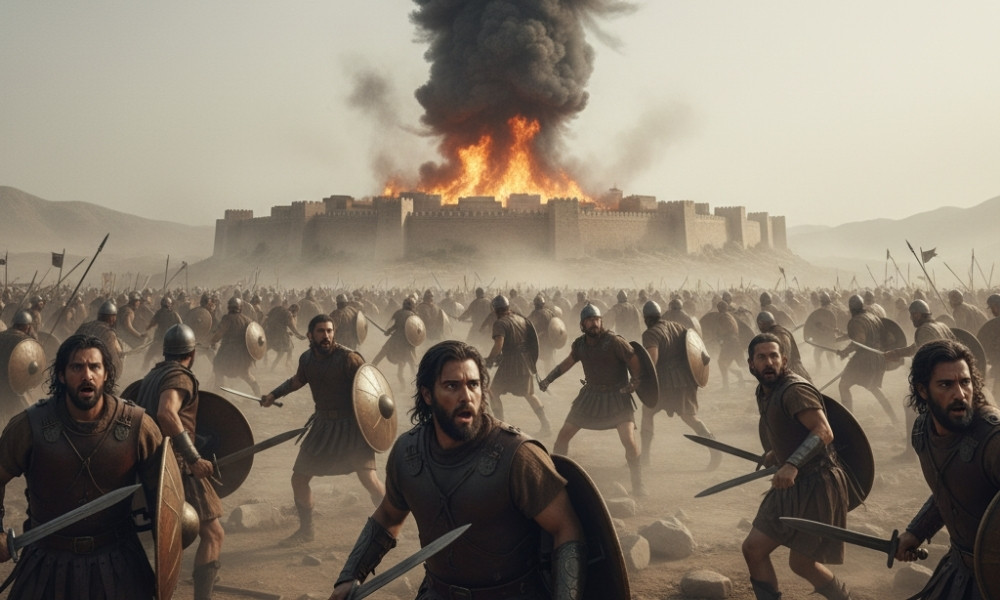
Judges 20 describes the outbreak of a devastating civil war in Israel. Following the horrific rape and murder of the Levite’s concubine in Gibeah (Chapter 19), the tribes of Israel unite to demand justice. When the tribe of Benjamin refuses to surrender the guilty men, opting instead to defend them, war ensues. Despite having superior numbers, the united tribes of Israel suffer two humiliating defeats, losing 40,000 men, as God disciplines the nation. After genuine repentance and fasting, God grants Israel victory on the third day. Using a tactical ambush, Israel decimates the tribe of Benjamin, killing 25,100 soldiers and burning their cities, leaving the tribe on the brink of extinction.
1. The Assembly and Indictment (Judges 20:1–11)
1 Then all the people of Israel came out, from Dan to Beersheba, including the land of Gilead, and the congregation assembled as one man to the Lord at Mizpah. 2 And the chiefs of all the people, of all the tribes of Israel, presented themselves in the assembly of the people of God, 400,000 men on foot that drew the sword. 3 (Now the people of Benjamin heard that the people of Israel had gone up to Mizpah.) And the people of Israel said, “Tell us, how did this evil happen?” 4 And the Levite, the husband of the woman who was murdered, answered and said, “I came to Gibeah that belongs to Benjamin, I and my concubine, to spend the night. 5 And the leaders of Gibeah rose against me and surrounded the house against me by night. They meant to kill me, and they violated my concubine, and she is dead. 6 So I took hold of my concubine and cut her in pieces and sent her throughout all the country of the inheritance of Israel, for they have committed abomination and outrage in Israel. 7 Behold, you people of Israel, all of you, give your advice and counsel here.” 8 And all the people arose as one man, saying, “None of us will go to his tent, and none of us will return to his house. 9 But now this is what we will do to Gibeah: we will go up against it by lot, 10 and we will take ten men of a hundred throughout all the tribes of Israel, and a hundred of a thousand, and a thousand of ten thousand, to bring provisions for the people, that when they come they may repay Gibeah of Benjamin for all the outrage that they have committed in Israel.” 11 So all the men of Israel gathered against the city, united as one man.
Commentary:
- Unprecedented Unity: The phrase “from Dan (north) to Beersheba (south)” and “Gilead” (east of the Jordan) indicates a rare moment of total national mobilization. Ironically, they unite for civil war, not to fight the Philistines or Canaanites.
- Mizpah: A central location in Benjaminite territory (just north of Jerusalem). Meeting here was a direct challenge to the tribe of Benjamin.
- The Levite’s Testimony: The Levite gives a technically true but manipulative account (vv. 4–5).
- He emphasizes the threat to his life (“meant to kill me”).
- He omits his own cowardice (that he pushed his concubine out to the mob).
- He calls the act “abomination and outrage” (Hebrew zimmah and nebalah), terms reserved for the gravest sexual and religious offenses.
- Rash Vows: The assembly reacts emotionally, swearing not to return home until justice is done. This mirrors the rash behavior seen throughout Judges (e.g., Jephthah), where zeal outpaces wisdom.
2. Benjamin’s Defiance and Resources (Judges 20:12–17)
12 And the tribes of Israel sent men through all the tribe of Benjamin, saying, “What evil is this that has taken place among you? 13 Now therefore give up the men, the worthless fellows in Gibeah, that we may put them to death and purge evil from Israel.” But the Benjaminites would not listen to the voice of their brothers, the people of Israel. 14 And the people of Benjamin came together out of the cities to Gibeah to go out to battle against the people of Israel. 15 And the people of Benjamin mustered out of their cities on that day 26,000 men who drew the sword, besides the inhabitants of Gibeah, who mustered 700 chosen men. 16 Among all these were 700 chosen men who were left-handed; every one could sling a stone at a hair and not miss. 17 And the men of Israel, apart from Benjamin, mustered 400,000 men who drew the sword; all these were men of war.
Commentary:
- Diplomacy First: Israel follows Deuteronomic law by offering terms of peace before attacking (Deut 20:10). They demand the surrender of the “worthless fellows” (Sons of Belial).
- Tribalism over Truth: Benjamin faces a moral choice: protect the guilty because they are “family,” or uphold God’s law. They choose tribal loyalty, making the whole tribe complicit in the sin of Gibeah.
- The Odds: 400,000 Israelites vs. 26,700 Benjaminites (roughly 15 to 1).
- Left-Handed Slingers: Benjamin was famous for left-handed warriors (like Ehud in Judges 3). In ancient hand-to-hand combat, left-handed fighters had an advantage against right-handed shields.
- Sling Accuracy: These were not children’s toys. Ancient military slings could propel stones at speeds over 100 mph with lethal force. “At a hair and not miss” is a hyperbole for sniper-like precision.
3. The Discipline of Defeat (Judges 20:18–28)
18 The people of Israel arose and went up to Bethel and inquired of God, “Who shall go up first for us to fight against the people of Benjamin?” And the Lord said, “Judah shall go up first.” … 21 The people of Benjamin came out of Gibeah and destroyed on that day 22,000 men of the Israelites. … 25 And Benjamin went out against them out of Gibeah the second day and destroyed 18,000 men of the people of Israel. All these were men who drew the sword. 26 Then all the people of Israel, the whole army, went up and came to Bethel and wept. They sat there before the Lord and fasted that day until evening, and offered burnt offerings and peace offerings before the Lord. 27 And the people of Israel inquired of the Lord (for the ark of the covenant of God was there in those days, 28 and Phinehas the son of Eleazar, son of Aaron, ministered before it in those days), saying, “Shall we go out once more to battle against our brothers, the people of Benjamin, or shall we cease?” And the Lord said, “Go up, for tomorrow I will give them into your hand.”
Commentary:
- The First Defeats: Why did God allow Israel to lose 40,000 men (22k + 18k) when they were punishing evil?
- Self-Righteousness: Israel was full of idolatry (see Judges 17–18) yet eager to judge Benjamin. God used Benjamin to discipline Israel before allowing Israel to judge Benjamin.
- Presumption: In verse 18, they didn’t ask if they should fight, but who should go first. They assumed God was on their side automatically.
- Progression of Repentance:
- Day 1: Casual inquiry.
- Day 2: Weeping (emotional response).
- Day 3: Fasting, burnt offerings (atonement for sin), and peace offerings (seeking restoration of fellowship).
- Phinehas: The mention of Phinehas (grandson of Aaron) suggests this event happened early in the Judges period, though it is placed at the end of the book as a thematic conclusion. Phinehas is known for his zeal against immorality (Numbers 25).
- Divine Assurance: Only after true repentance does God give the promise of victory: “Tomorrow I will give them into your hand.”
4. The Ambush and Annihilation (Judges 20:29–48)
29 So Israel set men in ambush around Gibeah. … 31 And the people of Benjamin went out against the people and were drawn away from the city… … 36 So the people of Benjamin saw that they were defeated. The men of Israel gave ground to Benjamin, because they trusted the men in ambush whom they had set against Gibeah. … 40 But when the cloud began to rise out of the city in a column of smoke, the Benjaminites looked behind them, and behold, the whole of the city went up in smoke to heaven. … 44 18,000 men of Benjamin fell, all of them men of valor. … 47 But 600 men turned and fled toward the wilderness to the rock of Rimmon and remained at the rock of Rimmon four months. 48 And the men of Israel turned back against the people of Benjamin and struck them with the edge of the sword, the city, men and beasts and all that they found. And all the towns that they found they set on fire.
Commentary:
- Tactical Shift: Israel moves from brute force to strategy, utilizing the “feigned retreat” tactic used by Joshua at Ai (Joshua 8).
- The Trap: The main army retreats, drawing the overconfident Benjaminites away from the city. The ambush unit (10,000 men) rushes in, slaughters the city guard, and burns the city.
- The Signal: The “column of smoke” (v. 40) signals the main army to turn and fight.
- Panic and Slaughter: Realizing they are surrounded, Benjamin breaks rank. It becomes a massacre rather than a battle.
- Holy War (Herem): Verse 48 describes “Herem” warfare—total devotion to destruction. Israel treats Benjamin not as brothers but as Canaanites, killing civilians and livestock. This indicates the total breakdown of Israelite society; they have become instruments of wrath against themselves.
- The Remnant: Only 600 warriors escape to the Rock of Rimmon, a defensible natural fortress. The tribe of Benjamin is effectively erased.
Theological Significance
- God’s Holiness and Discipline: God does not overlook sin in His own people. He allowed 40,000 Israelites to die to humble the nation before He allowed them to execute judgment on Benjamin. Judgment begins at the house of God (1 Peter 4:17).
- The Danger of Tribalism: Benjamin’s downfall was caused by blind loyalty to their own tribe over loyalty to God’s moral law.
- The Necessity of Atonement: Victory only came after the “burnt offerings.” There is no conquering evil without first dealing with one’s own sin through sacrifice.
- The Chaos of Kinglessness: The repeated refrain “no king in Israel” highlights that without righteous leadership, the people oscillate between apathy (ignoring God) and anarchy (civil war).
Practical Applications
- Check Your Heart Before Judging: Before confronting sin in others, we must ensure our own hearts are right with God. Israel was right to punish Gibeah, but wrong in their arrogant approach.
- Loyalty has Limits: We should never support family, friends, or political groups when they are defending “abomination.” Truth supersedes tribal loyalty.
- The Power of United Prayer and Fasting: When we face repeated defeats or spiritual strongholds, casual prayer is often insufficient. Deep repentance and fasting mark the turning point.
Final Insight
Judges 20 is a tragedy where everyone loses. Sin is not just a personal issue; it is a cancer that, when left unchecked (as in Gibeah), metastasizes until it consumes the entire body politic. The chapter leaves the reader longing for a King who can establish true justice without such horrific cost.







Leave a Reply