
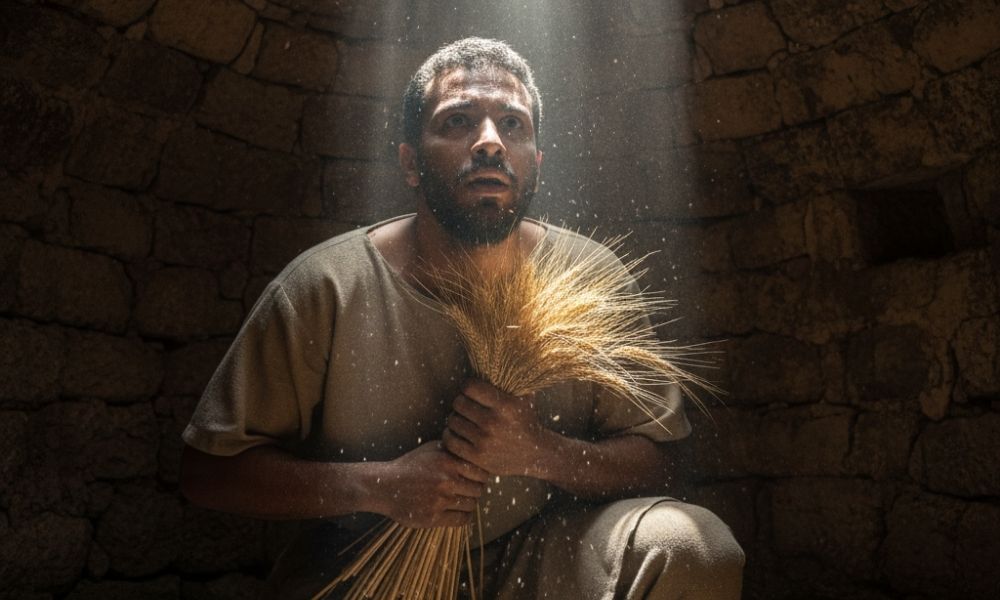
Judges 6 introduces one of Israel’s most famous judges, Gideon. The chapter follows the familiar cycle: Israel does evil, God hands them over to the Midianites, and the people cry out for help. Unlike previous accounts, God first sends a prophet to explain why they are suffering (idolatry) before sending a deliverer. The Angel of the Lord then appears to Gideon, a fearful man hiding in a winepress, and commissions him as a “mighty man of valor.” The chapter chronicles Gideon’s journey from skepticism to faith, marked by the destruction of his father’s idol and the famous test of the fleece, demonstrating God’s patience with human doubt.
1. The Midianite Oppression (Judges 6:1–10 ESV)
The people of Israel did what was evil in the sight of the Lord, and the Lord gave them into the hand of Midian seven years. … And Israel was brought very low because of Midian. … [God sends a prophet:] “…‘I led you up from Egypt and brought you out of the house of slavery. … And I said to you, “I am the Lord your God; you shall not fear the gods of the Amorites in whose land you dwell.” But you have not obeyed my voice.’”
Commentary:
- The Nature of the Threat: Unlike the Philistines (who occupied) or the Moabites (who taxed), the Midianites were nomadic raiders. They swarmed like “locusts” during harvest time, stripping the land of food and livestock. This forced the Israelites into caves and dens, dehumanizing them.
- “Brought Very Low”: The Hebrew text suggests they were drained of resources and spirit. The oppression was total—economic, physical, and psychological.
- The Nameless Prophet: Before God provides a savior, He provides a sermon. Verses 7–10 introduce a prophet who acts as a covenant prosecutor.
- The Diagnosis: The prophet does not offer a solution but clarifies the problem. The suffering is not because Yahweh is weak, but because Israel is disobedient. They feared the Amorite gods rather than obeying Yahweh.
- Insight: Repentance must be based on truth. God ensures they understand the reason for their distress before He intervenes.
2. The Call of Gideon (Judges 6:11–16 ESV)
Now the angel of the Lord came and sat under the terebinth at Ophrah… while Gideon his son was beating out wheat in the winepress to hide it from the Midianites. And the angel of the Lord appeared to him and said to him, “The Lord is with you, O mighty man of valor.” And Gideon said to him, “Please, my lord, if the Lord is with us, why then has all this happened to us? … But now the Lord has forsaken us…” And the Lord turned to him and said, “Go in this might of yours and save Israel from the hand of Midian; do not I send you?”
Commentary:
- The Setting (Irony): Gideon is threshing wheat in a winepress. Wheat is usually threshed on a hill to catch the breeze; a winepress is a sunken pit. Gideon is hiding, acting out of fear, yet the Angel calls him a “mighty man of valor.”
- God’s Perspective: God defines Gideon not by his present fear, but by his future potential under God’s hand.
- Gideon’s Complaint: Gideon is honest and cynical. He knows the theology (the Exodus miracles) but cannot reconcile it with his reality (Midianite oppression). He concludes God has “forsaken” them.
- The Commission: The Lord (the text shifts from “Angel of the Lord” to “The Lord”) does not argue with Gideon’s complaint. Instead, He redirects him: “Go in this might of yours.”
- “This Might”: What might? Perhaps the strength of his honesty, or simply the strength of the commission itself. The power lies in the sender (“do not I send you?”).
- Gideon’s Excuse: Gideon pleads insignificance—his clan is the weakest in Manasseh, and he is the least in his father’s house. God responds with the ultimate assurance: “I will be with you.”
3. The Sign of the Altar (Judges 6:17–24 ESV)
And he said to him, “If now I have found favor in your eyes, then show me a sign that it is you who speak with me. …” [Gideon prepares a meal. The Angel touches the meat and unleavened cakes with his staff.] …and fire sprang up from the rock and consumed the flesh and the unleavened cakes. And the angel of the Lord vanished from his sight. Then Gideon perceived that he was the angel of the Lord. … And the Lord said to him, “Peace be to you. Do not fear; you shall not die.” Then Gideon built an altar there to the Lord and called it The Lord Is Peace.
Commentary:
- Seeking Validation: Gideon asks for a sign, not out of rebellion, but to verify the identity of the messenger. This is a recurring theme—Gideon requires assurance.
- The Offering: Gideon brings a “present” (Minchah), which functions as a hospitality meal and a sacrificial offering. The quantity (an ephah of flour) is significant, showing generosity despite the famine.
- The Miracle: The fire from the rock validates the divine nature of the guest. It accepts the offering.
- The Terror of Holiness: Realizing he has seen God (or His Angel) face-to-face, Gideon fears death. This reaction is typical in the Old Testament (Exodus 33:20).
- Jehovah-Shalom: God speaks peace to his panic. Gideon names the altar Yahweh-Shalom (The Lord is Peace). Crucially, he finds peace before the battle is won. Peace is found in God’s relationship, not just the absence of conflict.
4. Tearing Down Baal’s Altar (Judges 6:25–32 ESV)
That night the Lord said to him, “Take your father’s bull… and pull down the altar of Baal that your father has, and cut down the Asherah that is beside it and build an altar to the Lord your God… So Gideon took ten men of his servants and did as the Lord had told him. But because he was too afraid of his family and the men of the town to do it by day, he did it by night. …And Joash said to all who stood against him, “Will you contend for Baal? … If he is a god, let him contend for himself, because his altar has been broken down.” Therefore on that day Gideon was called Jerubbaal…
Commentary:
- Public Obedience: Private worship (the previous altar) must lead to public action. Before delivering the nation, Gideon must clean up his own house.
- Syncretism: Gideon’s father, Joash, had an altar to Baal and an Asherah pole. The community was hedging its bets, worshipping Yahweh and Canaanite fertility gods simultaneously.
- Fearful Obedience: Gideon obeys, but “by night” because of fear. The text is realistic about his character—he is faithful, but he is not yet fearless.
- Joash’s Defense: The townspeople want to kill Gideon. Surprisingly, his father Joash defends him with logic: If Baal is a real god, he doesn’t need humans to fight his battles.
- Jerubbaal: Gideon earns a new name, meaning “Let Baal contend against him.” It stands as a mocking challenge to the impotence of idols.
5. The Spirit and the Fleece (Judges 6:33–40 ESV)
Now all the Midianites and the Amalekites and the people of the East came together… But the Spirit of the Lord clothed Gideon, and he sounded the trumpet… Then Gideon said to God, “If you will save Israel by my hand, as you have said, behold, I am laying a fleece of wool on the threshing floor. If there is dew on the fleece alone, and it is dry on all the ground, then I shall know…” And it was so. … Then Gideon said to God, “Let not your anger burn against me; let me speak just once more. Please let me test just once more with the fleece. Please let it be dry on the fleece only, and on all the ground let there be dew.” And God did so that night…
Commentary:
- Divine Empowerment: The “Spirit of the Lord clothed Gideon” (literally “put on Gideon like a glove”). The victory will be accomplished by the Spirit, not human military prowess.
- The Trumpet: Gideon blows the trumpet, and the Abiezrites (his clan who tried to kill him earlier) rally to him. This is a miracle of leadership renewal.
- The Fleece Test: Gideon asks for a sign after the Spirit has already come upon him. This indicates that the Spirit’s presence does not immediately eliminate all human doubt.
- The Nature of the Sign:
- First Night: Wet fleece, dry ground (supernatural concentration of dew).
- Second Night: Dry fleece, wet ground (supernatural repulsion of dew).
- God’s Patience: God does not rebuke Gideon for his “fleecing.” He condescends to Gideon’s weakness. This is not a precedent for “testing God” in unbelief, but an example of God assuring a struggling believer who wants to obey but is battling fear.
- Reversal: The manipulation of dew (a symbol of fertility usually attributed to Baal) demonstrates Yahweh’s absolute control over nature.
Theological Significance of Judges 6
- The Weakness of the Agent: God consistently chooses the weak things of the world to shame the strong. Gideon is the youngest of the weakest clan, hiding in a pit, yet he is God’s “mighty man.”
- Peace in Conflict: The revelation of Yahweh-Shalom occurs in the context of impending war. Biblical peace is wholeness and reconciliation with God, which sustains believers even in battle.
- Idolatry vs. Covenant: The chapter exposes the futility of Baal worship. The “gods” cannot even protect their own altars.
- Divine Patience: The narrative highlights God’s extraordinary patience with Gideon’s repeated requests for assurance (the meal, the first fleece, the second fleece).
Practical Applications
- Confront Private Sin: Like Gideon tearing down his father’s altar, we must remove “idols” in our own lives before we can be effective in public ministry.
- Obey Despite Fear: Courage is not the absence of fear; it is obeying God while you are afraid. Gideon worked at night because he was scared, but he still did the work.
- God Defines You: Do not define yourself by your circumstances (hiding in a winepress) or your background (least in the family). Define yourself by what God says about you (“Mighty man of valor”).
- Assurance is Available: If you struggle with doubt, it is permissible to ask God for reassurance and confirmation from His Word and Spirit. He is patient with those who seek to do His will.
Final Insight
Judges 6 is a masterclass on transformation. It begins with a man hiding in a hole and ends with a man clothed in the Spirit of God. The bridge between the two is the patient, reassuring presence of the Lord, who takes us as we are but loves us too much to leave us that way.







Leave a Reply