
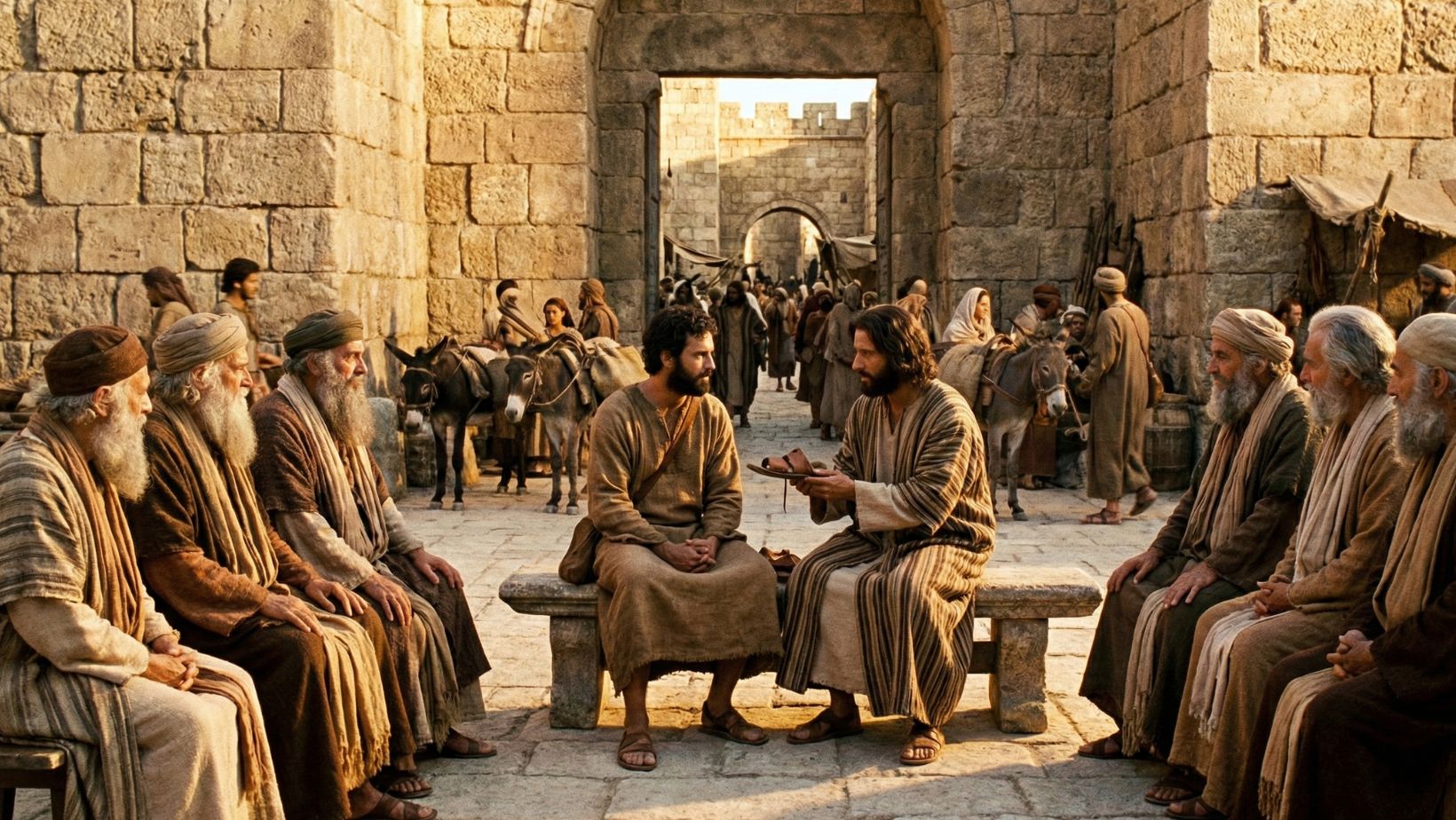
Ruth 4 serves as the grand resolution to the narrative. The scene shifts to the public square—the town gate—where Boaz expertly navigates the complex legal system to redeem Ruth and Naomi. The “Closer Kinsman” declines the right of redemption when he realizes the cost involved, clearing the way for Boaz. The marriage takes place, resulting in the birth of a son, Obed. This birth reverses Naomi’s emptiness from Chapter 1, and the book concludes with a genealogy that connects this humble family story to the future King David, placing these events at the heart of redemptive history.
1. The Legal Showdown at the Gate (Ruth 4:1–6 NLT)
1 Boaz went to the town gate and took a seat there. Just then the family redeemer he had mentioned came by, so Boaz called out to him, “Come over here and sit down, friend. I want to talk to you.” So they sat down together. 2 Then Boaz called ten leaders from the town and asked them to sit as witnesses. 3 And Boaz said to the family redeemer, “You know Naomi, who has returned from Moab. She is selling the land that belonged to our relative Elimelech. 4 I thought I should speak to you about it so that you can redeem it if you wish. If you want the land, then buy it here in the presence of these witnesses. But if you don’t want it, let me know right away, because I am next in line to redeem it after you.” The man replied, “All right, I’ll redeem it.” 5 Then Boaz told him, “Of course, your purchase of the land from Naomi also requires that you marry Ruth the Moabite widow. That way she can have children who will carry on her husband’s name and keep the land in the family.” 6 “Then I can’t redeem it,” the family redeemer replied, “because this might endanger my own estate. You redeem the land; I cannot do it.”
Commentary:
- The Town Gate (v. 1): In ancient Israel, the city gate was the equivalent of a courthouse, city hall, and marketplace rolled into one. It was where legal business was transacted publicly.
- “Friend” (v. 1): Boaz calls the man over. The Hebrew phrase used here is Peloni Almoni (roughly “So-and-so” or “Mr. What’s-his-name”). The narrator deliberately omits the man’s name, likely because the man refused to raise up a name for his deceased relative. He is anonymous because he chose self-preservation over covenant duty.
- The Jury (v. 2): Boaz assembles ten elders to ensure the transaction is legally binding and indisputable.
- The Bait (v. 3-4): Boaz shrewdly presents the easy part of the deal first: land. In an agrarian society, acquiring more land was highly desirable. The kinsman immediately agrees (“I’ll redeem it”), thinking he is merely expanding his property portfolio.
- The Hook (v. 5): Boaz reveals the “fine print.” This is a package deal. To redeem the land, one must also marry the widow (Ruth) to raise an heir for the deceased (Mahlon).
- The Reversal (v. 6): The kinsman realizes that if he has a son with Ruth, that son would legally belong to Mahlon’s line, not his own. The land he bought would eventually pass to this son, not his other children. Therefore, he would lose money on the purchase (“endanger my own estate”). He withdraws, prioritizing his wallet over his family duty.
2. The Sandal Ceremony (Ruth 4:7–12 NLT)
7 Now in those days it was the custom in Israel for anyone transferring a right of purchase to remove his sandal and hand it to the other party. This publicly validated the transaction. 8 So the other family redeemer drew off his sandal as he said to Boaz, “You buy the land.” 9 Then Boaz said to the elders and to the crowd standing around, “You are witnesses that today I have bought from Naomi all the property of Elimelech, Kilion, and Mahlon. 10 And with the land I have acquired Ruth, the Moabite widow of Mahlon, to be my wife. This way she can have a son to carry on the family name of her dead husband and to inherit the family property here in his hometown. You are all witnesses today.” 11 Then the elders and all the people standing in the gate replied, “We are witnesses! May the Lord make this woman who is coming into your home like Rachel and Leah, from whom all the nation of Israel descended! May you prosper in Ephrathah and be famous in Bethlehem. 12 And may the Lord give you descendants by this young woman who will be like those of our ancestor Perez, the son of Tamar and Judah.”
Commentary:
- The Sandal Custom (v. 7-8): Based on Deuteronomy 25, removing a sandal symbolized the transfer of rights. By handing over his shoe, the closer kinsman was walking away from his right to tread on that land, handing authority to Boaz.
- Public Declaration (v. 9-10): Boaz is explicit. He is redeeming everything—the people and the property. He states his motive clearly: “to carry on the family name of her dead husband.” This is pure selfless love (hesed), as Boaz is using his wealth to build a legacy that technically belongs to another.
- The Blessing (v. 11): The witnesses pronounce a blessing comparing Ruth (a Moabite!) to Rachel and Leah, the matriarchs who built the house of Israel. This is total acceptance of the foreigner into the covenant community.
- Reference to Perez (v. 12): The elders reference Perez, the son of Judah and Tamar (Genesis 38).
- Parallel: Tamar was also a foreign woman who fought for her rights within the family line when the men failed to do their duty. The blessing acknowledges that God often works through unexpected, messy lineages.
3. Restoration and Birth (Ruth 4:13–17 NLT)
13 So Boaz took Ruth into his home, and she became his wife. When he slept with her, the Lord enabled her to become pregnant, and she gave birth to a son. 14 Then the women of the town said to Naomi, “Praise the Lord, who has now provided a redeemer for your family! May this child be famous in Israel. 15 May he restore your youth and care for you in your old age. For he is the son of your daughter-in-law who loves you and has been better to you than seven sons!” 16 Naomi took the baby and cuddled him to her breast. And she cared for him as if he were her own. 17 The neighbor women said, “Now at last Naomi has a son again!” And they named him Obed. He became the father of Jesse and the grandfather of David.
Commentary:
- Divine Conception (v. 13): The text explicitly states, “the Lord enabled her to become pregnant.” After ten years of barrenness in Moab (Ruth 1:4), God opens her womb. This confirms God’s favor.
- Naomi’s Fullness (v. 14): The focus shifts back to Naomi. The women of Bethlehem, who saw her return “empty” in Chapter 1, now declare that the Lord has not left her without a redeemer.
- Better than Seven Sons (v. 15): In Hebrew culture, sons were the ultimate security. “Seven sons” represented the perfect family. The women declare that Ruth—a daughter-in-law—is worth more than the perfect family. This is a radical elevation of Ruth’s worth.
- Obed (v. 17): The child is named Obed, meaning “Servant” or “Worshiper.” He serves as the restorer of life to Naomi.
- The Adoption (v. 16): Naomi nursing/holding the child symbolizes her legal adoption of the boy as her heir. The line of Elimelech is saved.
4. The Royal Genealogy (Ruth 4:18–22 NLT)
18 This is the genealogical record of their ancestor Perez: Perez was the father of Hezron. 19 Hezron was the father of Ram. Ram was the father of Amminadab. 20 Amminadab was the father of Nahshon. Nahshon was the father of Salmon. 21 Salmon was the father of Boaz. Boaz was the father of Obed. 22 Obed was the father of Jesse. And Jesse was the father of David.
Commentary:
- The Bridge: This genealogy bridges the era of the Judges (chaos) to the era of the Kings (order).
- The Surprise: The book ends with the word “David.” For the original Hebrew audience, this was the climax. It revealed that the great King David did not come from pure blue-blood aristocracy, but from a family marked by famine, loss, and a faithful Moabite convert.
- Matthew 1 Connection: This genealogy is repeated in Matthew 1:3-6, listing Boaz and Ruth as ancestors of Jesus Christ.
Theological Significance of Ruth 4
- The Cost of Redemption: Redemption is not free. It cost Boaz money (buying the land) and required him to share his inheritance. This points to Christ, the ultimate Kinsman-Redeemer, who paid a much higher price to redeem His bride (the Church).
- God Uses the Outsider: The inclusion of Ruth in the line of David (and Jesus) destroys Jewish ethnocentrism. It shows that God’s covenant is based on faith, not just bloodline.
- Reversal of Fortune: The book creates a perfect inclusio (brackets). It started with famine, death, and emptiness. It ends with harvest, birth, and fullness. God is the God of restoration.
Practical Applications
- Legacy over Convenience: The “Closer Kinsman” chose financial safety and is forgotten by history (nameless). Boaz chose sacrificial love and is remembered forever in the lineage of the Messiah. Our sacrifices for others build our true legacy.
- God in the Ordinary: There are no parted seas or burning bushes in Ruth. God works through laws, marriages, conversations at gates, and babies being born. We should look for God’s hand in the ordinary administrative details of life.
- Community Matters: The elders, the witnesses, and the women of the town all played a role in validating and celebrating this redemption. Faith is lived out in community.
Final Insight
Ruth 4 is the “happily ever after,” but it is grounded in legal grit and sacrificial love. It proves that no life is too shattered for God to redeem. The emptiness of a widow in Moab becomes the womb that brings forth the King of Israel.







Leave a Reply