
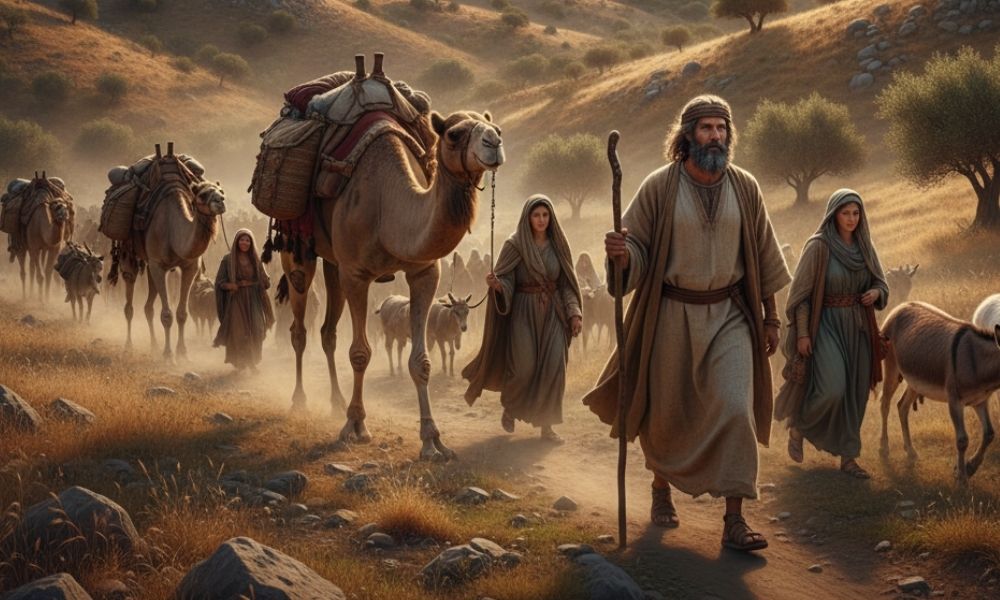
Abram’s journey to Canaan marks the first great step of faith in the biblical story of God’s covenant people. Obeying God’s command, Abram left his homeland and traveled to the land that God promised to show him – Canaan. This act of obedience became a powerful symbol of faith, trust, and the beginning of God’s redemptive plan for all nations.
Quick Facts
Name: Abram (later Abraham, “father of many nations”)
Event: Abram’s journey from Haran to Canaan
Scripture: Genesis 12:4–9
Location: From Haran (in Mesopotamia) to Canaan (modern-day Israel/Palestine)
Approx. Date: Early 2nd millennium BCE
Key Figures: Abram, Sarai, Lot
Distance Traveled: About 400–500 miles (640–800 km)
Symbol: The journey of faith and obedience
Name Meaning
Abram means “exalted father,” a name that foreshadows God’s promise to make him the ancestor of a great nation. His faith-filled journey gives life to the meaning of his name.
Biblical Account (Genesis 12:4–9)
When God commanded Abram to go “to the land I will show you,” he immediately obeyed. At age 75, Abram left Haran, taking his wife Sarai, his nephew Lot, and all their possessions. They traveled through the land of Canaan, stopping at key sites where Abram built altars to worship the Lord.
- At Shechem, God appeared to Abram and said, “To your offspring I will give this land.” Abram built an altar there (Genesis 12:7).
- From there, he moved to Bethel, pitched his tent, and again built an altar, calling on the name of the LORD (Genesis 12:8).
- Finally, he journeyed south toward the Negev, continuing to follow God’s leading.
Key Themes & Lessons
1. Faith and Obedience:
Abram’s willingness to leave his home without knowing his destination (Hebrews 11:8) exemplifies complete trust in God’s word.
2. God’s Promise of Land and Descendants:
Canaan was the physical sign of God’s covenant promise — that Abram’s descendants would inherit the land and become a great nation.
3. Worship and Devotion:
At every stop, Abram built an altar — symbolizing gratitude, dependence, and the establishment of God’s presence in a new land.
4. Journey as a Spiritual Symbol:
Abram’s physical journey represents the spiritual journey of believers — leaving behind the old life and walking by faith toward God’s promises.
Historical & Geographical Context
Abram’s route likely followed the Fertile Crescent, passing through well-traveled trade paths along the Euphrates River before turning south into Canaan.
- Haran: A city in northern Mesopotamia where Abram’s father, Terah, had settled.
- Shechem: Central Canaan, an important site for Israel’s later history.
- Bethel: A future place of worship and divine encounter for Jacob.
- Negev: The southern region of Canaan, symbolizing Abram’s full entry into the promised territory.
Symbolism / Typology
- Journey of Faith: Represents the believer’s pilgrimage toward God’s promise.
- Altars: Symbolize worship, covenant, and communion with God.
- Canaan: A foreshadowing of the ultimate “Promised Land” — eternal life with God.
Legacy & Impact
Abram’s obedience established him as the father of faith and the model of righteousness by belief (Romans 4:3). His journey became the beginning of Israel’s history and the channel through which God’s blessing would come to all nations through Christ.
“By faith Abraham obeyed when he was called to go out… not knowing where he was going.” — Hebrews 11:8







Leave a Reply