
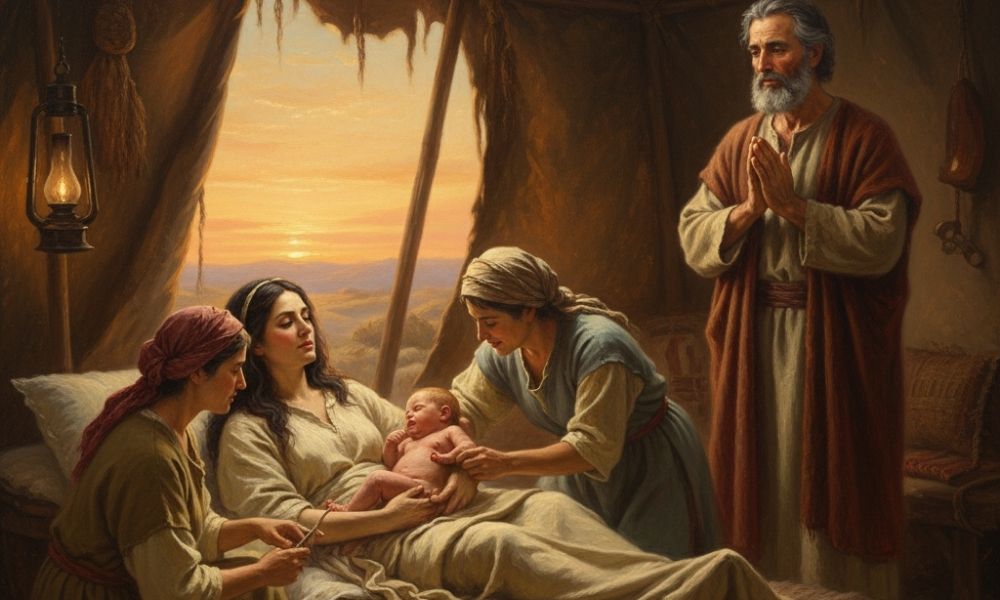
The birth of Jacob and Esau marks a pivotal moment in the unfolding of God’s covenant promises to Abraham and Isaac. Their story reveals God’s sovereign choice and divine purpose even before their birth — that His plan would continue through Jacob, the younger twin. Born to Isaac and Rebekah after years of barrenness, Jacob and Esau represent two nations and two destinies, one chosen for covenant blessing and the other for worldly strength.
Event: Birth of Jacob and Esau
Parents: Isaac and Rebekah
Location: Canaan
Scriptural Reference: Genesis 25:19–26
Themes: Divine sovereignty, prayer, purpose, family conflict, covenant continuation
Symbols: Twins — representing contrast and divine election
Rebekah’s Barrenness and Isaac’s Prayer
Just as Sarah before her, Rebekah was barren. Isaac, showing faith in God’s promise, prayed earnestly on her behalf. God heard his prayer and granted conception — a direct sign of divine mercy and covenant faithfulness.
“Isaac prayed to the LORD on behalf of his wife, because she was childless. The LORD answered his prayer, and his wife Rebekah became pregnant.”
(Genesis 25:21)
The Struggle Within the Womb
Rebekah’s pregnancy was unusually difficult; she sensed turmoil within her and sought the LORD for understanding. God revealed a profound prophecy:
“Two nations are in your womb, and two peoples from within you will be separated; one people will be stronger than the other, and the older will serve the younger.”
(Genesis 25:23)
This divine declaration foretold that Jacob, the younger son, would carry the covenant blessing, and Esau, the elder, would become a separate nation — Edom.
The Birth of the Twins
When the time came to give birth, the first twin emerged red and hairy, and they named him Esau, meaning “hairy.” Soon after, his brother followed, grasping Esau’s heel — a striking image that inspired his name Jacob, meaning “he grasps the heel” or “supplanter.”
“After this, his brother came out, with his hand grasping Esau’s heel; so he was named Jacob.”
(Genesis 25:26)
Isaac was sixty years old when Rebekah gave birth, fulfilling God’s promise of descendants through him.
Character and Contrast
As the boys grew, their differences deepened:
- Esau became a skillful hunter and man of the open country — impulsive, passionate, and earthly-minded.
- Jacob was quiet and thoughtful, dwelling among the tents — reflective, patient, and spiritually attuned.
This contrast foreshadowed their lifelong conflict and the distinction between worldly strength and spiritual calling.
Symbolism and Meaning
- The Twins: Represent two nations — Israel (Jacob) and Edom (Esau).
- The Heel: Symbolizes Jacob’s determination and destiny to overtake his brother.
- Rebekah’s Prayer: Highlights God’s responsiveness and sovereignty.
- Divine Choice: Shows that God’s plan depends on His will, not human order or tradition.
Key Verse
Genesis 25:23 (NIV)
“The LORD said to her, ‘Two nations are in your womb, and two peoples from within you will be separated; one people will be stronger than the other, and the older will serve the younger.’”
Legacy
Jacob and Esau’s birth set the stage for a story of conflict, reconciliation, and destiny. Through Jacob, the line of promise continued, leading to the twelve tribes of Israel and, ultimately, the Messiah. Their story reminds us that God’s purposes prevail — not by human strength or position, but by His divine will.







Leave a Reply