
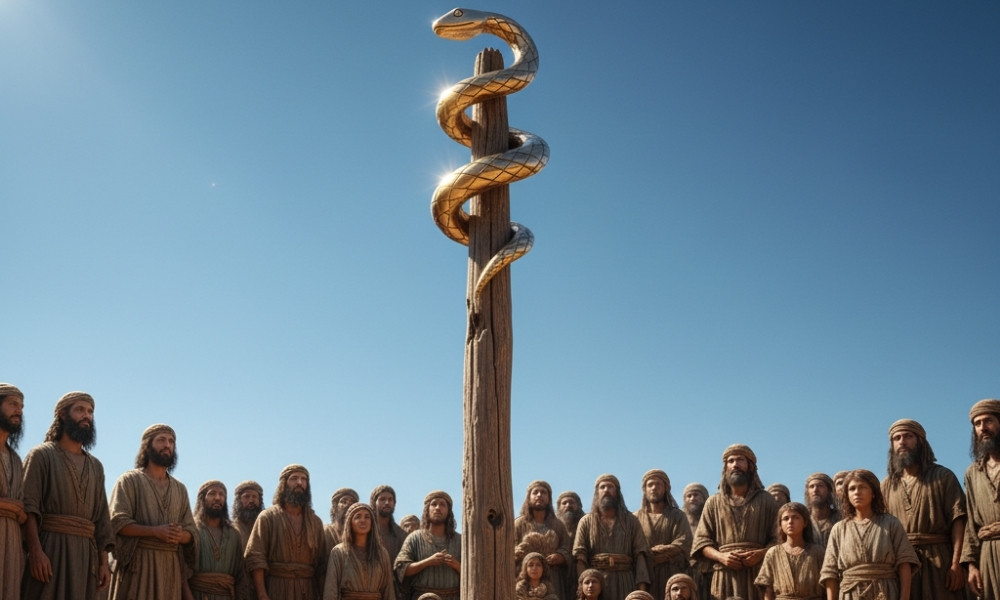
The account of the Bronze Serpent is one of the most enigmatic and profound episodes in the Torah. It presents a jarring paradox: the very creature that brought death is used as the symbol of life. Occurring near the end of the wilderness wanderings, this event addresses the “stubborn root” of Israel’s sin—ingratitude. It serves as a powerful theological pivot, moving from the concept of salvation through doing (law) to salvation through looking (faith). It is also the specific Old Testament story Jesus chose to explain His own mission to Nicodemus, cementing its status as the ultimate foreshadowing of the Cross.
- Object: The Bronze Serpent (Hebrew: Nehushtan)
- Scripture: Numbers 21:4–9
- New Testament Reference: John 3:14–15
- Location: The route around Edom (The Arabah)
- The Sin: Rejecting God’s provision (“We loathe this worthless food”)
- The Judgment: “Fiery serpents” (Seraphim)
- The Cure: Looking at the raised bronze figure
- Key Theme: Salvation through faith/vision, not works
- Symbol: The Snake on a Pole (precursor to the Caduceus/Asclepius medical symbols, though distinct in meaning)
Biblical Era / Context
Time: ~1406 BCE (The 40th year of wandering). The Setting: The Israelites were forced to take a long detour because Edom refused them passage. The text says the “soul of the people became impatient” (Numbers 21:4). The Provocation: The people did not just complain about thirst; they attacked the Manna. They called the bread of angels “worthless food.” This was a direct rejection of God’s grace.
The Narrative Arc
1. The Plague of Fire: God sent “fiery serpents” among the people. The Hebrew word is Seraphim (burning ones), likely referring to the burning sensation of the venom or the inflammation caused by the bite. Many Israelites died.
2. The Confession: For the first time in the wilderness narratives, the people come to Moses and explicitly admit guilt without making excuses: “We have sinned, for we have spoken against the LORD and against you” (Numbers 21:7).
3. The Strange Remedy: God did not remove the snakes immediately. Instead, He provided a way to survive amidst them. He commanded Moses to make a fiery serpent out of bronze and set it on a pole.
4. The Act of Faith: “And if a serpent bit anyone, he would look at the bronze serpent and live.” The cure required no medicine, no surgery, and no good works. It required a specific orientation of the head and eyes—a look of reliance on God’s word.
Typology / Symbolism (The Jesus Connection)
This is the definitive “Type” of the Crucifixion. Jesus makes the connection explicit in John 3:14: “As Moses lifted up the serpent in the wilderness, so must the Son of Man be lifted up.”
Why a Snake? Snakes usually represent Satan, sin, and the curse. Why would Christ be compared to a snake?
- The Theology of Imputation: On the Cross, Jesus “became sin” for us (2 Corinthians 5:21). He took the form of the thing that was killing the people. The bronze serpent was a snake, but it had no venom. Jesus was a man, but He had no sin.
- Judgment Arrested: Bronze is the metal of judgment in the Bible (the bronze altar). A bronze snake represents judgment already judged.
The Upward Look: The physical act of looking away from one’s wound and toward the pole represents faith.
- Looking at the wound = introspection and despair.
- Looking at the pole = dependence on God’s finished work.
Historical Aftermath: The Idol Nehushtan
The story has a fascinating and tragic epilogue. The Israelites kept this bronze artifact for centuries as a relic. Eventually, they began to burn incense to it, turning the instrument of grace into an idol.
2 Kings 18:4: King Hezekiah, during his reforms (~700 years later), broke it in pieces. He called it Nehushtan, a play on words meaning “A piece of brass” or “A bronze thing.”
- Lesson: God destroys our crutches when we worship the method rather than the Healer. Even a God-ordained instrument can become an idol if it replaces the Creator.
Key Theological Takeaways
Faith vs. Logic: Logically, looking at a statue cannot cure a neurotoxin. God often uses foolish things to confound the wise (1 Corinthians 1:27), ensuring that the glory goes to Him, not to human effort.
Proximity vs. Attention: Being near the pole didn’t save you. Knowing about the pole didn’t save you. Only looking at the pole saved you. Salvation is personal contact through faith.
The Simultaneity of Judgment and Grace: The snakes remained on the ground (judgment) while the pole was raised (grace). The believer lives in a fallen world where “snakes” still bite, but they have a remedy that neutralizes the sting of death.







Leave a Reply