
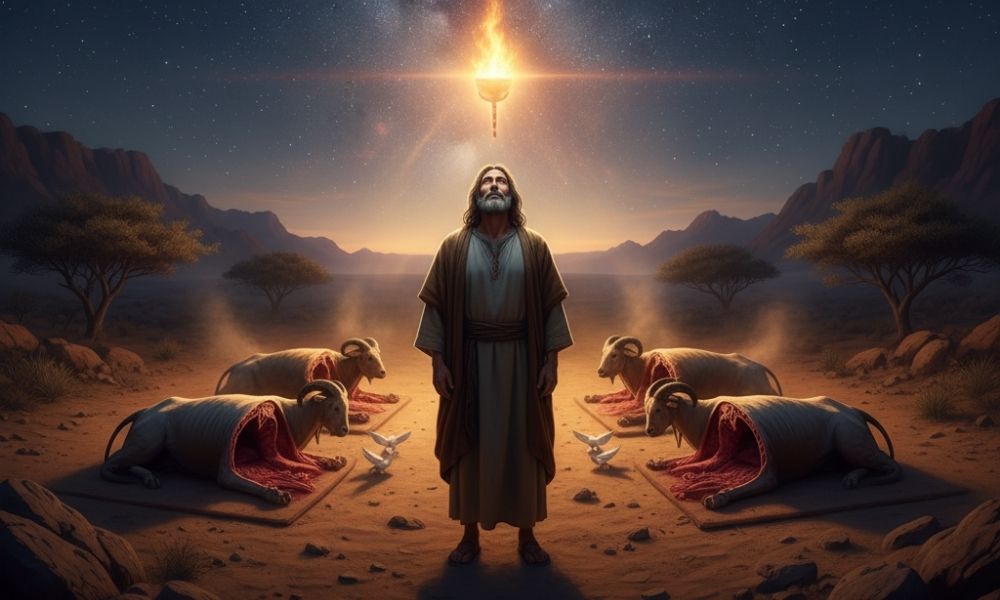
The confirmation of God’s covenant with Abram marks a defining moment in the story of faith. After Abram obeyed God and journeyed to Canaan, the Lord reaffirmed His promises with a solemn covenant—pledging land, descendants, and blessing. This divine agreement reveals God’s unchanging faithfulness and establishes Abram as the father of all who live by faith.
Quick Facts
Name: Abram (later Abraham, meaning “father of many nations”)
Event: God confirms His covenant with Abram
Scripture: Genesis 15; Genesis 17
Location: Canaan
Key Figures: Abram, Sarai, God
Promise: Descendants as numerous as the stars and the land of Canaan
Sign: Covenant sacrifice (Genesis 15) and later circumcision (Genesis 17)
Symbol: Stars and land—God’s faithfulness to His promises
Name Meaning
Abram means “exalted father.” God later changed his name to Abraham, meaning “father of many nations,” to reflect the fulfillment of His promise (Genesis 17:5).
Biblical Context
Years after Abram first entered Canaan, he still had no child. Yet God appeared to him in a vision, reassuring him of the promise:
“Do not be afraid, Abram. I am your shield, your very great reward.” — Genesis 15:1
Abram believed God’s word, and his faith was “credited to him as righteousness” (Genesis 15:6), a central truth later echoed throughout Scripture (Romans 4:3; Galatians 3:6).
The Covenant Ceremony (Genesis 15)
God commanded Abram to prepare a sacrifice of animals—a heifer, goat, ram, dove, and pigeon—cut in two and arranged opposite each other. As Abram fell into a deep sleep, a smoking firepot and blazing torch passed between the pieces, symbolizing God’s presence.
This act sealed the unconditional covenant:
“To your descendants I give this land, from the river of Egypt to the great river, the Euphrates.” — Genesis 15:18
It was a divine promise independent of human effort—God Himself took full responsibility for its fulfillment.
Covenant Renewed (Genesis 17)
Later, God appeared again and renewed His covenant, changing Abram’s name to Abraham and instituting circumcision as the sign of the covenant.
“I will establish My covenant as an everlasting covenant between Me and you and your descendants after you.” — Genesis 17:7
He also changed Sarai’s name to Sarah, promising that she would bear a son—Isaac, the child of promise.
Key Themes & Lessons
1. Faith Credited as Righteousness:
Abram’s belief in God’s word—not his works—made him righteous before God (Genesis 15:6).
2. God’s Faithfulness:
Despite Abram’s old age and human impossibility, God’s word remained certain.
3. Covenant Grace:
God alone passed through the sacrifice, showing His covenant was based on divine grace, not human merit.
4. Everlasting Promise:
The covenant looked forward to the New Covenant in Christ, the ultimate fulfillment of God’s promise to bless all nations through Abraham’s seed (Galatians 3:16).
Symbolism / Typology
- Stars: Represent Abram’s innumerable descendants by faith.
- Sacrifice & Fire: God’s holy presence sealing His promise.
- Circumcision: Sign of belonging to the covenant people.
- Faith: The pathway to righteousness in every generation.
Legacy & Impact
The covenant with Abram became the foundation of Israel’s identity and the pattern of salvation by faith for all believers. Through Abraham’s lineage came Jesus Christ, the ultimate heir of the promise.
“If you belong to Christ, then you are Abraham’s seed, and heirs according to the promise.” — Galatians 3:29
God’s covenant with Abram thus points to His unchanging plan—to redeem and bless the world through faith and obedience to His promises.







Leave a Reply