
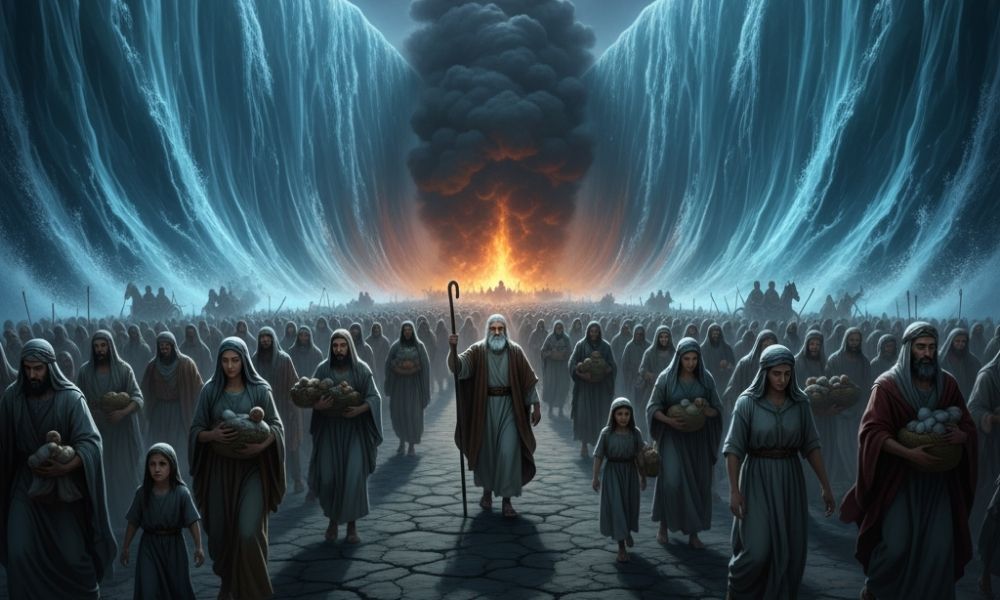
The crossing of the Red Sea is one of the most dramatic and defining miracles in all of Scripture. It marks the moment when God delivered Israel completely from Egypt’s power, transforming a nation of slaves into a people of freedom. Pursued by Pharaoh’s army and trapped between the sea and the soldiers, the Israelites witnessed the hand of God split the waters—turning terror into triumph and slavery into salvation.
Quick Facts
Event: God parts the Red Sea for Israel’s escape from Egypt
Key Figures: Moses, Pharaoh, the Israelites, the Egyptian army
Primary Source: Exodus 14:1–31
Era: The Exodus (c. 15th–13th century BCE)
Location: The wilderness between Egypt and the Sinai Peninsula, near the Red Sea
Consequence: The Israelites cross safely on dry ground; Pharaoh’s army is destroyed; Israel is fully delivered
Context of the Event
After the tenth plague—the death of Egypt’s firstborn—Pharaoh finally allowed Israel to leave. But soon after, his heart hardened again, and he pursued them with chariots and soldiers. Meanwhile, God led the Israelites by a pillar of cloud by day and a pillar of fire by night, showing His presence and protection.
“Then the Lord said to Moses… I will gain glory for myself through Pharaoh and all his army, and the Egyptians will know that I am the Lord.” (Exodus 14:1, 4 NIV)
When Pharaoh’s army approached, the Israelites found themselves trapped between the sea and the soldiers. Panic gripped the people, but God had already planned their deliverance.
The Miracle at the Sea
1. God’s Command
Moses told the fearful people:
“Do not be afraid. Stand firm and you will see the deliverance the Lord will bring you today.” (Exodus 14:13, NIV)
At God’s instruction, Moses stretched out his staff over the sea.
2. The Waters Divide
“Then Moses stretched out his hand over the sea, and all that night the Lord drove the sea back with a strong east wind and turned it into dry land.” (Exodus 14:21, NIV)
The waters parted, forming walls of water on both sides, and Israel crossed safely on dry ground. The pillar of cloud moved behind them, blocking the Egyptian army until Israel had crossed completely.
3. Pharaoh’s Pursuit and Judgment
As the Egyptians followed, God caused confusion among their chariots. When Moses stretched out his hand again, the waters returned, covering Pharaoh’s entire army.
“Not one of them survived.” (Exodus 14:28, NIV)
4. Israel’s Deliverance
When the Israelites saw their enemies dead on the shore, awe and faith filled their hearts.
“And when the Israelites saw the mighty hand of the Lord displayed against the Egyptians, the people feared the Lord and put their trust in Him and in Moses His servant.” (Exodus 14:31, NIV)
Key Characters
- Moses: The chosen leader and instrument of God’s power, guiding Israel in faith.
- Pharaoh: The defiant ruler whose pride led to destruction.
- The Israelites: Freed slaves who witnessed God’s salvation firsthand.
- God: The Redeemer and Warrior who demonstrates His supremacy over all earthly powers.
Major Themes
- Divine Deliverance: Salvation comes by God’s power alone—not human effort.
- Faith Over Fear: God’s people learn to trust Him even when escape seems impossible.
- Judgment and Mercy: The same sea that saved Israel destroyed Egypt’s army.
- God’s Glory Revealed: The miracle declares God’s sovereignty over nature and nations.
- Foreshadowing of Redemption: The crossing prefigures baptism and Christ’s ultimate victory over sin and death.
Key Passages
- Exodus 14:13–14 (NIV):
“Do not be afraid. Stand firm and you will see the deliverance the Lord will bring you today… The Lord will fight for you; you need only to be still.” - Exodus 14:21 (NIV):
“Then Moses stretched out his hand over the sea… and the Israelites went through the sea on dry ground, with a wall of water on their right and on their left.” - Exodus 14:31 (NIV):
“When the Israelites saw the mighty hand of the Lord… they put their trust in Him and in Moses His servant.”
Theological Significance
The crossing of the Red Sea reveals God’s power to save and His faithfulness to His covenant. It is both a historical deliverance and a spiritual symbol of redemption—freedom from bondage through divine intervention. Just as Israel passed through the waters to new life, believers today pass through the waters of baptism, leaving behind the slavery of sin and entering into the freedom of God’s salvation through Christ (1 Corinthians 10:1–2).
The event also reminds us that God’s people may face impossible situations, yet He always makes a way where there seems to be none.







Leave a Reply