
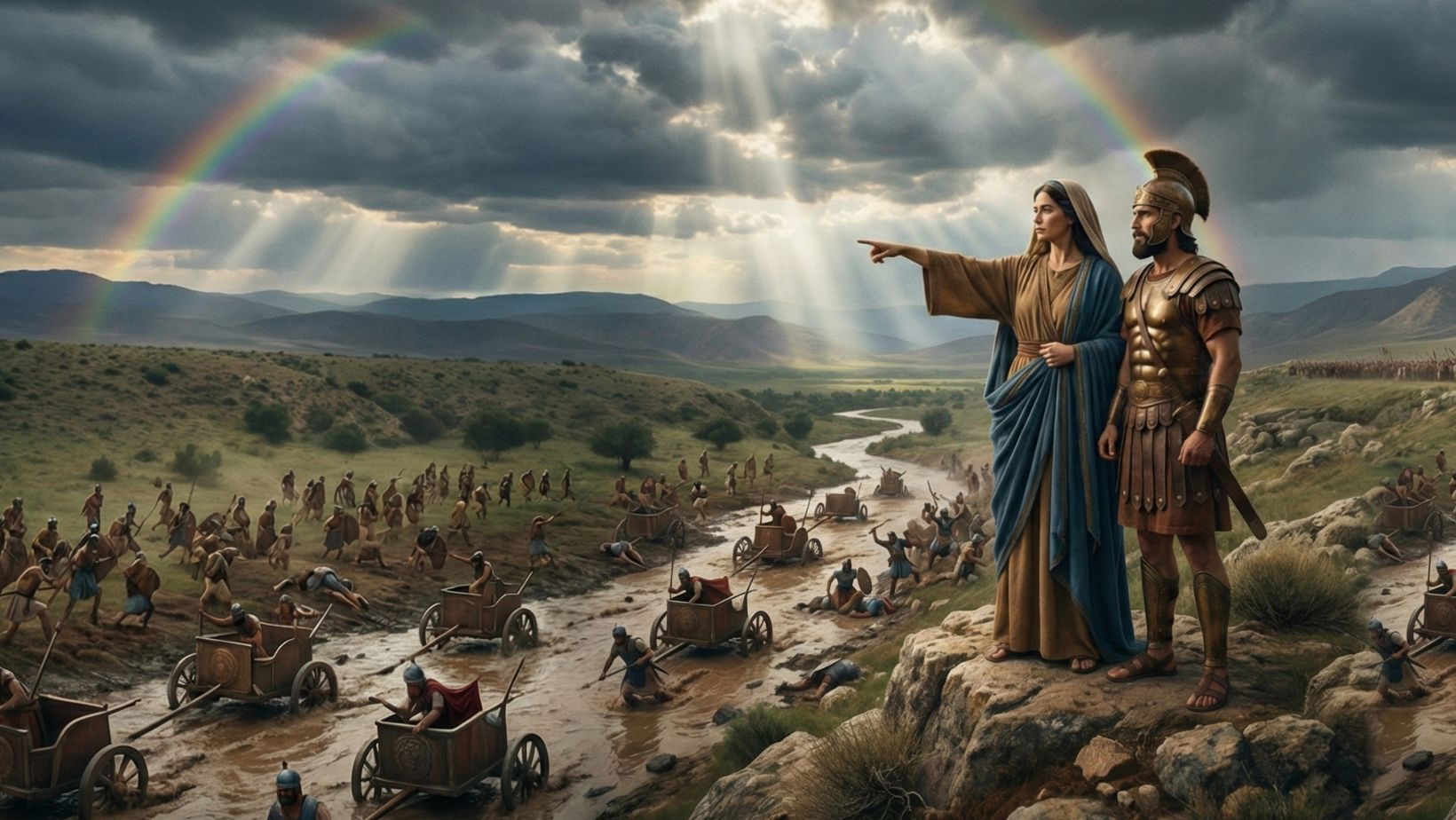
Deborah stands out as a unique and commanding figure in the Old Testament, being the only female Judge of Israel and a prophetess of great authority. Her story, recorded in Judges 4 and 5, marks a pivotal moment where spiritual insight and military strategy converged to break twenty years of Canaanite oppression. Unlike other judges who were primarily military warriors, Deborah ruled through wisdom and adjudication under a palm tree in the hill country of Ephraim. She summoned the reluctant military commander Barak to lead the charge against the fearsome General Sisera, prophesying that the ultimate glory of the victory would fall not to a man, but to a woman.
Quick Facts
- Name: Deborah (Hebrew: Dvorah)
- Title: Prophetess, Judge, “Mother in Israel”
- Tribe: Likely Ephraim or Issachar (lived in Ephraim)
- Era: Period of the Judges (~12th century BCE)
- Husband: Lappidoth
- Key Allies: Barak (General), Jael (Kenite woman)
- Enemy: Jabin (King of Canaan) and Sisera (Commander)
- Key Scripture: Judges 4–5
- Victory: Defeat of Sisera’s army at Mount Tabor and the River Kishon
Name Meaning
“Deborah” means “Bee” in Hebrew. This name suggests industry, order, and perhaps a “sting” for the enemies of God. It is also a symbol of sweetness (honey) and community.
Lineage / Family Background
Husband: She is identified as the wife of Lappidoth. (Note: “Lappidoth” means “torches” or “lightning,” leading some rabbinic traditions to suggest she was a woman of “fiery spirit” or that Lappidoth is another name for Barak, though the text treats them as separate).
Home: She lived between Ramah and Bethel in the hill country of Ephraim, a central location accessible to the tribes.
Biblical Era / Context
The Oppression: The Israelites were under the iron grip of Jabin, a Canaanite king reigning in Hazor. His commander, Sisera, terrorized the region with 900 iron chariots—ancient equivalents of tanks—making resistance seem impossible for the poorly armed Israelite hill-tribes.
Spiritual State: Israel had done “evil in the eyes of the Lord,” leading to this subjugation. Deborah arose during a time when village life had ceased and highways were abandoned due to fear (Judges 5:6-7).
Major Roles / Identity
The Prophetess: She received direct revelation from God regarding the timing and strategy of war.
The Judge: Before the war, she was already established as a civil leader. Israelites came to her “Palm of Deborah” to have their disputes settled, indicating she held high respect and judicial authority.
The “Mother in Israel”: A title she gave herself in her victory song (Judges 5:7), signifying her protective, nurturing, and guiding role over the fractured tribes.
Key Character Traits
Decisiveness: She recognized the moment God ordained for victory and acted immediately.
Courage: She accompanied the army into the battle zone, providing spiritual morale when the military commander (Barak) hesitated.
Authority: She commanded a general (Barak) and rebuked tribes that failed to join the fight (Judges 5:15-17).
Worshipful: She composed and sang a magnificent victory hymn, attributing all success to Yahweh.
Main Life Events
Judging Israel: Established a seat of judgment under a palm tree where people sought her counsel.
Summoning Barak: Called Barak from Kedesh-Naphtali and relayed God’s command to muster 10,000 men at Mount Tabor.
The Condition: When Barak refused to go unless she accompanied him, she agreed but prophesied, “The road you take will not lead to your glory, for the Lord will sell Sisera into the hand of a woman.”
The Battle of Mount Tabor: As Barak charged down the mountain, God threw Sisera’s army into confusion—likely aided by a flash flood of the River Kishon that rendered the iron chariots useless (Judges 5:21).
The Defeat of Sisera: While the army was destroyed, Sisera fled on foot to the tent of Jael, where he was killed, fulfilling Deborah’s prophecy.
The Song of Victory: Deborah and Barak sang a duet of praise, recounting the battle and the history of the tribes.
Major Relationships
Barak: A partnership of spiritual authority (Deborah) and military might (Barak). While Barak is listed in the “Hall of Faith” (Hebrews 11), he relied heavily on Deborah’s connection to God.
Jael: The Kenite woman who struck the final blow. Deborah praises her in Judges 5:24 as “most blessed of women.”
The Tribes: Deborah acted as a unifier, rallying Zebulun and Naphtali, while critiquing tribes like Reuben and Dan for staying home with their flocks and ships.
Notable Passages
Judges 4:9: Her prophecy to Barak — “I will surely go with you; nevertheless, the road on which you are going will not lead to your glory, for the LORD will sell Sisera into the hand of a woman.”
Judges 4:14: The command to attack — “Up! For this is the day in which the LORD has given Sisera into your hand. Does not the LORD go out before you?”
Judges 5:7: Her self-identification — “Village life ceased, it ceased in Israel, until I, Deborah, arose, arose a mother in Israel.”
Legacy & Impact
Peace: Following her victory, the land had peace for 40 years.
Women in Leadership: Deborah remains the primary biblical example of a woman exercising God-ordained political, judicial, and spiritual leadership over the entire nation of Israel.
Literary Contribution: The “Song of Deborah” (Judges 5) is considered by scholars to be one of the oldest passages of poetry in the Hebrew Bible, preserving archaic Hebrew forms and historical details.
Symbolism / Typology
The Palm Tree: Represents righteousness and stability. While reeds shake in the wind, the palm stands firm—symbolizing her unwavering faith amidst national chaos.
Iron Chariots vs. Rain: The victory symbolizes the supremacy of God over human technology. Sisera’s strength (heavy chariots) became his weakness when God sent the rain (mud).
Partnership: The Deborah-Barak dynamic illustrates the synergy between the Word of God (prophecy) and the Sword of the Lord (action).
Extra-Biblical References
Archaeology at Hazor: Excavations at Tel Hazor show a massive destruction layer dating to the 12th century BCE, consistent with the biblical account of the destruction of Jabin’s city.
Jewish Tradition: The Talmud counts Deborah as one of the seven female prophetesses of Israel.







Leave a Reply