
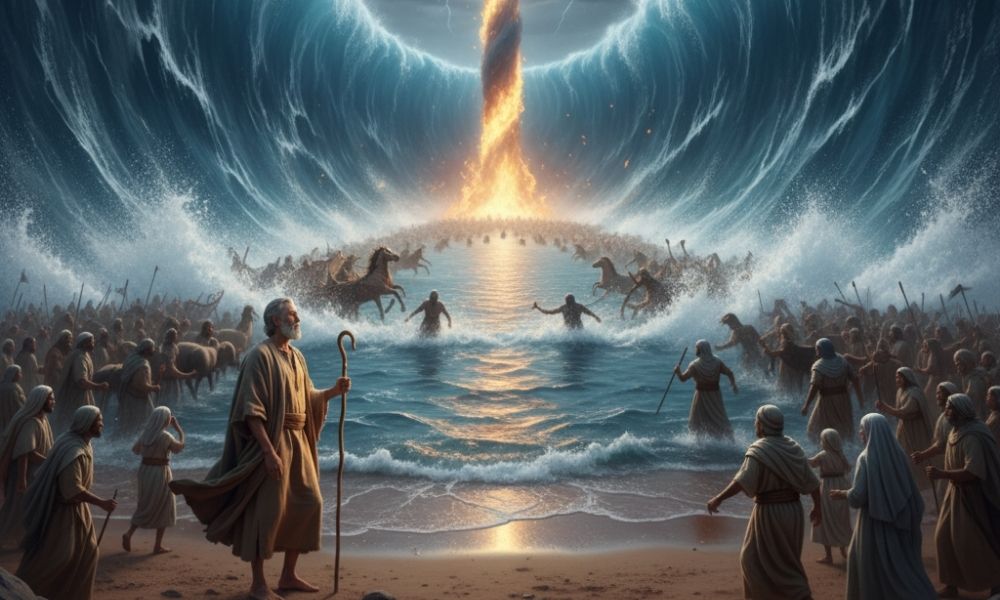
The Exodus from Egypt is the foundational redemptive event of the Old Testament and the birth of Israel as a nation. Following the tenth plague and the first Passover, the Israelites were thrust out of Egypt by a grieving Pharaoh. Led by God through Moses, this mass departure saw the miraculous deliverance of the Hebrew people from 430 years of slavery. The event culminates in the climactic parting of the Red Sea, where God definitively saved His people and destroyed their oppressors, cementing His covenant and His power.
- Event: The Exodus from Egypt
- Biblical Name: Yetziat Mitzrayim (Hebrew for “Departure from Egypt”)
- Location: From Goshen (Egypt), across the Red Sea, into the Sinai Wilderness
- Era: The Time of the Exodus (~15th–13th century BCE)
- Book: The Book of Exodus (Chapters 12–15)
- Key Figures: God, Moses, Aaron, Miriam, Pharaoh, the Israelites
- Purpose: To liberate Israel from slavery, fulfill God’s covenant with the patriarchs, and form a holy nation.
- Key Themes: Redemption, deliverance, divine power, judgment, covenant, faith
- Legacy: The birth of the nation of Israel; the giving of the Law; the Passover feast
Event Definition
The Exodus is the literal “departure” of the children of Israel from their bondage in Egypt. The event begins immediately after the Passover, as Pharaoh commands Moses to leave, and concludes with the Song of the Sea after God miraculously parts the Red Sea, allowing Israel to escape and drowning the pursuing Egyptian army.
Biblical Context
This event is the direct result of the Ten Plagues. After the devastating Death of the Firstborn, Pharaoh no longer refused to let the Israelites go; he commanded them to leave. The Exodus is the fulfillment of God’s promise to Moses at the burning bush and to the patriarchs (Abraham, Isaac, and Jacob) centuries earlier. It is the action that follows the faith of the Passover: they were “passed over” by death, and now they “pass through” the sea to new life.
Cultural / Religious Context
This event was a national catastrophe for Egypt, the world’s superpower, and a miraculous birth for Israel. The Israelites left not as a rabble of disorganized slaves, but as an organized “host” (Exodus 12:41), having “plundered” the Egyptians (who gave them gold, silver, and clothing, just as God had promised). A “mixed multitude” of non-Israelites, witnessing God’s power, also left with them (Exodus 12:38).
Key Figures Involved
- God: The divine Redeemer and Warrior, who leads Israel and personally fights for them.
- Moses: The human leader, acting as God’s mediator, who stretches out his staff to part the sea.
- The Israelites: A people (estimated at over 600,000 men, plus women and children) moving from slavery and fear to freedom and faith.
- Pharaoh and his Army: The symbols of human pride and worldly power, who defy God and are ultimately destroyed by Him.
- Miriam: Moses’ sister, who leads the women in worship after the deliverance (Exodus 15).
Key Events of the Exodus
- The Departure: On the night of the 15th of Nisan, the Israelites are rushed out of Egypt. They take their unleavened dough, their livestock, and the wealth given to them by the Egyptians.
- The Pillar of Cloud and Fire: God leads the people supernaturally. He appears as a pillar of cloud by day to guide them and a pillar of fire by night to give them light (Exodus 13:21–22).
- Pharaoh’s Hardened Heart: God hardens Pharaoh’s heart one last time, compelling him to pursue Israel with his elite chariots to “gain glory” over him.
- Trapped at the Sea: The Israelites are trapped between the Red Sea (Yam Suph, or “Sea of Reeds”) and Pharaoh’s approaching army. The people panic and cry out to Moses.
- The Parting of the Sea: God commands Moses, “Do not be afraid. Stand firm… The LORD will fight for you” (Exodus 14:13-14). Moses stretches his hand over the sea, and God drives the sea back with a strong east wind all night, turning the seabed into dry ground.
- The Crossing: The Israelites walk through the sea, with “a wall of water on their right and on their left” (Exodus 14:22).
- The Destruction of Egypt: The Egyptian army pursues them into the sea. God clogs their chariot wheels. At God’s command, Moses again stretches out his hand, and the sea returns to its normal state at dawn, drowning the entire Egyptian army.
- The Song of the Sea: After witnessing this ultimate deliverance, Moses and the people sing a song of praise (Exodus 15), and Miriam leads the women in dance, proclaiming, “Sing to the LORD, for he has triumphed gloriously; the horse and his rider he has thrown into the sea.”
Notable Passages
- Exodus 13:21–22: “And the LORD went before them by day in a pillar of cloud to lead them along the way, and by night in a pillar of fire to give them light…”
- Exodus 14:13–14: “And Moses said to the people, ‘Fear not, stand firm, and see the salvation of the LORD, which he will work for you today… The LORD will fight for you, and you have only to be silent.’”
- Exodus 14:29: “But the people of Israel walked on dry ground through the sea, the waters being a wall to them on their right hand and on their left.”
- Exodus 15:2: “The LORD is my strength and my song, and he has become my salvation; this is my God, and I will praise him…”
Legacy & Impact
- Birth of a Nation: This event transformed a tribe of slaves into a redeemed nation, bound by covenant to their deliverer, God.
- Foundation of Faith: The Exodus became the central “creed” of Israel. All future generations would look back on this event as the ultimate proof of God’s power and His unique love for them.
- The Passover Memorial: The annual Passover feast was instituted specifically to remember this event (“This is a day to be remembered… for by a strong hand the LORD brought you out of Egypt,” Exodus 13:3).
- The Law: The Exodus was the prerequisite for the giving of the Law. God first saved the people (grace) and then gave them the Law at Mount Sinai (covenant).
Symbolism / Typology
- Egypt: A symbol of sin, bondage, and the “kingdom of darkness.”
- Pharaoh: A type of Satan, the oppressor who seeks to keep God’s people in slavery.
- Moses: A type of Christ, the mediator who leads God’s people out of bondage.
- The Blood of the Lamb: (From the Passover) The propitiation that saves from death, pointing to the blood of Christ.
- The Red Sea Crossing: Universally seen as a “type” of baptism (1 Corinthians 10:1-2). It represents a death to the old life (Egypt/sin) by passing through the waters of judgment, and a resurrection to a new life of covenant with God.
Extra-Biblical References
- The Exodus story is the centerpiece of the Jewish Haggadah, the text recited during the annual Passover Seder.
- The event is referenced hundreds of times throughout the rest of the Bible (e.g., in the Psalms, by the prophets, and by New Testament writers) as the primary example of God’s saving power.
- While direct archaeological evidence of the Exodus is debated (as a migrating people would leave little trace), the Merneptah Stele (c. 1208 BCE) is an Egyptian artifact that contains the first known extra-biblical reference to the people of “Israel” as a nation in the land of Canaan, placing them in that region during the relevant historical window.







Leave a Reply