
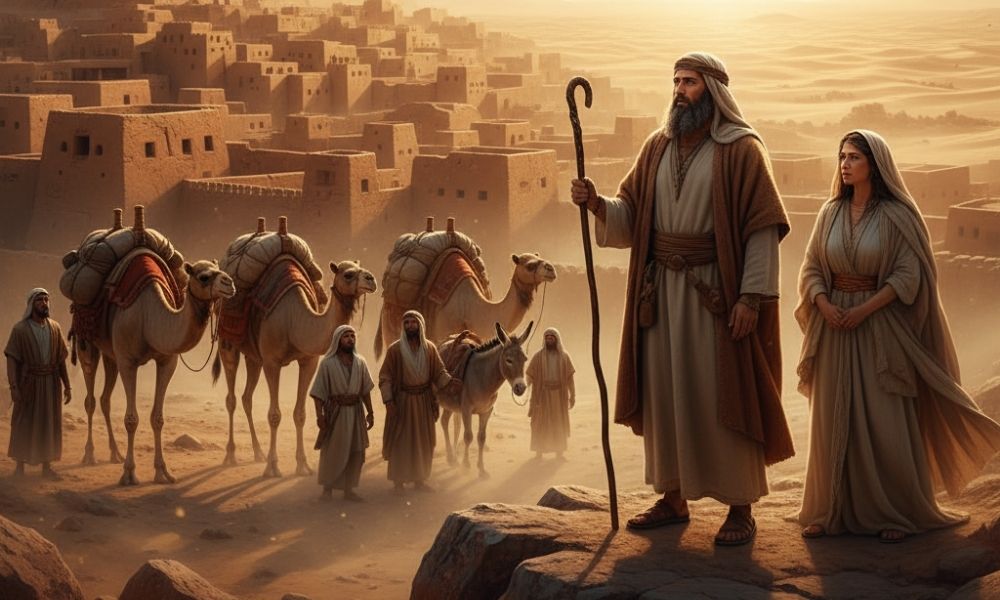
The call of Abram (later named Abraham) marks the beginning of God’s redemptive covenant with His chosen people. From a wealthy city in Mesopotamia, Abram was called by God to leave behind his homeland, family, and security to journey to an unknown land. His obedience became the foundation of faith for generations, showing that God’s promises are fulfilled through trust and obedience.
Quick Facts
Name: Abram (later Abraham, meaning “father of many”)
Event: God’s call to leave Ur of the Chaldeans
Scripture: Genesis 12:1–9; Genesis 11:27–32
Location: From Ur (Mesopotamia) to Canaan
Time Period: Early 2nd millennium BCE
Key Figures: Abram, Sarai (later Sarah), Lot
Promise: God would make Abram a great nation and bless all nations through him
Symbol: Journey of faith and covenant obedience
Name Meaning
Abram means “exalted father,” while his later name, Abraham, means “father of many nations” (Genesis 17:5). The change signifies God’s promise that his descendants would be numerous and bring blessing to the world.
Historical & Biblical Context
Abram lived in Ur of the Chaldeans, a prosperous city in ancient Mesopotamia known for trade, culture, and idol worship. In that setting of security and polytheism, God’s call was radical — commanding Abram to leave everything familiar for a promise unseen.
Biblical Passage:
“The LORD had said to Abram, ‘Go from your country, your people and your father’s household to the land I will show you.’” — Genesis 12:1 (NIV)
God’s Promise (Genesis 12:1–3)
God made a threefold promise to Abram:
- A Land: “To the land I will show you.”
- A Nation: “I will make you into a great nation.”
- A Blessing: “All peoples on earth will be blessed through you.”
This covenant pointed forward to the coming of Jesus Christ, the ultimate descendant of Abraham, through whom salvation would reach all nations (Galatians 3:8,16).
Abram’s Obedience and Journey
Abram responded with faithful obedience:
- He departed from Haran at age 75, taking Sarai, his nephew Lot, and their possessions.
- They traveled through Canaan, stopping at Shechem and Bethel, where Abram built altars and worshiped the Lord.
- Despite uncertainty, Abram trusted God’s word — a defining example of faith later praised in Hebrews 11:8–10.
Symbolism / Themes
- Faith in God’s Promise: Abram’s journey represents trust in God without knowing the full plan.
- Separation from the World: Leaving Ur symbolizes turning from human security to divine guidance.
- Covenant Relationship: The call marks the beginning of God’s covenant people, Israel.
- Blessing to the Nations: God’s plan through Abram extends salvation beyond Israel to all humanity.
Notable Related Events
- Call from Ur (Genesis 12:1–3): The divine command and promise.
- Journey to Canaan (Genesis 12:4–9): Abram’s obedience and altar-building.
- Covenant Renewal (Genesis 15 & 17): God reaffirms His promises with signs and a name change.
Archaeological & Historical Insights
Ancient Ur (modern Tell el-Muqayyar, Iraq) was a center of civilization, featuring temples, ziggurats, and advanced urban life. Abram’s departure from such a city underscores the depth of his faith in God’s unseen future rather than earthly comfort.
Legacy & Impact
Abram’s obedience set the foundation for the Abrahamic Covenant, a cornerstone of biblical history and faith.
- In Judaism: He is the father of Israel.
- In Christianity: He is the “father of faith,” whose trust points to righteousness by belief (Romans 4:3).
- In Islam: Revered as Ibrahim, a prophet and patriarch of monotheism.
His journey from Ur to Canaan symbolizes the believer’s own spiritual pilgrimage — leaving the old life to follow God’s call into His promises.
Symbolism / Typology
- Journey of Faith: From security to trust in God’s word.
- Covenant Seed: Promise of descendants leading to Christ.
- Obedience through Uncertainty: Walking by faith, not by sight (2 Corinthians 5:7).







Leave a Reply