
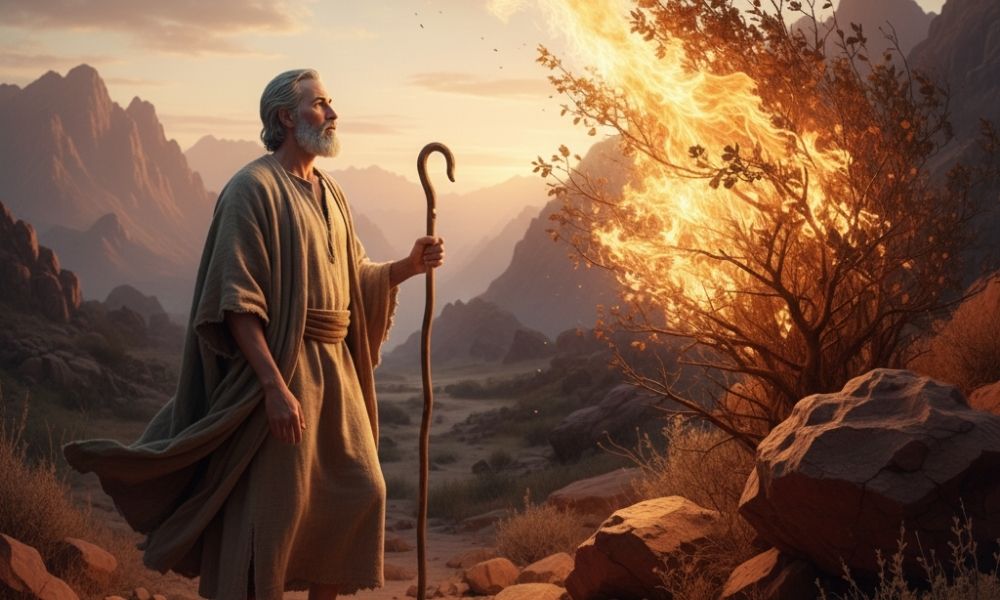
God Speaks Through the Burning Bush

God revealed His holy presence and mission to Moses through a bush that burned without being consumed, calling him to deliver Israel from oppression.


The encounter at the burning bush is a pivotal moment in Scripture—where God breaks into Moses’ ordinary life with a holy presence, a clear calling, and a message that would reshape the destiny of an entire nation. It is a story of revelation, identity, mission, and the God who steps into human suffering with power and compassion.


Quick Facts

Event: The Lord appears to Moses in a burning bush
Location: Mount Horeb, also called Mount Sinai
Biblical Passage: Exodus 3:1–15
Key Themes: Calling, holiness, covenant, deliverance, divine identity
Purpose: To commission Moses and reveal God’s name and mission


The Wilderness Setting

Moses was living far from Egypt, working as a shepherd for his father-in-law Jethro. This quiet, rugged terrain—often seen as a place of exile—became the very ground where God prepared him for leadership. The wilderness, both harsh and silent, created space for God’s voice to break through.


The Sign of the Burning Bush

Moses noticed a bush engulfed in flames but not consumed. This was no ordinary fire. The miracle drew him closer, and that act of turning aside revealed his readiness to listen. God often uses signs to capture attention before revealing deeper truths.


A Holy Moment

As Moses approached, God called him by name. The double call—“Moses, Moses”—signaled intimacy and urgency. God instructed him to remove his sandals, marking the place as holy ground. In an instant, the ordinary became sacred because of God’s presence.


The God Who Sees and Responds

God revealed that He had seen the suffering of His people in Egypt, heard their cries, and knew their pain. This is one of the clearest portraits of God’s compassion. He does not ignore injustice. He acts. And His chosen instrument for this mission was Moses.


The Call and Commission

God told Moses that he would go to Pharaoh and lead Israel out of bondage. Moses felt inadequate and hesitant, but God promised His presence. The strength of Moses’ mission was never in his ability—it was in God’s constant companionship.


The Divine Name Revealed

When Moses asked, “Who should I say sent me?” God answered with a profound declaration: I AM WHO I AM. This name revealed God as eternal, self-sufficient, unchanging, and faithful to His covenant. It anchored Moses’ authority and Israel’s hope.


Why the Burning Bush Matters Today

The burning bush teaches that God interrupts ordinary life with purpose. He calls people who feel unqualified. He stands with those He sends. He sees suffering and moves to deliver. And His presence transforms any place—wilderness or home—into holy ground.


Leave a Reply

Your email address will not be published. Required fields are marked *

Bible Characters

  • Mark (John Mark)
  • Mark (John Mark)

    John Mark was a young disciple who overcame early failure to become a trusted companion of Paul and Peter, ultimately authoring the dynamic Gospel that bears his name.


  • Matthew

    Matthew was a despised tax collector transformed by grace into a devoted apostle, whose Gospel bridges the Old and New Testaments by proclaiming Jesus as the promised Messiah and King.


  • Nabal

    Nabal was a wealthy but foolish landowner whose arrogance and refusal to show hospitality to David led to divine judgment and his sudden death.


Biblical Events

  • David lies to Ahimelech
  • Mark (John Mark)

    John Mark was a young disciple who overcame early failure to become a trusted companion of Paul and Peter, ultimately authoring the dynamic Gospel that bears his name.


  • Matthew

    Matthew was a despised tax collector transformed by grace into a devoted apostle, whose Gospel bridges the Old and New Testaments by proclaiming Jesus as the promised Messiah and King.


  • Nabal

    Nabal was a wealthy but foolish landowner whose arrogance and refusal to show hospitality to David led to divine judgment and his sudden death.


Bible Locations

  • Jezreel
  • Jezreel

    Jezreel was the fertile royal seat of King Ahab and Queen Jezebel, famous for the murder of Naboth and the site where divine judgment eventually wiped out their entire dynasty.


  • Aphek

    Aphek was a strategic military stronghold and staging ground on the Sharon Plain where the Philistines gathered to capture the Ark and where David was providentially released from the Philistine army.


  • Lachish

    Lachish was the second most powerful city in ancient Judah, a mighty fortress whose dramatic fall to Assyria and Babylon serves as a pivotal moment in biblical history and archaeology.


You May Also Like:

  • The Twelve Tribes of Israel were the tribal divisions descended from the sons of Jacob that formed the foundation of the Israelite nation and the prophetic lineage of the Messiah.

  • After burying Jacob in Canaan with great honor, Joseph reassures his fearful brothers that their past evil was overruled by God for good, and he dies in Egypt with a prophetic command that his bones be carried to the Promised Land.

  • On his deathbed, Jacob gathers his twelve sons to prophesy their destinies, disqualifying the firstborns for their sins and appointing Judah as the royal line and Joseph as the fruitful recipient of the double portion.

  • On his deathbed, Jacob adopts Joseph’s two sons as his own, deliberately crossing his hands to give the greater blessing to the younger Ephraim, declaring God as his Shepherd and Redeemer.

Bibliva

FREE
VIEW




