
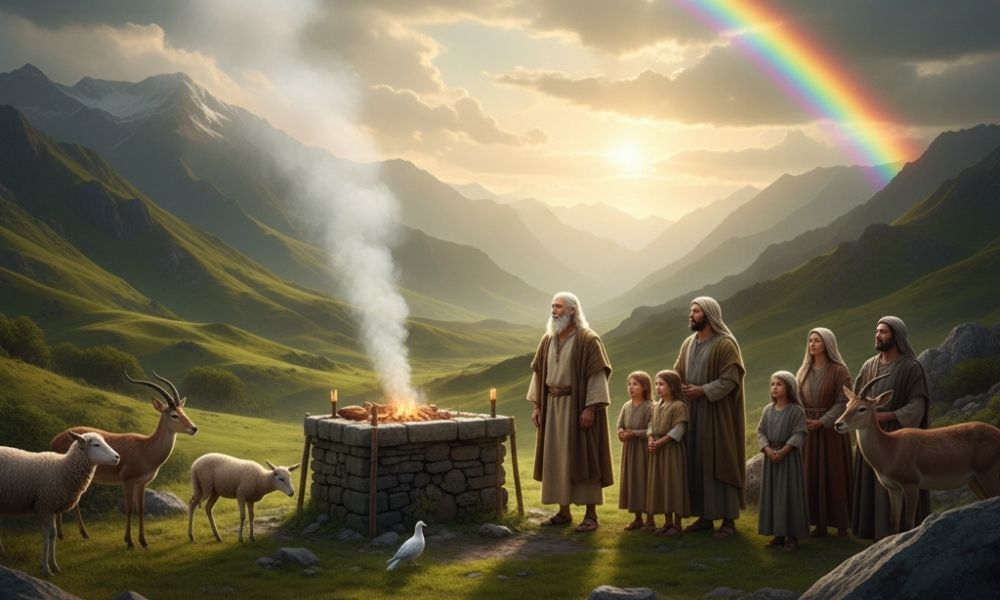
After the Great Flood, God established a covenant with Noah, his descendants, and every living creature on earth. This covenant was God’s solemn promise never again to destroy the world by a flood. The rainbow, stretching across the heavens, became the visible sign of this everlasting covenant — a symbol of divine mercy, peace, and faithfulness that endures through every generation.
Quick Facts
Event Name: God’s Covenant with Noah
Location: Mountains of Ararat, post-Flood world
Key Figures: God, Noah, Noah’s family
Key Scripture: Genesis 9:12–13 — “This is the sign of the covenant I am making between Me and you and every living creature with you, a covenant for all generations to come: I have set My rainbow in the clouds, and it will be the sign of the covenant between Me and the earth.”
Symbol: The Rainbow — sign of peace, mercy, and divine promise
Promise: God will never again destroy all life with a flood
Type: Universal and everlasting covenant
Meaning of the Event
The covenant with Noah was God’s declaration that, despite humanity’s sin, He would show mercy toward creation. The rainbow serves as a divine reminder that God’s wrath is tempered by grace. It signifies the restoration of order, the renewal of life, and the assurance that God’s faithfulness extends to all people and all time.
Biblical Era / Timeline
Era: Post-Flood (Genesis 9:8–17)
Context: After the Great Flood cleansed the earth, Noah offered sacrifices of thanksgiving. God responded with a covenant of peace, ensuring stability and mercy for the renewed world.
The Story
1. God Establishes the Covenant (Genesis 9:8–11)
God spoke to Noah and his sons, confirming His covenant not only with them but with every living creature that survived the Flood. It was the first universal covenant, encompassing all life on earth.
“Never again shall all flesh be cut off by the waters of the flood; never again shall there be a flood to destroy the earth.”
2. The Rainbow Appears (Genesis 9:12–17)
God placed a rainbow in the clouds as the sign of His covenant — a visible reminder of His mercy. Whenever rain clouds gather, the rainbow stands as a bridge between heaven and earth, a symbol that God remembers His promise.
“When I bring clouds over the earth and the rainbow appears in the clouds, I will remember My covenant…”
This is not because God forgets, but to show that He chooses to remember mercy instead of judgment.
Symbolism & Meaning
| Symbol | Meaning |
|---|---|
| Rainbow | Peace between God and creation; mercy following judgment |
| Clouds | A reminder that God’s promise stands even amid storms |
| Covenant | God’s unbreakable word of grace to all living beings |
| Seven Colors of the Rainbow | Completeness and perfection in God’s promise |
| Rain after Flood | Renewal and the restoration of life on earth |
Theological Significance
- Divine Faithfulness: God keeps His promises, offering mercy after judgment.
- Universal Grace: The covenant applies to all living things, not just humankind.
- Peace Restored: The rainbow symbolizes reconciliation between heaven and earth.
- Foreshadow of Christ: Just as the rainbow bridged heaven and earth, Christ bridges God and humanity through the New Covenant of grace.
Key Lessons
- God’s promises are sure and eternal.
- Even after judgment, mercy triumphs.
- Creation itself is included in God’s plan of redemption.
- The rainbow reminds us that God’s grace endures through every storm.
- True peace is found only in God’s covenant faithfulness.
Legacy & Impact
- The rainbow remains one of Scripture’s most powerful symbols of hope and mercy.
- It represents God’s enduring love for all creation and His restraint in judgment.
- The covenant with Noah laid the foundation for all later covenants, pointing forward to God’s ultimate promise of salvation through Jesus Christ.
- Every rainbow in the sky is a living reminder that God’s word never fails.







Leave a Reply