
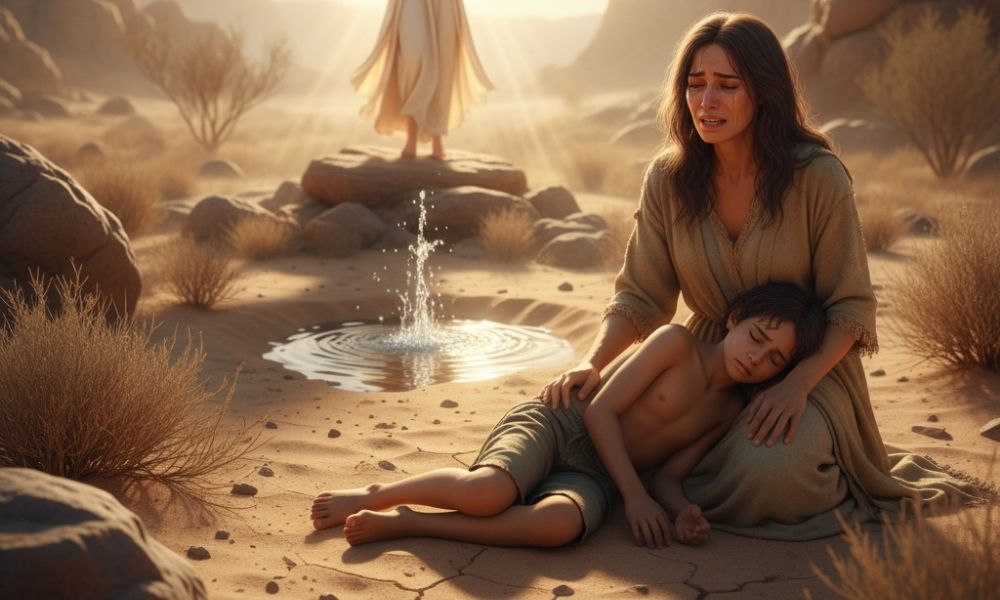
The story of Hagar and Ishmael reveals both human impatience and divine compassion. When Abram and Sarai struggled to believe God’s promise of a son, they attempted to fulfill it through human means — resulting in the birth of Ishmael. Yet even amid broken choices, God’s mercy prevailed, caring for Hagar and her child and reaffirming His promise to Abram. This account shows that while human plans may fail, God’s purposes never do.
Quick Facts
Main Figures: Abram (Abraham), Sarai (Sarah), Hagar, Ishmael
Event: Birth of Ishmael through Hagar, Sarai’s Egyptian maidservant
Scripture: Genesis 16; Genesis 17:18–21; Genesis 21:8–21
Location: Canaan and the wilderness of Shur
Time Period: c. 2000 BCE
Key Themes: Faith versus human effort, God’s mercy, promise and purpose
Symbol: The well in the wilderness — God’s provision and care
Name Meanings
- Hagar — “Stranger” or “Flight,” reflecting her role as a foreign servant and her fleeing into the wilderness.
- Ishmael — “God hears,” because the Lord heard Hagar’s distress and answered her cry (Genesis 16:11).
Biblical Background
After ten years in Canaan, Abram and Sarai still had no child. Sarai, barren and growing older, suggested that Abram take Hagar, her Egyptian maidservant, to bear a child in her place — a custom accepted in their culture but not aligned with God’s promise.
“Go, sleep with my slave; perhaps I can build a family through her.” — Genesis 16:2
Abram agreed, and Hagar conceived — but the household soon fell into tension and jealousy.
Hagar’s Flight and God’s Compassion (Genesis 16:4–14)
When Hagar became pregnant, she began to despise Sarai, and Sarai treated her harshly. Fleeing into the wilderness, Hagar encountered “the Angel of the LORD” near a spring on the way to Shur.
There, God revealed His compassion and purpose:
“Hagar, slave of Sarai, where have you come from, and where are you going?… Return to your mistress and submit to her.” — Genesis 16:8–9
The Angel of the LORD promised that her son would become a great nation:
“You shall name him Ishmael, for the LORD has heard your misery.” — Genesis 16:11
Hagar called the Lord El Roi, meaning “the God who sees me.” This marked the first time in Scripture someone gave God a personal name, expressing His intimate care for those in distress.
Birth of Ishmael
Hagar returned and gave birth to Ishmael, when Abram was 86 years old (Genesis 16:16). Though Ishmael was not the child of the covenant, God promised to bless him and make him a great nation (Genesis 17:20).
The Covenant Clarified (Genesis 17:18–21)
Years later, God appeared to Abram again, reaffirming that the true heir of the promise would come through Sarah, not Hagar.
“Your wife Sarah will bear you a son, and you will call him Isaac. I will establish My covenant with him as an everlasting covenant for his descendants after him.” — Genesis 17:19
Still, God’s mercy extended to Ishmael:
“As for Ishmael, I have heard you: I will surely bless him; I will make him fruitful and will greatly increase his numbers.” — Genesis 17:20
Hagar and Ishmael Sent Away (Genesis 21:8–21)
After Isaac’s birth, conflict arose between Sarah and Hagar. Sarah asked Abraham to send Hagar and Ishmael away, and though it grieved him, God told Abraham to do so, assuring him that Ishmael would also become a nation.
In the wilderness, Hagar and her son ran out of water. As Hagar wept in despair, God again intervened:
“Do not be afraid; God has heard the boy crying… I will make him into a great nation.” — Genesis 21:17–18
God opened Hagar’s eyes to see a well of water, saving them and reaffirming His care. Ishmael grew up in the wilderness, became an archer, and settled in the Desert of Paran.
Key Themes & Lessons
1. Faith vs. Human Effort:
Sarai and Abram tried to achieve God’s promise by their own means, showing how human impatience can lead to conflict and sorrow.
2. God’s Compassion:
Even when people act out of doubt, God remains merciful — seeing, hearing, and caring for those who suffer.
3. God’s Sovereignty:
God’s covenant plan continued through Isaac, but His blessing extended to Ishmael, showing His kindness to all nations.
4. El Roi — “The God Who Sees”:
Hagar’s encounter reminds believers that no one is unseen by God, no matter how abandoned or lost they feel.
Symbolism / Typology
- Hagar: Represents human striving apart from divine promise.
- Sarah: Symbolizes faith in God’s supernatural provision.
- Ishmael: The result of human effort; still blessed, but not the covenant heir.
- Isaac: The child of promise, born by God’s power.
Legacy & Impact
The story of Hagar and Ishmael emphasizes that God’s promises depend on His faithfulness, not human schemes. Ishmael became the father of many Arab tribes, while Isaac’s line led to the covenant fulfilled in Christ. Both demonstrate that God’s mercy extends beyond boundaries, and His purposes prevail despite human weakness.
“The Lord is near to all who call on Him, to all who call on Him in truth.” — Psalm 145:18







Leave a Reply