
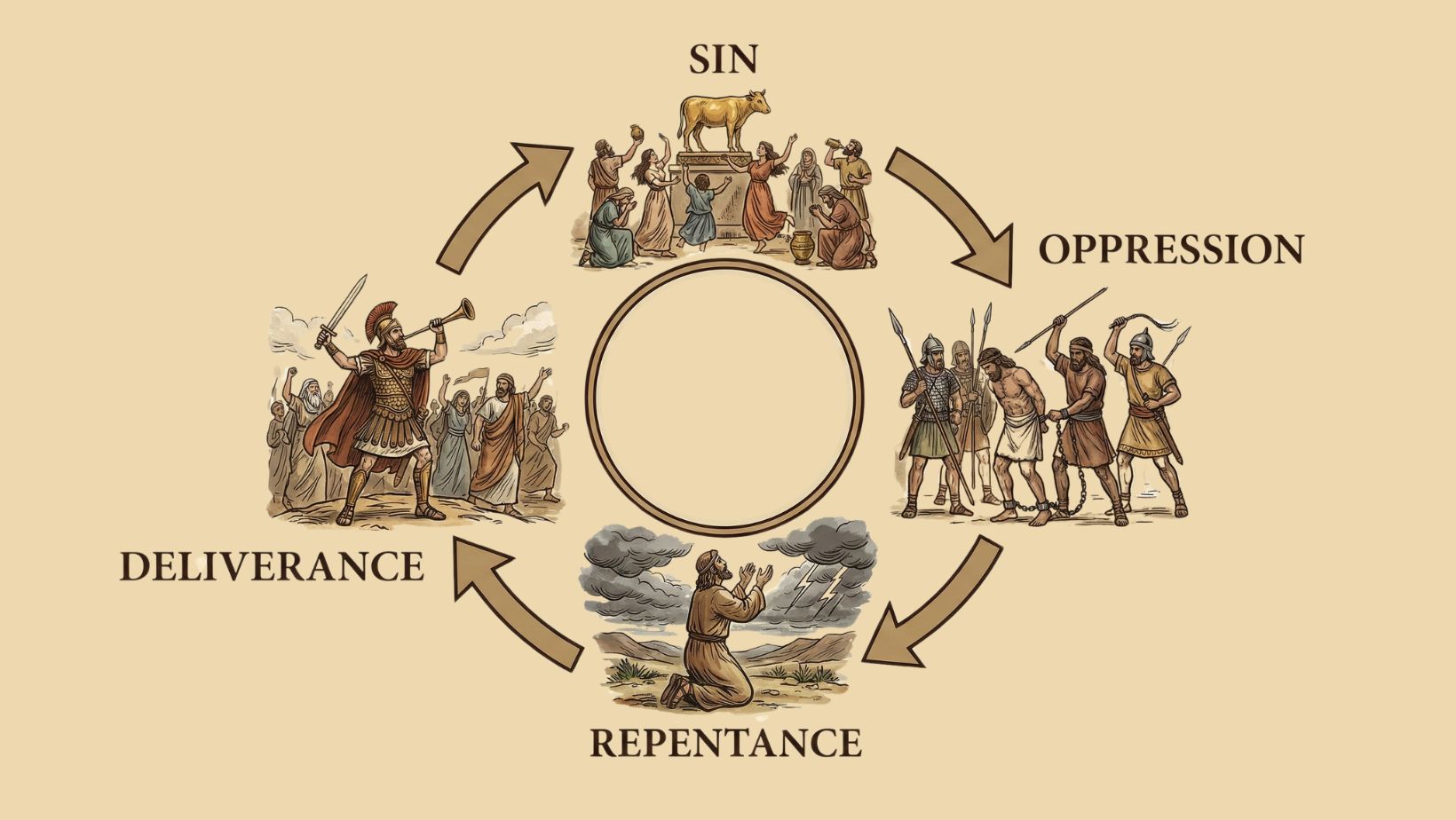
Israel’s cycle of rebellion and deliverance, often referred to as the “Cycle of the Judges,” is a recurring historical and spiritual pattern found primarily in the Book of Judges. This period, lasting roughly 300 to 400 years between the death of Joshua and the rise of the monarchy, is characterized by a distinctive four-part sequence: Sin (Israel turns to idolatry), Servitude (God allows foreign oppression), Supplication (Israel cries out for help), and Salvation (God raises a Judge to deliver them). It serves as a stark historical lesson on human frailty and the disastrous consequences of moral relativism, while simultaneously highlighting God’s relentless mercy and willingness to redeem His people despite their repetitive unfaithfulness.
Quick Facts
- Subject: The Cycle of Judges (Sin, Servitude, Supplication, Salvation)
- Nation: Israel (The Twelve Tribes)
- Era: Period of the Judges (~1375–1050 BCE)
- Key Book: Judges (Chapters 2–21)
- Key Phrase: “In those days Israel had no king; everyone did as they saw fit.” (Judges 21:25)
- Oppressors: Mesopotamians, Moabites, Canaanites, Midianites, Ammonites, Philistines
- Deliverers: Othniel, Ehud, Shamgar, Deborah, Gideon, Tola, Jair, Jephthah, Ibzan, Elon, Abdon, Samson
- Outcome: Temporary peace followed by a return to apostasy
- Theme: The conflict between God’s covenant faithfulness and Israel’s spiritual adultery
Name Meaning / Definition
The Cycle: Refers to the repetitive loop of behavior exhibited by the Israelites. It is often summarized by the “Four S’s”:
- Sin: Rebellion against Yahweh.
- Servitude: Oppression by foreign enemies.
- Supplication: Crying out to God in distress.
- Salvation: Deliverance through a divinely appointed Judge.
Lineage / Context
Origin: Began shortly after the death of Joshua and the elders who had witnessed the conquest of Canaan.
Predecessor: The era of Joshua, characterized by obedience and conquest.
Successor: The United Monarchy (Saul, David, Solomon), established because the people demanded a king to break the instability of the tribal confederacy.
Setting: The land of Canaan, where Israel existed as a loose confederation of tribes rather than a unified nation-state.
Biblical Era / Context
Time: The Iron Age I period, a time of general political instability in the Ancient Near East.
Cultural Context: The Israelites failed to drive out the Canaanites completely. Living among them led to cultural assimilation and the worship of local fertility deities like Baal and Ashtoreth, which triggered the cycle.
Spiritual Climate: Defined by “moral relativism,” where the authority of God’s law was abandoned for individual preference.
Major Components of the Cycle
1. Rebellion (Apostasy): The people would “do evil in the eyes of the Lord,” abandoning Yahweh to serve the gods of the surrounding nations.
2. Retribution (Oppression): In response to their broken covenant, God would remove His protection, allowing raiders or neighboring kings to plunder and enslave the tribes.
3. Repentance (Outcry): Under the weight of suffering, the Israelites would remember Yahweh and cry out for relief (often motivated more by pain than true heart change).
4. Rescue (Deliverance): Moved by pity, God would raise up a “Judge” (a military and civil leader) to defeat the enemy and restore peace to the land.
Key Character Traits of the Nation
Fickleness: The nation showed an inability to remain loyal to God for more than one generation.
Forgetfulness: They quickly forgot the miracles of the Exodus and Conquest.
Compromise: They chose coexistence with idolatry rather than the holiness God commanded.
Dependence: Despite their rebellion, they were utterly dependent on God’s intervention for survival.
Main Iterations of the Cycle
Othniel: Israel worships idols; King Cushan-Rishathaim oppresses them for 8 years; Othniel delivers them; land has peace for 40 years. (Judges 3:7–11)
Ehud: Israel does evil; Eglon of Moab oppresses them for 18 years; Ehud assassinates Eglon; land has peace for 80 years. (Judges 3:12–30)
Deborah & Barak: Israel does evil; Jabin the Canaanite oppresses them for 20 years; Deborah and Barak defeat Sisera; land has peace for 40 years. (Judges 4–5)
Gideon: Israel does evil; Midianites ravage the land for 7 years; Gideon defeats them with 300 men; land has peace for 40 years. (Judges 6–8)
Jephthah: Israel serves Baals; Philistines and Ammonites oppress them for 18 years; Jephthah delivers them (with a tragic vow); judged for 6 years. (Judges 10–12)
Samson: Israel does evil; Philistines oppress them for 40 years; Samson fights the Philistines individually; judged for 20 years. (Judges 13–16)
Major Relationships
Yahweh and Israel: A covenant relationship likened to a marriage, where Israel plays the unfaithful spouse and God acts as the jealous but redeeming husband.
The Judges and the People: The Judges were charismatic leaders empowered by the Spirit of God, though many were deeply flawed individuals (e.g., Samson’s lust, Jephthah’s rashness, Gideon’s ephod).
Israel and the Nations: A relationship of constant tension—alternating between violent warfare and sinful intermarriage/syncretism.
Notable Passages
Judges 2:18-19: The summary of the cycle — “Whenever the LORD raised up a judge for them, he was with the judge and saved them… But when the judge died, the people returned to ways even more corrupt than those of their fathers.”
Judges 21:25: The thematic conclusion — “In those days Israel had no king; everyone did as they saw fit.”
1 Samuel 12:9-11: Samuel reviews this history — “But they forgot the LORD their God; so he sold them into the hand of Sisera… and they cried out to the LORD.”
Legacy & Impact
Demonstration of Grace: The cycle proves that God’s grace is not exhausted by human failure; He saved them repeatedly despite their unworthiness.
Need for a King: The downward spiral of the period (becoming progressively worse with each cycle) demonstrated that a loose tribal confederacy was insufficient and pointed toward the need for a righteous King.
Human Depravity: It serves as a theological case study on the inability of humanity to self-govern righteously without submission to God.
Symbolism / Typology
The Judges: They serve as imperfect “types” of Christ. They brought temporary deliverance from physical enemies, foreshadowing Jesus, the ultimate Judge and King who provides eternal deliverance from sin.
The Cycle: Represents the believer’s struggle with the flesh—the tendency to drift from God, experience the discipline of the Spirit, and return through repentance.
Idolatry: Symbolizes the constant temptation to trust in created things (fertility, power, wealth) rather than the Creator.
Extra-Biblical References
Archaeology: Excavations of Iron Age I sites in the hill country of Canaan show a lack of pig bones (dietary laws) and specific pottery styles distinct from the Philistine coastal plains, confirming the cultural struggle described in Judges.
Amarna Letters: Tablets from this general historical era describe chaos and the presence of “Habiru” (outsiders/raiders) in Canaan, reflecting the turbulent environment of the time.







Leave a Reply