
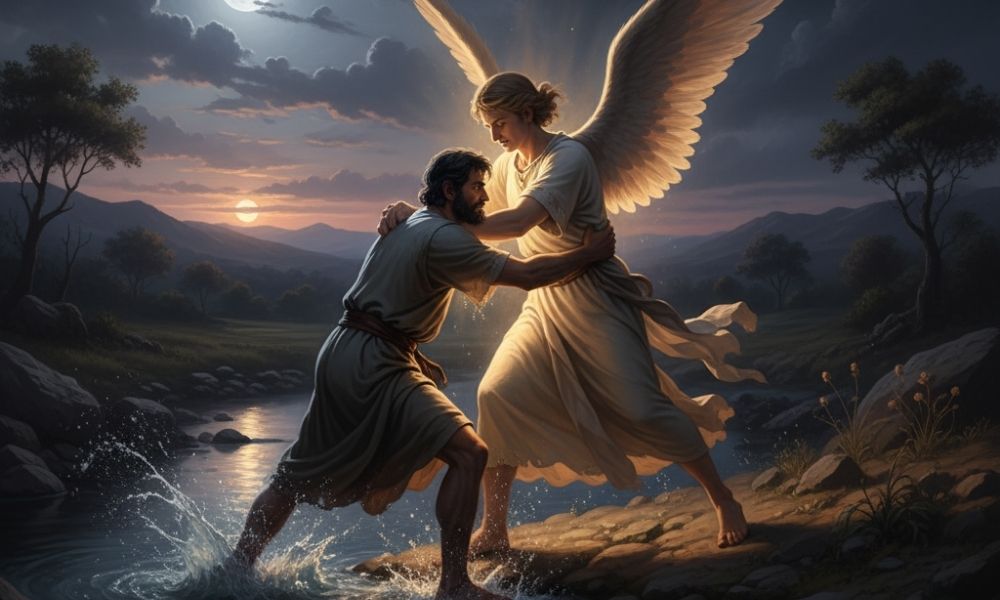
Jacob’s wrestling with God is one of the most mysterious and transformative encounters in the Old Testament. It occurs as Jacob prepares to meet his estranged brother Esau after twenty years in exile. On the eve of that reunion, Jacob finds himself alone by the River Jabbok, where he wrestles through the night with a divine being. This struggle marks the turning point of Jacob’s life—he moves from being a deceiver to becoming Israel, “one who struggles with God.”
Quick Facts
Event: Jacob wrestles with God and receives a new name, Israel
Key Figures: Jacob and the Angel of the Lord (God in human form)
Primary Source: Genesis 32:22–32
Era: Patriarchal Age
Location: River Jabbok, east of the Jordan River
Outcome: Jacob is blessed, renamed Israel, and left with a limp as a lasting reminder of the encounter
Context of the Event
After twenty years in Haran, Jacob was returning to Canaan with his family, flocks, and servants. He had prospered under Laban but carried deep anxiety about facing Esau, whom he had deceived long ago. Fearing revenge, Jacob sent gifts ahead to appease his brother and divided his camp for safety. That night, as he stayed behind alone, a mysterious figure appeared and engaged him in a physical struggle that lasted until daybreak.
The Struggle at the River Jabbok
The narrative describes Jacob wrestling with “a man” through the night. This was no ordinary opponent—it was a divine being, often understood as the Angel of the Lord or a manifestation of God Himself. The two wrestled with intense determination until dawn. When the man saw that Jacob would not let go, he touched Jacob’s hip, wrenching it out of socket.
Despite his pain, Jacob refused to release his opponent, saying,
“I will not let you go unless you bless me.” (Genesis 32:26, NIV)
The man then asked Jacob his name—a symbolic moment forcing him to confess his identity as Jacob, the deceiver. In response, the man declared,
“Your name will no longer be Jacob, but Israel, because you have struggled with God and with humans and have overcome.” (Genesis 32:28, NIV)
Jacob then realized he had encountered God face-to-face and named the place Peniel, meaning “Face of God.”
Jacob’s Transformation
Jacob limped away from the encounter forever changed—physically marked and spiritually renewed. No longer merely a schemer surviving by wit and deception, he became a man who prevailed through surrender and faith. His new name, Israel, symbolized his new identity and destiny: the father of a nation that would bear God’s name.
Key Characters
- Jacob (Israel): Once a deceiver, now transformed by humility and divine encounter; symbolizes perseverance and faith.
- The Divine Wrestler: Identified as God in human form, representing divine confrontation, discipline, and blessing.
Major Themes
- Struggle and Surrender: Jacob’s physical struggle mirrors his lifelong spiritual battle between self-reliance and dependence on God.
- Transformation: The new name “Israel” marks a new identity and mission—one born through struggle and submission.
- Divine Encounter: God meets Jacob personally, not to destroy him, but to bless and refine him.
- Weakness as Strength: Jacob’s limp becomes a lasting reminder that true strength comes from dependence on God, not human cunning.
- Covenant Renewal: The blessing reaffirms God’s covenant promises to Abraham and Isaac, now carried forward through Israel.
Key Passages
- Genesis 32:24 (NIV):
“So Jacob was left alone, and a man wrestled with him till daybreak.” - Genesis 32:26 (NIV):
“Then the man said, ‘Let me go, for it is daybreak.’ But Jacob replied, ‘I will not let you go unless you bless me.’” - Genesis 32:28 (NIV):
“Then the man said, ‘Your name will no longer be Jacob, but Israel, because you have struggled with God and with humans and have overcome.’” - Genesis 32:30 (NIV):
“So Jacob called the place Peniel, saying, ‘It is because I saw God face to face, and yet my life was spared.’”
Theological Significance
This encounter represents the spiritual transformation necessary for those whom God calls. Jacob’s new name, Israel, signifies not perfection but perseverance—he prevails because he refuses to let go of God. The story reveals that divine blessing often comes through struggle, and that brokenness can lead to spiritual strength. It also foreshadows Israel’s national identity: a people who wrestle with God yet remain under His covenant care.







Leave a Reply