
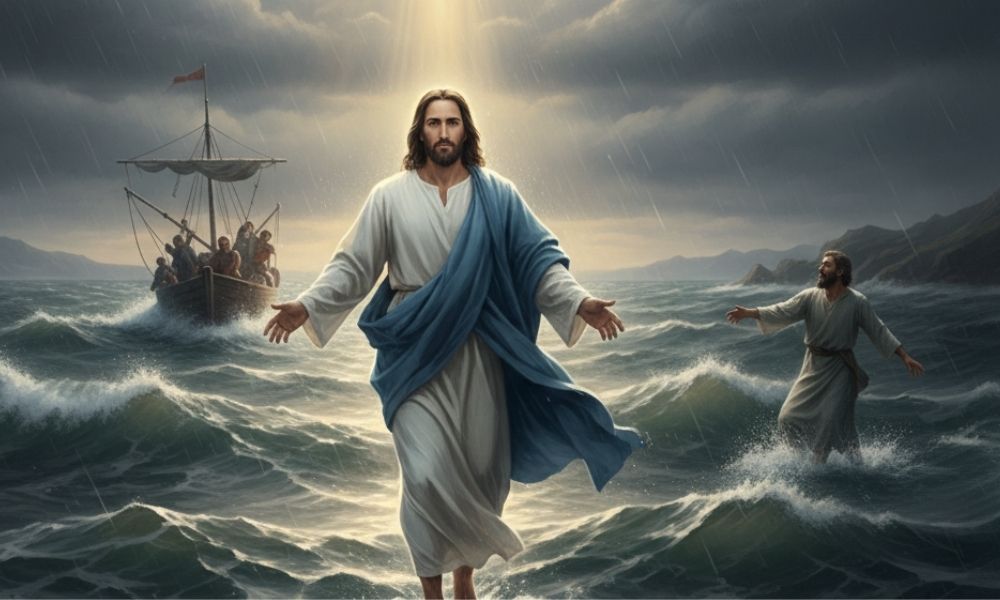
This remarkable event reveals Jesus’ divine power and deep compassion for His followers. After feeding the five thousand, He sent His disciples across the Sea of Galilee while He went to pray alone. During the night, a violent storm arose, and the disciples struggled against the waves. In their moment of fear, Jesus came to them — walking on the water — showing that He is Lord even over the forces of nature and that faith in Him can overcome all fear.
Quick Facts
- Location: Sea of Galilee (also called the Lake of Gennesaret or Sea of Tiberias)
- Time: Immediately after the Feeding of the Five Thousand
- Key People: Jesus Christ, His twelve disciples (especially Peter)
- Time of Event: During the fourth watch of the night (between 3:00–6:00 a.m.)
- Main Miracle: Jesus walks on water and calms the storm
- Main Message: Faith overcomes fear; Jesus is Lord over all creation
Setting the Scene: After the Miracle of the Loaves
After performing the great miracle of feeding over 5,000 people with only five loaves and two fish (Matthew 14:13–21), Jesus knew the crowd wanted to make Him king by force (John 6:15). To prevent this and to teach His disciples further, He immediately sent them away:
“Immediately Jesus made the disciples get into the boat and go on ahead of Him to the other side, while He dismissed the crowd.” (Matthew 14:22)
Once the multitudes had left, Jesus went up alone on a mountain to pray. This was late in the evening. He often withdrew for private prayer to commune with His Father and find strength for His mission (Mark 6:46).
Meanwhile, the disciples were rowing their boat across the lake toward Bethsaida (Mark 6:45). The night deepened, and a strong wind began to blow against them. The waves tossed their small boat, and progress became slow and difficult.
Jesus Appears in the Storm
During the fourth watch of the night — between 3:00 and 6:00 a.m. — Jesus came to them, walking on the sea (Matthew 14:25). The disciples, weary and frightened, saw a figure moving across the water. Terrified, they cried out in fear, thinking it was a ghost (Matthew 14:26).
But immediately Jesus called out to calm them:
“Take courage! It is I. Don’t be afraid.” (Matthew 14:27)
His words, “It is I” (Greek: Ego eimi), echo the divine name God revealed to Moses — “I AM” (Exodus 3:14). In this moment, Jesus revealed His divine nature: the One who walks upon the waters (Job 9:8) and rules the seas.
Peter Steps Out in Faith
Peter, ever bold and impetuous, answered,
“Lord, if it’s You, tell me to come to You on the water.” (Matthew 14:28)
Jesus said,
“Come.” (Matthew 14:29)
Without hesitation, Peter stepped out of the boat and began walking on the water toward Jesus. For that moment, faith held him up — as long as his eyes were fixed on Christ.
But when Peter noticed the violent wind and roaring waves, fear entered his heart. He began to sink and cried out,
“Lord, save me!” (Matthew 14:30)
Immediately, Jesus reached out His hand and caught him, saying,
“You of little faith, why did you doubt?” (Matthew 14:31)
Peter’s failure was not that he sank — but that he allowed fear to take his focus off Jesus.
The Storm Ceases
As soon as Jesus and Peter climbed into the boat, the wind stopped (Matthew 14:32). The sea that had moments before been raging grew completely calm.
In awe, the disciples fell down and worshiped Him, saying,
“Truly You are the Son of God.” (Matthew 14:33)
John adds that immediately the boat reached the shore where they were heading (John 6:21) — another quiet but astonishing miracle showing Jesus’ authority over time, space, and nature.
Spiritual Lessons from Walking on Water
- Faith Keeps Us Afloat
- Jesus Is Sovereign Over Nature
- The One who created the seas walked upon them with ease.
- Psalm 93:4: “Mightier than the waves of the sea is the Lord on high.”
- Prayer Strengthens the Soul
- Fear and Doubt Sink Faith
- Fear doesn’t remove the storm, but it removes our ability to walk above it.
- Isaiah 41:10: “Fear not, for I am with you… I will uphold you with My righteous right hand.”
- Jesus Saves Instantly When We Call
- Peter’s desperate cry, “Lord, save me!” was met with immediate rescue.
- Romans 10:13: “Everyone who calls on the name of the Lord will be saved.”
- Worship Is the Only Proper Response
- When the disciples saw Jesus’ power and mercy, they didn’t just marvel — they worshiped.
- Matthew 14:33: “Truly You are the Son of God.”
Key Takeaway
The story of Jesus walking on water teaches that no storm is too strong, no wave too high, and no night too dark for Christ to reach us. When fear threatens to overwhelm us, we can call out just as Peter did — “Lord, save me!” — and He will stretch out His hand without delay.
Our greatest safety is not in the calmness of the sea, but in the nearness of Jesus.







Leave a Reply