
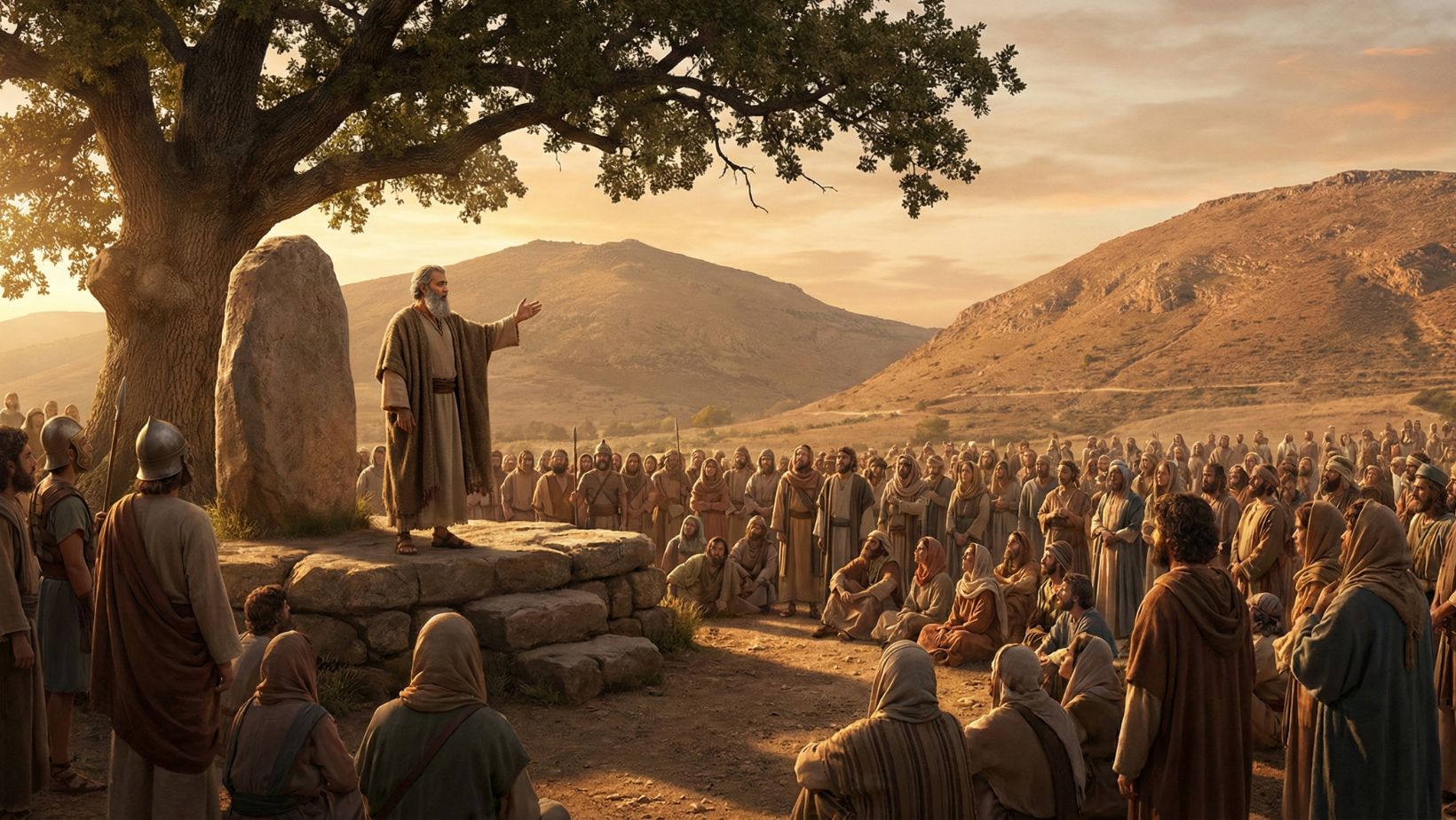
The account of Joshua’s farewell and death marks the conclusion of a monumental era in Israel’s history. After years of conquest and settlement, an aging Joshua gathers the nation—first its leaders, then the entire assembly—to ensure their spiritual stability after he is gone. Recorded in Joshua 23 and 24, these final acts serve as a solemn covenant renewal. Joshua does not focus on his own military achievements but on the faithfulness of God, issuing a final, piercing challenge to the people to reject idolatry and serve Yahweh exclusively. His death at the age of 110 signifies the end of the generation that witnessed the Exodus and the Conquest.
- Event: Joshua’s Farewell & Covenant Renewal
- Scripture Reference: Joshua 23–24
- Date: ~1375 BCE
- Age at Death: 110 years old
- Key Locations: Shechem (Covenant Ceremony), Timnath Serah (Burial)
- Key Statement: “Choose for yourselves this day whom you will serve… But as for me and my house, we will serve the LORD.” (Joshua 24:15)
- Burial: Buried in the hill country of Ephraim
- Secondary Deaths: Eleazar the Priest; burial of Joseph’s bones
The First Farewell: Warning the Leaders (Joshua 23)
The Audience: Joshua summoned the “elders, heads, judges, and officers” of Israel. This was a leadership briefing regarding national security and governance.
The Review: He reminded them that “the Lord your God is He who has fought for you.” The land was theirs, but the conquest was not fully complete; pockets of resistance remained.
The Warning: Joshua issued a stern warning against assimilation.
- No Intermarriage: Mingling with the remnants of the Canaanite nations would lead to spiritual apostasy.
- The Trap: If they compromised, these nations would become “a snare and a trap to you, and a whip on your sides and thorns in your eyes” (Joshua 23:13).
- The Consequence: Just as God had brought every good thing He promised, He would also bring every disaster/curse if they broke the covenant.
The Second Farewell: Covenant at Shechem (Joshua 24)
The Setting: Joshua gathered all the tribes at Shechem. This location was historically pregnant with meaning: it was where God first promised the land to Abraham (Genesis 12:6) and where Jacob buried his family’s foreign idols (Genesis 35:4).
The History Lesson: Speaking as a prophet (“Thus says the Lord”), Joshua recounted Israel’s history, starting not with Moses, but with Terah and Abraham, emphasizing that their forefathers served other gods “beyond the River” (Euphrates). He traced God’s sovereign hand through the Patriarchs, the Exodus, the wilderness, and the victories over the Amorites.
The Challenge: Joshua stripped away the pretense of cultural religion. He told them to put away the gods their fathers served in Egypt and Mesopotamia.
- The Ultimatum: “If it is evil in your eyes to serve the LORD, choose this day whom you will serve.”
- The Declaration: Joshua drew a line in the sand: “As for me and my house, we will serve the LORD.”
The Covenant Renewal: The people responded, “Far be it from us to forsake the Lord.” Joshua pressed them, warning that God is a “jealous God” and “holy God” who will not tolerate half-heartedness. When the people insisted on their loyalty, Joshua made a covenant with them that day, writing it in the Book of the Law of God.
The Witness Stone: Joshua took a large stone and set it up under the oak (terebinth) by the sanctuary of the Lord at Shechem to serve as a witness against the people if they ever denied their God.
Three Burials (The End of an Era)
The book concludes with three significant burials, tying up the loose ends of the Exodus and Conquest narratives:
- Joshua: He died at 110 and was buried in Timnath Serah in the hill country of Ephraim, the inheritance he had requested. The text notes that Israel served the Lord all the days of Joshua and the elders who outlived him.
- Joseph: The bones of Joseph, which the Israelites had carried out of Egypt (Genesis 50:25; Exodus 13:19), were finally laid to rest at Shechem, in the plot of ground Jacob had purchased. This fulfilled Joseph’s dying wish and symbolized the final arrival home.
- Eleazar: The son of Aaron and High Priest, who had worked alongside Joshua, died and was buried at Gibeah. This marked the passing of the religious leadership to his son, Phinehas.
Key Lessons & Themes
Leadership by Example: Joshua did not survey opinion polls; he led by conviction. His declaration “As for me and my house” established the family unit as the primary fortress of faith.
The Danger of Complacency: Joshua knew that once the wars were over and the people became wealthy and settled, they would be tempted to forget God. Prosperity is often a greater test of faith than adversity.
Choice is Essential: Faith cannot be inherited; it must be chosen. Joshua forced the new generation to make their own volition to serve Yahweh, rather than just riding on the momentum of their parents’ miracles.
God’s Faithfulness: Joshua’s dying testimony was, “Not one word has failed of all the good things that the LORD your God promised you” (Joshua 23:14).







Leave a Reply