
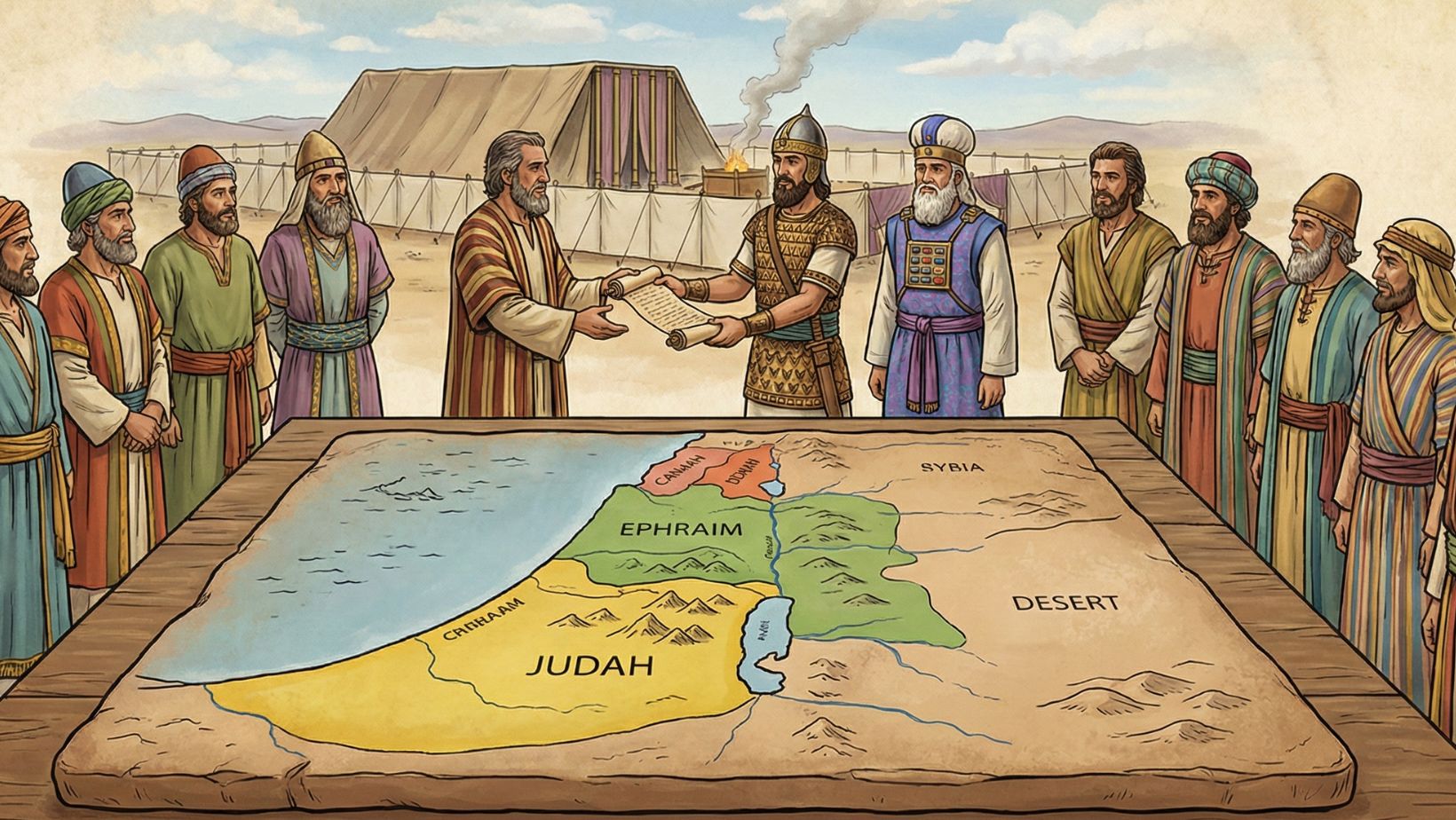
The division of the Promised Land among the twelve tribes of Israel is the fulfillment of God’s centuries-old promise to Abraham, Isaac, and Jacob. Recorded primarily in Joshua 13–21, this administrative and spiritual undertaking turned a nomadic people into a settled nation. The distribution was not decided by favoritism or mere politics but by divine will, determined through the casting of lots (likely using the Urim and Thummim) under the supervision of Joshua and Eleazar the High Priest. The land was divided into two main regions: the Transjordan (East of the Jordan River) and Cisjordan (West of the Jordan River/Canaan proper).
- Event: Division of the Land
- Scripture Reference: Joshua 13–21
- Date: ~1390 BCE
- Leaders: Joshua, Eleazar (High Priest), Tribal Heads
- Method: Casting of Lots at Shiloh & Gilgal
- Unique Exception: The Tribe of Levi received no land (only cities)
- Key Location: Shiloh (where the Tabernacle was set up)
- Symbolism: God’s faithfulness in providing an inheritance
The Process of Division
The Transjordan Settlement: Before crossing the Jordan, the tribes of Reuben, Gad, and the half-tribe of Manasseh asked Moses for the fertile grazing lands east of the river (Gilead and Bashan). Moses granted this on the condition that their warriors would cross over and help conquer Canaan first.
The Casting of Lots: The remaining nine and a half tribes received their inheritance by lot. This was likely done at Gilgal for the major tribes (Judah, Ephraim, Manasseh) and later at Shiloh for the remaining seven tribes (Joshua 18:1). Casting lots was not gambling; it was a sacred act of trusting God’s sovereignty to appoint the exact boundaries.
The Levites: The tribe of Levi received no territorial province. As the priestly tribe, “the LORD, the God of Israel, is their inheritance” (Joshua 13:33). Instead, they were given 48 Levitical cities scattered throughout the other tribes, ensuring that spiritual instruction and justice were accessible to all Israel.
The Tribal Allotments
1. The Southern Tribes
- Judah: Received the largest and most prominent portion in the south, including the hill country, the Negev, and the Shephelah. This territory included Jerusalem (eventually) and Hebron.
- Simeon: Their inheritance was unique—it was located within the territory of Judah. Because their population had dwindled and Judah’s land was too large, Simeon was essentially absorbed into the south (fulfilling Jacob’s prophecy that they would be “scattered”).
- Benjamin: A small but strategically critical strip of land between the giants of Judah and Ephraim. It contained significant cities like Jericho, Bethel, and eventually Jerusalem (on the border).
2. The Central Tribes (House of Joseph)
- Ephraim: Occupied the fertile central hill country. This area became the political and religious center of Israel for centuries (containing Shiloh and Shechem).
- Manasseh (West): The other half of Joseph’s double portion. They held a vast territory north of Ephraim, stretching from the Jordan River to the Mediterranean Sea.
3. The Northern Tribes (Galilee Region)
- Zebulun & Issachar: Located in the lower Galilee, controlling the fertile Valley of Jezreel—the breadbasket of Israel.
- Asher: Occupied the western coast along the Mediterranean, known for its olive groves and rich resources.
- Naphtali: Located in the eastern Galilee near the Sea of Galilee and the northern mountains.
- Dan: Originally allotted a strip on the coast (near modern Tel Aviv) but failed to drive out the Philistines/Amorites. They eventually migrated north and conquered Laish, renaming it Dan.
4. The Transjordan Tribes (East)
- Reuben: The furthest south on the east bank, near the Dead Sea.
- Gad: In the center (Gilead), a rugged, mountainous region.
- Manasseh (East): The northern section (Bashan), known for its oaks and cattle.
Special Cities
Cities of Refuge: Six cities (three on each side of the Jordan) were designated as sanctuaries for anyone who committed accidental manslaughter. This prevented “blood feuds” and ensured due process (Joshua 20).
Caleb’s Request: Caleb, the other faithful spy alongside Joshua, requested the hill country of Hebron—home of the Anakim (giants). Despite being 85 years old, he declared, “Give me this mountain!” and successfully drove them out.
Key Lessons & Themes
Faithfulness Fulfilled: The division of the land serves as the “receipt” for the promise made to Abraham in Genesis 12. It proves that God finishes what He starts, even if it takes centuries.
Inheritance is a Gift: The tribes did not earn the land; it was an “inheritance.” In the New Testament, this mirrors the believer’s inheritance in Christ—secured not by works, but by grace.
Community Responsibility: The Levites were scattered to teach the law, and the Cities of Refuge were established to ensure justice. This shows that a God-centered society cares for spiritual health and legal justice.
No Squatters: The Israelites were commanded to drive out the inhabitants completely. Where they failed (e.g., the Canaanites in the valleys), those inhabitants became “thorns in their sides,” leading to future idolatry.







Leave a Reply