
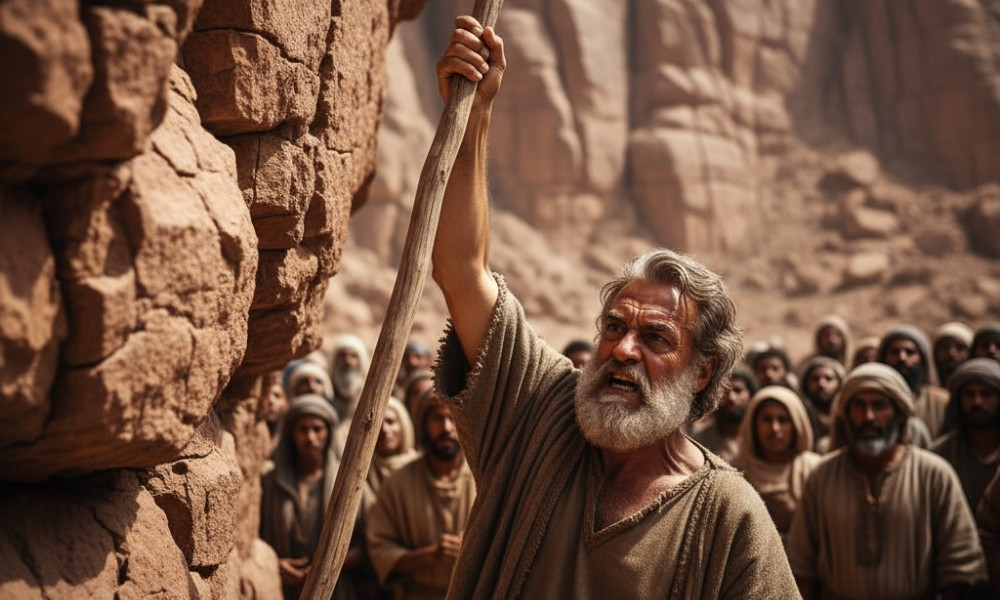
The incident where Moses strikes the rock at Meribah (Numbers 20) is the supreme tragedy of his life. After leading a stubborn nation for 40 years, enduring their insults and interceding for their lives, Moses finally breaks. In a moment of frustration and fatigue, he allows his anger to override God’s specific command. This single act of disobedience is the reason the greatest prophet in the Old Testament was barred from entering the Promised Land. It serves as a sobering reminder that those in positions of spiritual authority are held to a stricter standard of holiness and obedience.
- Event: The Waters of Meribah (Quarreling)
- Scripture: Numbers 20:1–13
- Location: Kadesh (in the Wilderness of Zin)
- The Command: “Speak to the rock”
- The Action: Struck the rock twice
- The Consequence: Barred from entering Canaan
- Key Lesson: Obedience is better than results; God’s holiness must be upheld.
The Tale of Two Rocks
To understand the gravity of this error, one must distinguish between the two times Moses brought water from a rock.
1. The First Rock (Exodus 17):
- Time: Early in the Exodus (start of the 40 years).
- Command: God told Moses to strike the rock.
- Action: Moses struck it.
- Result: Water flowed, God was pleased.
2. The Second Rock (Numbers 20):
- Time: End of the wandering (40th year).
- Command: God told Moses to speak to the rock.
- Action: Moses struck it twice.
- Result: Water flowed, but God was angry.
The Narrative Arc (Numbers 20)
The Context of Grief: The chapter opens with the death of Miriam, Moses’ sister. While Moses is likely grieving, the people immediately surround him, complaining about thirst: “Why have you brought the assembly of the LORD into this wilderness to die?”
The Divine Instruction: God tells Moses to take the staff, gather the people, and “tell the rock before their eyes to yield its water.” It was to be a demonstration of easy grace—a word would suffice.
The Human Failure: Moses, “hot” with anger, stands before the people and shouts:
“Hear now, you rebels: shall we bring water for you out of this rock?” (Numbers 20:10)
Then, instead of speaking, he lifts his hand and strikes the rock twice with his staff.
The Paradox: Water gushed out abundantly. The miracle worked—the people and livestock drank. But the method was flawed. God honored the people’s need but rejected Moses’ method.
The Anatomy of the Sin
Why was the punishment so severe? Was God being petty over a technicality? Theologians identify three major failures in this one act:
1. Misrepresentation of God (Emotional): God was not angry with the people’s thirst; He was ready to provide mercy. By shouting and striking the rock, Moses acted in wrath. He made God look angry when God was being gracious. He distorted the image of God before the people.
2. Theft of Glory (Pride): Moses asked, “Shall we bring water for you out of this rock?” He did not say, “Shall Yahweh bring water?” In that moment, he took credit for the miracle, acting as if he and Aaron were the sources of provision.
3. Disobedience (Liturgical): God gave a specific protocol (“speak”). Moses reverted to an old method (“strike”). This showed a lack of trust that God’s word alone was sufficient power.
Typological Significance (The Rock as Christ)
The New Testament provides a fascinating layer of meaning to this event. Paul writes in 1 Corinthians 10:4 that the Israelites “drank from the spiritual Rock that followed them, and the Rock was Christ.”
- Struck Once (Exodus 17): Represents Christ crucified. He was “struck” and “smitten by God” (Isaiah 53:4) once for the sins of the world.
- Spoken To (Numbers 20): Represents Christ resurrencted and interceding. After the crucifixion, Jesus does not need to die (be struck) again. He only needs to be “spoken to” in prayer to release the living water of the Spirit.
The Error: By striking the rock a second time, Moses ruined the typology. He symbolically “crucified Christ again,” implying that the first sacrifice was insufficient.
The Consequence
God’s verdict was swift:
“Because you did not believe in me, to uphold me as holy in the eyes of the people of Israel, therefore you shall not bring this assembly into the land that I have given them.” (Numbers 20:12)
This punishment highlights a terrifying principle of leadership: The higher the calling, the stricter the judgment. Moses was the lens through which Israel saw God. If the lens is distorted, the people cannot see clearly. Therefore, Moses had to be disciplined publicly.







Leave a Reply