
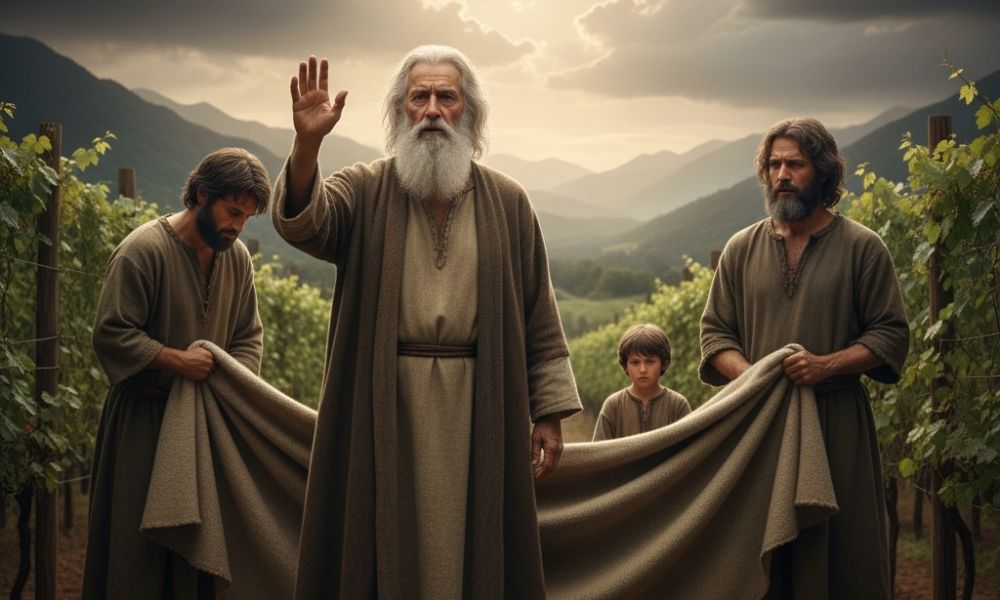
After the Flood, Noah and his sons began to repopulate the earth. Though Noah was a righteous man chosen to preserve humanity, this post-Flood account reveals both the reality of human weakness and the unfolding of divine prophecy. In an incident involving Noah’s drunkenness and his son Ham’s dishonor, Noah pronounced a curse on Ham’s son Canaan—a declaration that carried far-reaching consequences for future generations.
Quick Facts
Main Figures: Noah, Ham, Shem, Japheth, and Canaan
Location: Post-Flood world, likely near Mount Ararat or early Mesopotamia
Event: The curse of Canaan following Noah’s shame and Ham’s dishonor
Scripture: Genesis 9:18–27
Key Theme: Honor, respect, and divine justice through prophetic blessing and curse
Symbolism: The beginning of moral and spiritual divisions among humanity’s descendants
Biblical Context
After surviving the Flood, Noah became “a man of the soil” and planted a vineyard (Genesis 9:20). When he drank from the wine and became drunk, he lay uncovered in his tent.
Ham, one of his sons, saw his father’s nakedness and went out to tell his brothers, instead of showing respect or covering him. His brothers, Shem and Japheth, walked backward with a garment to cover their father without looking.
When Noah awoke and learned what had been done, he pronounced a prophetic curse—not on Ham himself, but on Ham’s son Canaan—and blessings on Shem and Japheth.
The Passage (Genesis 9:24–27)
“When Noah awoke from his wine and knew what his youngest son had done to him, he said,
‘Cursed be Canaan;
a servant of servants shall he be to his brothers.’He also said,
‘Blessed be the Lord, the God of Shem;
and let Canaan be his servant.
May God enlarge Japheth,
and let him dwell in the tents of Shem,
and let Canaan be his servant.’”
The Sin and Its Nature
The sin here was not merely seeing Noah’s nakedness but dishonoring him through irreverence and mockery.
- Ham’s failure: Instead of covering his father’s shame, Ham exposed it.
- Shem and Japheth’s response: Out of reverence, they covered Noah carefully without gazing upon him.
- Spiritual meaning: This incident highlights the virtue of honor and discretion in contrast with shame and disrespect.
The Curse Explained
- Why Canaan and not Ham?
The curse targeted Ham’s son Canaan, possibly because Ham’s moral character was passed down to his offspring, or because God foresaw the corruption of the Canaanite nations who would later occupy the Promised Land and be judged by Israel.
It was prophetic, not personal — foretelling the subjugation of Canaan’s descendants. - “Servant of Servants”:
This phrase indicates complete subjugation — Canaan’s line would serve the descendants of Shem and Japheth.
The Blessings
- Blessing on Shem:
“Blessed be the Lord, the God of Shem.”
Through Shem’s line would come Abraham, Israel, the prophets, and ultimately Jesus Christ — the covenant line through which God’s redemptive plan would unfold. - Blessing on Japheth:
“May God enlarge Japheth.”
His descendants (often associated with Indo-European peoples) would spread widely across the earth and “dwell in the tents of Shem,” meaning they would share in the spiritual blessings of Shem’s covenant line — fulfilled as Gentiles came to share in salvation through Christ.
Historical and Theological Significance
- Prophetic Fulfillment:
Centuries later, the descendants of Canaan (the Canaanite nations) became morally corrupt and were conquered by the Israelites (descendants of Shem) during Joshua’s conquest (Joshua 3–12). - Moral Lesson:
This event warns against disrespect toward authority and family, especially in spiritual contexts. - Covenantal Implications:
The blessings and curses show how God’s purposes in salvation and judgment are carried through families and generations.
Character Dynamics
- Noah: A righteous but human man, whose failure reveals that even the godly are imperfect. Yet God still spoke through him prophetically.
- Ham: Represents moral carelessness and irreverence.
- Shem: Represents reverence and covenant faithfulness — the chosen line of divine blessing.
- Japheth: Symbolizes expansion and inclusion in divine blessing.
- Canaan: Represents the future nations marked by moral corruption and subjugation.
Symbolism / Typology
- Nakedness and Shame: Symbolic of humanity’s sin and the need for covering — a theme that traces back to Adam and Eve (Genesis 3:21).
- Covering by Shem and Japheth: Symbolic of righteousness and grace covering sin — a foreshadowing of Christ’s redemptive work.
- Canaan’s Servitude: Represents the bondage of sin and the eventual triumph of God’s covenant people over moral corruption.
Spiritual Lessons
- Honor Brings Blessing: Respect for parents and spiritual authority aligns with God’s order.
- Sin Has Generational Effects: Ham’s dishonor affected his descendants, showing the lasting reach of moral choices.
- God’s Sovereignty: Even in human failure, God’s plan for redemption and justice moves forward.
- Grace Over Shame: Shem and Japheth’s act of covering points to the grace that covers sin — fulfilled perfectly in Jesus Christ.
Legacy & Impact
- Canaan’s Descendants: Became the nations of the Canaanites, Phoenicians, and others — often enemies of Israel.
- Shem’s Line: Produced Abraham, Israel, and the Messiah.
- Japheth’s Line: Spread throughout Europe and Asia, fulfilling the “enlargement” prophecy.
This passage became foundational for understanding God’s unfolding plan for nations, blessing, and redemption — not racial or ethnic superiority, but spiritual order and covenant purpose.
Summary
After Noah’s drunkenness and Ham’s disrespect, Noah cursed Ham’s son Canaan, prophesying servitude for his descendants and blessing for Shem and Japheth — marking the beginning of God’s covenant line through Shem and setting the course for humanity’s future divisions and destinies.







Leave a Reply