
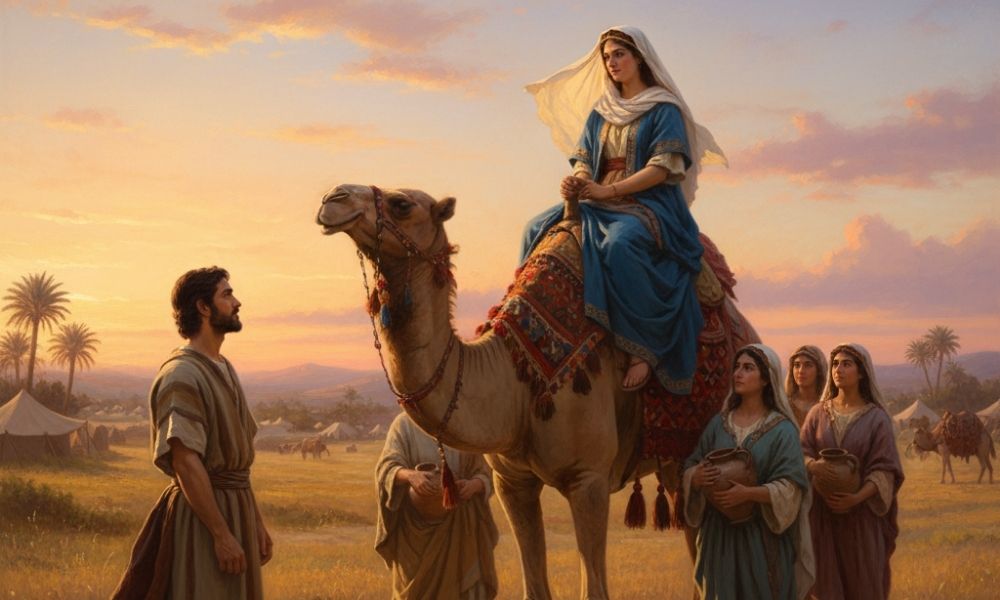
The marriage of Isaac and Rebekah is one of the most beautiful love stories in the Bible — not born of chance, but of divine guidance, prayer, and covenant faithfulness. It reveals God’s providence in continuing His promise through the chosen family of Abraham, and highlights the virtues of faith, obedience, and love. The story of their union, recorded in Genesis 24, shows how God directs human lives according to His divine plan.
Event: Marriage of Isaac and Rebekah
Main Figures: Isaac, Rebekah, Abraham’s servant (traditionally Eliezer)
Location: From Nahor in Mesopotamia to the land of Canaan
Scriptural Reference: Genesis 24
Themes: Divine guidance, answered prayer, covenant continuation, faith, love
Symbol: The well — representing providence, purity, and divine leading
Abraham’s Faith and the Servant’s Mission
As Abraham neared the end of his life, his heart turned toward securing a godly wife for his son, Isaac. Determined that Isaac not marry among the Canaanites, he entrusted his senior servant with a sacred mission — to travel to his homeland and find a wife from his own kin. Abraham declared confidently:
“The LORD, the God of heaven… will send His angel before you so that you can get a wife for my son from there.”
(Genesis 24:7)
This mission was not just about marriage — it was about continuing the covenant promise that God had made with Abraham: that his descendants would become a great nation through whom all the earth would be blessed.
At the Well — The Servant’s Prayer
Arriving in the city of Nahor, the servant stopped by a well outside the town at evening, the time when women came to draw water. There, he prayed earnestly for a specific sign from God:
“May it be that when I say to a young woman, ‘Please let down your jar that I may have a drink,’ and she says, ‘Drink, and I’ll water your camels too’ — let her be the one you have chosen for your servant Isaac.”
(Genesis 24:14)
Before he even finished praying, Rebekah appeared — beautiful, gracious, and carrying her water jar. Her actions precisely fulfilled the sign he had asked of God, revealing her generous and humble spirit.
Divine Confirmation and Family Consent
Amazed, the servant gave her gifts of gold and asked about her family. When he learned that she was the granddaughter of Nahor, Abraham’s brother, he bowed down and worshiped the LORD, saying:
“Praise be to the LORD… who has not abandoned his kindness and faithfulness to my master.”
(Genesis 24:27)
Rebekah’s family — her father Bethuel and brother Laban — recognized God’s hand in the matter and said, “This is from the LORD; we can say nothing to you one way or the other.” (Genesis 24:50). When asked if she would go, Rebekah responded with courage and faith:
“I will go.”
(Genesis 24:58)
Like Abraham before her, Rebekah left her homeland to follow God’s calling into the unknown.
The Meeting of Isaac and Rebekah
As Rebekah and her attendants journeyed to Canaan, Isaac was in the fields, meditating in the evening. When he looked up and saw the approaching camels, he met the woman chosen for him by God. Rebekah covered herself with a veil in modesty, and the servant told Isaac all that had happened.
“Isaac brought her into the tent of his mother Sarah, and he married Rebekah. So she became his wife, and he loved her; and Isaac was comforted after his mother’s death.”
(Genesis 24:67)
This tender verse captures both the depth of their love and the comfort that Rebekah brought into Isaac’s life — a union ordained by divine will.
Symbolism and Spiritual Meaning
- The Well: A symbol of God’s provision, purity, and destiny. Many significant biblical unions occur near wells — places of meeting and divine encounter.
- The Servant’s Prayer: Illustrates faith and dependence on God’s guidance.
- Rebekah’s Willingness: Reflects obedience, courage, and trust in divine purpose.
- Isaac and Rebekah’s Marriage: Symbolizes love rooted in God’s plan — not chance, but covenant destiny.
- Rebekah’s Journey: Mirrors the believer’s walk of faith — leaving the familiar to follow God’s call.
Key Verse
Genesis 24:67 (NIV)
“Isaac brought her into the tent of his mother Sarah, and he married Rebekah. So she became his wife, and he loved her; and Isaac was comforted after his mother’s death.”
Legacy
The marriage of Isaac and Rebekah stands as a timeless example of God’s faithfulness and guidance in life’s most personal matters. Their story reflects how prayer, faith, and divine providence work together to fulfill God’s covenant promises. Through their union came Jacob, the father of the twelve tribes of Israel, and through their lineage — the Messiah Himself.







Leave a Reply