
The marriage of Ruth and Boaz is the climax of the Book of Ruth, transforming a story of famine and funeral into one of harvest and wedding. This union was not merely romantic; it was a legal and redemptive act based on the Hebrew law of the “Kinsman-Redeemer” (Goel). By marrying Ruth, Boaz accepted the responsibility to provide an heir for her deceased husband’s lineage and to buy back the family land that Naomi had lost. This act of grace secured Ruth’s future, restored Naomi’s joy, and established the lineage that would eventually produce King David and Jesus Christ.
Quick Facts
- Husband: Boaz (Name means “In him is strength”)
- Wife: Ruth (The Moabite)
- Legal Custom: Levirate Marriage / Kinsman-Redeemer (Goel)
- Location: The City Gate of Bethlehem
- Child: Obed (Father of Jesse, Grandfather of David)
- Key Scripture: Ruth 4:9–17
- Significance: The Gentile Ruth is officially grafted into the tribe of Judah.
Key Concept: The Kinsman-Redeemer (Goel)
To understand this marriage, one must understand the law behind it (Leviticus 25:25, Deuteronomy 25:5–10). A close relative had the duty to:
- Redeem Property: Buy back family land sold due to poverty to keep it within the clan.
- Redeem Persons: Buy back a relative who had sold themselves into slavery.
- Levirate Marriage: If a man died without a son, his brother (or close kin) was to marry the widow. The first son born would be legally considered the son of the deceased, ensuring his name did not die out.
The Legal Proceeding (The City Gate)
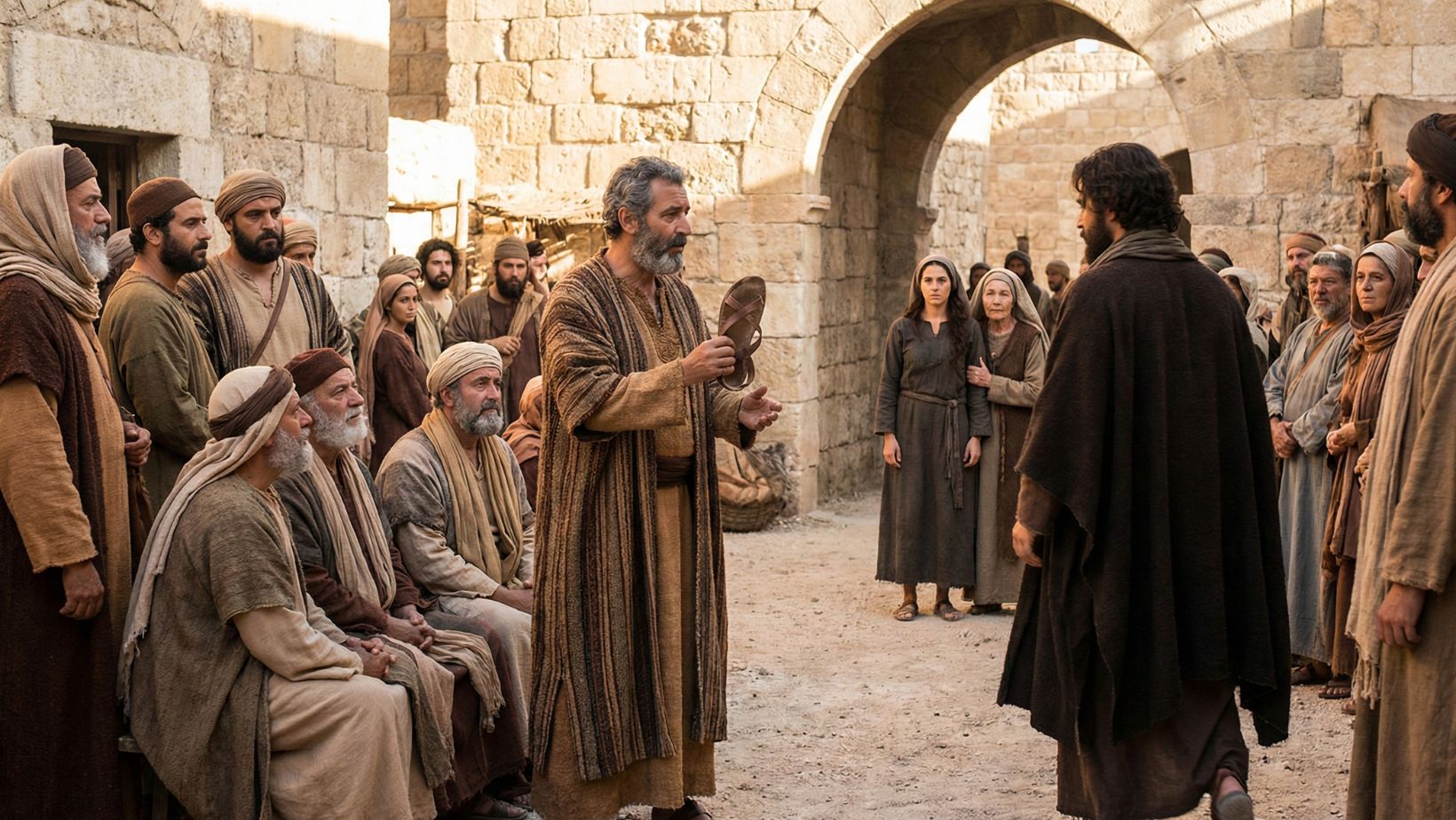
Before the marriage could happen, Boaz had to clear a legal hurdle. There was another relative closer to Naomi than Boaz.
The Confrontation: Boaz convened a court of ten elders at the city gate (the ancient equivalent of a courthouse/city hall).
The Offer: Boaz told the closer kinsman that Naomi was selling Elimelech’s land. The man immediately agreed to buy it, as it was a good investment.
The Catch: Boaz then revealed the condition: “On the day you buy the land… you also acquire Ruth the Moabite, the dead man’s widow, in order to maintain the name of the dead with his property” (Ruth 4:5).
The Refusal: Upon hearing he had to marry Ruth, the man backed down. Doing so would complicate his own estate and inheritance (since the child would belong to Elimelech’s line, not his).
The Sandal Ceremony: To seal the transaction, the man removed his sandal and gave it to Boaz. This was the ancient custom of renouncing rights to property or position (Ruth 4:7).
The Marriage and Blessing
The Vow: Boaz publicly declared that he had acquired Mahlon’s widow, Ruth, to preserve the dead man’s name.
The Community Blessing: The elders blessed Ruth with a powerful prophecy:
“May the LORD make the woman who is coming into your home like Rachel and Leah, who together built up the family of Israel… May your family be like that of Perez, whom Tamar bore to Judah.” (Ruth 4:11–12).
The Birth of Obed: The Lord enabled Ruth to conceive, and she gave birth to a son named Obed (meaning “Servant” or “Worshiper”).
Impact on Naomi
The birth of Obed provided a resolution to Naomi’s bitterness. The women of Bethlehem declared: “Praise be to the LORD… He [Obed] will renew your life and sustain you in your old age. For your daughter-in-law, who loves you and who is better to you than seven sons, has given him birth.” (Ruth 4:14–15). Naomi took the child and became his nurse, symbolizing her total restoration.
Lineage / Genealogy
The book ends with a specific genealogy (Ruth 4:18–22) that connects the era of the Patriarchs to the era of the Kings:
- Perez (Son of Judah)
- Hezron
- Ram
- Amminadab
- Nahshon (Leader during the Exodus)
- Salmon (Married Rahab the harlot)
- Boaz (Married Ruth the Moabitess)
- Obed
- Jesse
- David (The King)
Symbolism / Typology
- The Goel: Just as Boaz had the right (as a kinsman), the means (wealth), and the will (love) to redeem Ruth, Jesus became our Kinsman (human) to redeem us.
- The Bride: Ruth represents the Gentile church—foreigners and strangers who are brought into the covenant family through the grace of the Redeemer.
- The Price: Boaz paid the price publicly at the gate; Christ paid the price publicly at the cross.







Leave a Reply