
Samson is the final and most famous Judge in the book of Judges (Chapters 13–16), a figure of immense paradox. He was a man of supernatural physical strength but crippling moral weakness; a Nazirite dedicated to God from the womb, yet a man who repeatedly violated his vows; a hero called to deliver Israel, who fought largely for personal vengeance. His life is a dramatic saga of wasted potential, ending in a solitary act of sacrificial victory that destroyed the Philistine leadership.
Quick Facts
- Name: Samson (Hebrew: Shimshon)
- Meaning: “Sun” or “Little Sun”
- Tribe: Dan
- Era: ~11th Century BCE (40-year Philistine oppression)
- Key Identity: Nazirite from birth
- Source of Strength: The Spirit of the Lord (symbolized by his uncut hair)
- Weakness: Philistine women (uncontrolled lust)
- Nemesis: The Philistines
- Lover/Betrayer: Delilah
The Nazirite Vow
Samson was unique because his vow was lifetime and divinely imposed before birth, not voluntary or temporary (Numbers 6). It involved three strict prohibitions:
- Dietary: No wine, grapes, or fermented drink.
- Ritual Purity: No contact with dead bodies.
- Appearance: No razor was ever to touch his head.
Analysis: Samson systematically broke these vows. He likely drank at his wedding feast (feasts traditionally involved alcohol), he touched the dead carcass of a lion to get honey, and he ultimately allowed his hair to be cut.
Major Feats of Strength
Samson’s feats were not the result of bulky muscles, but sudden bursts of the Holy Spirit’s power (“The Spirit of the LORD came powerfully upon him”).
1. The Lion of Timnah: While on his way to woo a Philistine woman, a young lion attacked him. Samson tore it apart with his bare hands “as he might have torn a young goat” (Judges 14:6).
2. The 300 Foxes: After his father-in-law gave Samson’s wife to another man, Samson caught 300 foxes (or jackals), tied their tails together in pairs with lit torches, and released them into the standing grain of the Philistines, destroying their food supply (Judges 15:4–5).
3. The Jawbone of a Donkey: After the Philistines came to arrest him, he snapped his ropes, grabbed a fresh (bloody) jawbone of a donkey, and struck down 1,000 men. He named the place Ramath Lehi (“Jawbone Hill”) (Judges 15:15).
4. The Gates of Gaza: Trapped in the city of Gaza, Samson ripped the city gates—posts, bar, and all—out of the ground, carried them on his shoulders up a hill facing Hebron (approx. 40 miles away/uphill), leaving the city defenseless and humiliated (Judges 16:3).
The Downfall: Delilah and the Valley of Sorek
Samson’s downfall was not instantaneous but the result of a long drift toward compromise. It culminated in his relationship with Delilah, a woman bribed by the Philistine rulers (5,500 shekels of silver total) to discover the secret of his strength.
The Seduction: Delilah pestered Samson three times to reveal his secret. He lied three times (fresh bowstrings, new ropes, weaving his hair into a loom).
The Betrayal: “With such nagging she prodded him day after day until he was sick to death of it” (Judges 16:16). He finally revealed that his hair was the symbol of his dedication to God.
The Capture: While he slept on her lap, a man shaved off his seven braids. The text records one of the saddest lines in Scripture: “He awoke from his sleep and thought, ‘I will go out as before and shake myself free.’ But he did not know that the LORD had left him.”
The Consequence:
- Physical: His eyes were gouged out.
- Social: He was bound with bronze shackles.
- humiliation: He was forced to grind grain in prison (women’s work/livestock work).
The Final Victory
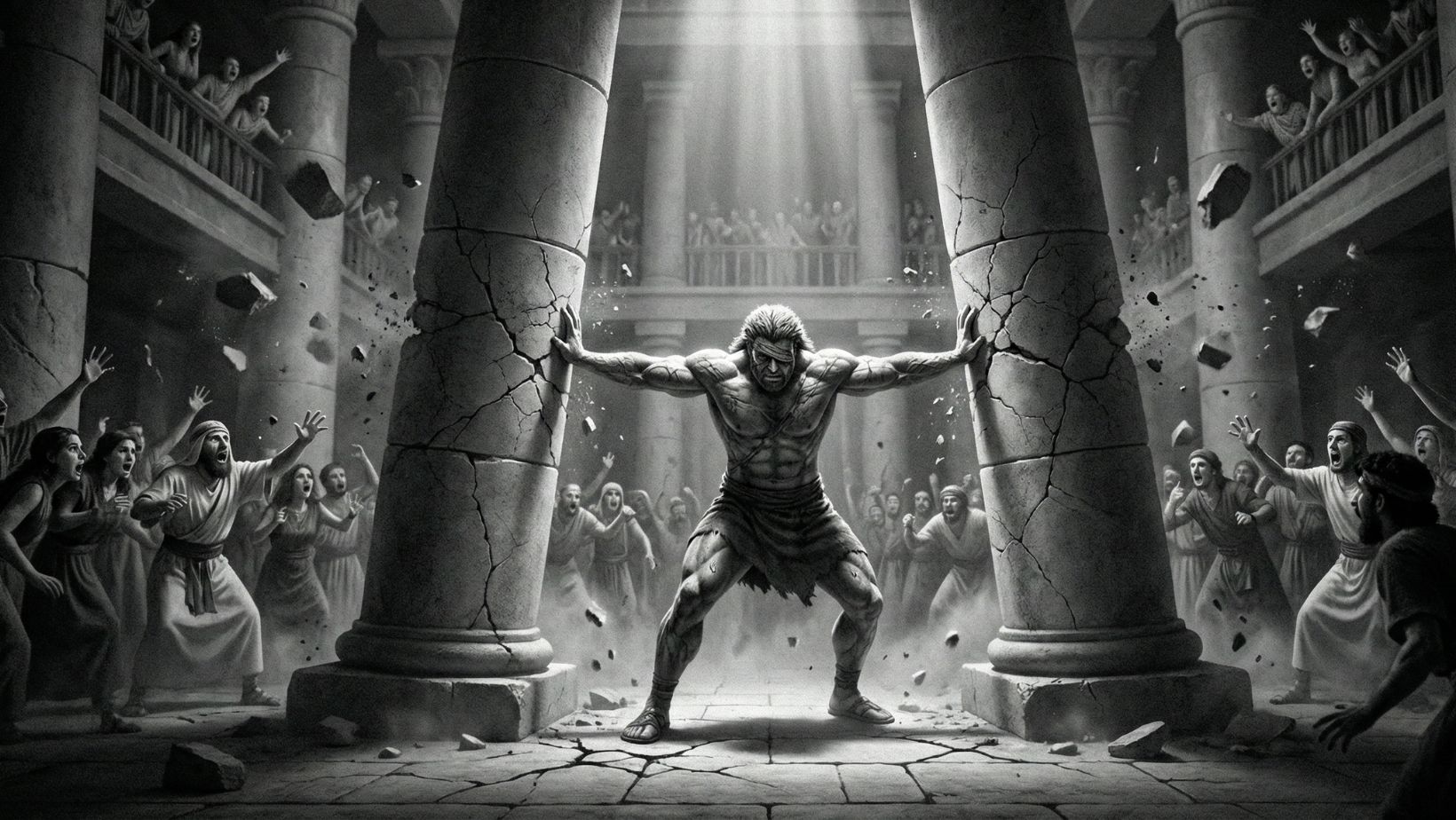
During a festival to Dagon (the grain/fish god), the Philistines brought Samson out to entertain them. Thousands of Philistines, including all five rulers, were on the roof and in the temple.
The Prayer: Samson prayed one final time, not for Israel’s sake, but for vengeance: “Sovereign LORD, remember me. Please, God, strengthen me just once more, and let me with one blow get revenge on the Philistines for my two eyes.”
The Act: He pushed apart the two central pillars supporting the temple. The structure collapsed, killing Samson and everyone inside. The text notes, “He killed many more when he died than while he lived.”
Legacy & Impact
A Flawed Deliverer: Samson represents Israel at this time—consecrated to God yet flirting with idolatry and the world.
Wasted Potential: He judged Israel for 20 years, yet unlike other judges, he never led an army, never united the tribes, and never truly liberated his people; he only began the deliverance.
Hebrews 11: Despite his failures, he is listed in the Hall of Faith, emphasizing that salvation is by grace, not moral perfection.
Symbolism / Typology
Type of Christ:
- Both had miraculous births announced by angels.
- Both were betrayed for silver by someone close to them.
- Both were handed over to the Gentiles by their own people (Judah handed Samson over).
- Both destroyed the power of the enemy through their own death.
The Hair: His hair was not “magical”; it was the external sign of his internal covenant. When the sign was removed (indicating the covenant was fully broken), the power left.







Leave a Reply