
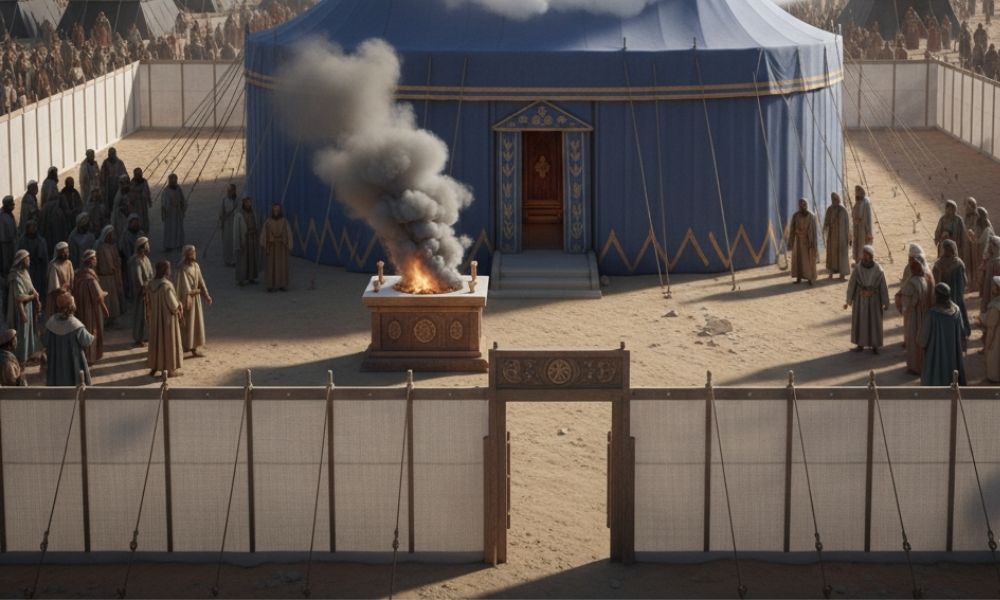
The construction of the Tabernacle was the divinely-ordered creation of a portable, holy sanctuary where God would dwell among the Israelites. After establishing His covenant at Mount Sinai, God gave Moses a precise, detailed blueprint for this “dwelling place” (Mishkan). This project was an act of both God’s grace—His desire to be near His people—and the people’s obedience, who generously provided the materials and labor, led by the Spirit-filled artisans Bezalel and Oholiab.
- Event: Construction of the Tabernacle
- Biblical Name: Mishkan (Hebrew for “Dwelling Place” or “Residence”)
- Location: The wilderness, at the base of Mount Sinai
- Era: The Exodus, immediately after the giving of the Law
- Books: Exodus (Chapters 25–31 [The Plan], 35–40 [The Construction])
- Key Figures: God (The Architect), Moses (The Overseer), Bezalel and Oholiab (The Artisans), The Israelites (The Donors)
- Purpose: To be a holy, visible, and portable sanctuary for God’s presence to dwell among His people.
- Key Themes: God’s holiness, God’s presence, worship, sacrifice, atonement, obedience, divine pattern
- Legacy: The center of Israelite worship for 400 years; the model for the permanent Temple in Jerusalem.
Event Definition
The construction of the Tabernacle was the sacred project, following God’s exact specifications, to build a “tent of meeting” for Him. It was comprised of a layered tent structure, a surrounding courtyard, and holy furniture. Every detail, from the materials to the dimensions, was given by God to Moses to create a physical space that would illustrate God’s holiness and His covenant relationship with Israel.
Biblical Context
The command to build the Tabernacle was given to Moses on Mount Sinai, immediately after God gave the Ten Commandments. The instructions are given before the Golden Calf rebellion, but the construction largely takes place after it. This timing is critical: it shows that even after Israel’s great sin, God, in His mercy and faithfulness, renewed His covenant and moved forward with His plan to dwell among them.
Cultural / Religious Context
In the ancient Near East, all nations had temples for their gods. However, these temples housed physical idols and were fixed in one location. The Tabernacle was revolutionary:
- It was portable: Designed to be disassembled and moved, showing that God was traveling with His nomadic people.
- It had no idol: The most holy place contained the Ark of the Covenant, which held the Ten Commandments—God’s word and presence, not a man-made image. This radically defined God as an unseen, covenantal, and holy Being.
Key Figures Involved
- God (Yahweh): The Chief Architect, who provided the “pattern” for every detail.
- Moses: The project manager, who received the blueprint from God and relayed it to the people.
- Bezalel and Oholiab: The master craftsmen whom God “filled… with the Spirit of God” (Exodus 31:3), giving them the divine skill, wisdom, and artistry needed to complete the intricate work.
- The Israelites: The people, who responded with such overwhelming generosity, offering their gold, silver, linens, and skills, that Moses had to command them to stop giving.
Main Elements of the Tabernacle
The structure was organized in three main areas, each representing a step closer to God’s holy presence:
- The Outer Courtyard: A large, open-air space enclosed by a linen fence. It was accessible to all Israelites and contained:
- The Bronze Altar: Where animal sacrifices for sin were made.
- The Bronze Laver: A basin for the priests to wash, symbolizing the need for purity.
- The Holy Place: The first room of the tent itself, accessible only to the priests. It contained:
- The Golden Lampstand (Menorah): Providing light, symbolizing God’s light.
- The Table of Showbread: Holding 12 loaves, representing God’s provision for the 12 tribes.
- The Altar of Incense: Where incense was burned, symbolizing the prayers of the people rising to God.
- The Most Holy Place (Holy of Holies): The innermost, perfectly square room, separated by a thick veil. It was the place of God’s manifest presence. Only the High Priest could enter, and only once per year on the Day of Atonement. It contained:
- The Ark of the Covenant: A gold-covered box containing the stone tablets of the Ten Commandments. Its lid was the Mercy Seat, where God’s presence, the Shekinah glory, was said to dwell.
Notable Passages
- Exodus 25:8–9: “And let them make me a sanctuary, that I may dwell in their midst. Exactly as I show you concerning the pattern of the tabernacle, and of all its furniture, so you shall make it.”
- Exodus 31:2–3: “See, I have called by name Bezalel… and I have filled him with the Spirit of God, with ability and intelligence, with knowledge and all craftsmanship…”
- Exodus 36:5–7: “…The people bring much more than enough for the work… So Moses gave command… ‘Let neither man nor woman do any more work for the offering’… And the material they had was sufficient for all the work to be done, and more.”
- Exodus 40:34: “Then the cloud covered the tent of meeting, and the glory of the LORD filled the tabernacle.”
Legacy & Impact
- Center of Worship: The Tabernacle was the center of Israel’s national and spiritual life for 400 years, from the wilderness wanderings until King Solomon built the permanent Temple.
- Sacrificial System: It was the place where the entire sacrificial system, the means of atonement and fellowship with God, was carried out.
- God’s Immanence: It was a constant, tangible reminder that God was not a distant deity but a holy King dwelling in the very center of their camp.
Symbolism / Typology
The Tabernacle is rich with symbolism, seen as a “copy and shadow of the heavenly things” (Hebrews 8:5).
- The Pathway to God: The layout (Altar, Laver, Holy Place, Most Holy Place) symbolized the progressive journey required for a sinful person to approach a holy God.
- The Veil: Symbolized the separation between God and humanity due to sin. In the New Testament, this veil was “torn in two” at Christ’s death, symbolizing that He had opened the way to God.
- The High Priest: A type of Christ, the one mediator who could enter the holy presence.
- The Sacrifices: Pointed to the need for a final, perfect sacrifice for sin, which Christians believe was fulfilled in Jesus Christ.
- Jesus as the Tabernacle: The New Testament (John 1:14) states that Jesus “became flesh and dwelt (literally, ‘tabernacled’) among us.” Jesus is seen as the ultimate fulfillment: He is God’s presence dwelling with humanity in person.







Leave a Reply