
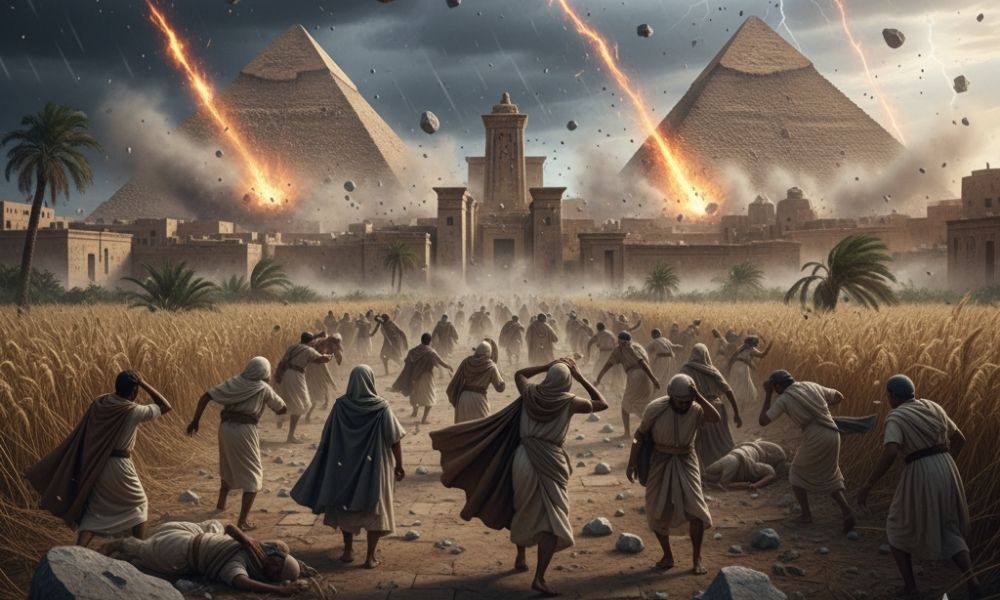
The Ten Plagues were a series of ten catastrophic judgments inflicted by God upon the nation of Egypt, as chronicled in the Book of Exodus. These devastating events were not random acts of nature but deliberate signs and wonders orchestrated through Moses and Aaron. Their purpose was twofold: to demonstrate the absolute sovereignty and power of Yahweh (the God of Israel) over the pantheon of Egyptian gods, and to compel the hard-hearted Pharaoh to release the Israelites from centuries of brutal slavery.
- Event: The Ten Plagues of Egypt
- Biblical Name: Makkot Mitzrayim (Hebrew for “Plagues of Egypt”)
- Location: The land of Egypt, focusing on the Nile Delta and the capital
- Era: The Time of the Exodus (~15th–13th century BCE)
- Book: The Book of Exodus (Chapters 7–12)
- Key Figures: God (Yahweh), Moses, Aaron, Pharaoh
- Purpose: To demonstrate God’s power, judge Egypt’s gods, and liberate Israel
- Key Themes: Divine sovereignty, judgment, hard-heartedness, redemption, deliverance
- Legacy: The Exodus of the Israelites and the institution of the Passover
Event Definition
The Ten Plagues were a series of escalating divine judgments targeting Egypt’s land, economy, people, and, most importantly, its religious system. Each plague was a direct assault on a specific Egyptian deity or area of belief, demonstrating God’s power over all creation. They began with natural afflictions and culminated in a supernatural, devastating loss.
Biblical Context
The plagues occurred after generations of Israelite enslavement in Egypt. God, remembering His covenant with Abraham, Isaac, and Jacob, called Moses to confront Pharaoh with the simple command: “Let my people go” (Exodus 5:1). Pharaoh refused, and his “hard heart” became the symbolic battleground for a contest of wills between the ruler of Egypt and the God of the universe.
Cultural / Religious Context
This event was a theological war. Egypt worshipped a vast pantheon of gods tied to nature: Hapi (the Nile), Heqet (fertility, a frog), Ra (the sun god), Hathor (a cow goddess), and Pharaoh himself, who was considered a living god. The plagues were targeted attacks:
- Water to Blood challenged Hapi.
- Frogs challenged Heqet.
- Disease on Livestock challenged deities like Hathor and Apis (the bull god).
- Total Darkness challenged Ra, Egypt’s supreme deity.
- Death of the Firstborn challenged Pharaoh’s own divine status and his heir.
Key Figures Involved
- God (Yahweh): The initiator of the plagues, demonstrating His power and faithfulness to His covenant.
- Moses: God’s chosen prophet and mediator, who announced each plague to Pharaoh.
- Aaron: Moses’ brother and spokesman, who often performed the sign (e.g., striking the Nile).
- Pharaoh: The unnamed ruler of Egypt (identity is debated). He is the story’s antagonist, defined by his stubbornness and “hard heart,” which God is said to have “hardened” as a form of judgment.
- Egyptian Magicians: (Jannes and Jambres, according to later tradition). They replicated the first two plagues but were overwhelmed by the third, admitting, “This is the finger of God” (Exodus 8:19).
The Ten Plagues (In Order)
- Water to Blood (Exodus 7:14–24): The Nile River and all water in Egypt turned to blood, killing the fish.
- Frogs (Exodus 8:1–15): Frogs swarmed the land, even entering homes and bedrooms.
- Gnats or Lice (Exodus 8:16–19): Swarms of insects infested the people and animals.
- Flies (Exodus 8:20–32): Thick swarms of flies plagued Egypt, but God “set apart” the Land of Goshen, where the Israelites lived, protecting them.
- Pestilence on Livestock (Exodus 9:1–7): All of Egypt’s livestock (horses, donkeys, cattle, etc.) were struck with a deadly disease, while Israel’s were unharmed.
- Boils (Exodus 9:8–12): Painful boils broke out on the skin of all Egyptians and their remaining animals.
- Hail and Fire (Exodus 9:13–35): A catastrophic storm of hail mixed with fire rained down, destroying crops and people, but sparing Goshen.
- Locusts (Exodus 10:1–20): A massive swarm of locusts consumed every remaining plant.
- Darkness (Exodus 10:21–29): A thick, “tangible” darkness covered Egypt for three days, but the Israelites had light.
- Death of the Firstborn (Exodus 11:1–12:30): The final, devastating plague. At midnight, God struck down every firstborn son in Egypt, from Pharaoh’s heir to the firstborn of the prisoners and cattle. Israel was spared by obeying God’s command to apply the blood of a lamb to their doorposts.
Notable Passages
- Exodus 7:5: “The Egyptians shall know that I am the LORD, when I stretch out my hand against Egypt and bring out the people of Israel from among them.”
- Exodus 9:16: “But for this purpose I have raised you up, to show you my power, so that my name may be proclaimed in all the earth.”
- Exodus 12:13: “The blood shall be a sign for you… And when I see the blood, I will pass over you, and no plague will befall you to destroy you when I strike the land of Egypt.”
Legacy & Impact
- The Exodus: The tenth plague finally broke Pharaoh’s will, leading directly to the Israelites’ departure from Egypt.
- The Passover: The feast of Passover (Pesach) was instituted during the final plague. It is an annual celebration that commemorates God’s deliverance, where the blood of the lamb caused the “Destroyer” to “pass over” Israelite homes.
- Foundation of Israel: The Exodus, initiated by the plagues, is the foundational redeeming event in the Old Testament, forging Israel’s identity as God’s chosen and delivered people.
Symbolism / Typology
- Egypt: Represents bondage, sin, and the worldly systems that stand in opposition to God.
- Pharaoh: A symbol of human pride and hard-hearted defiance against God’s will.
- The Passover Lamb: The sacrifice of a spotless lamb, whose blood provided protection from death, is seen in Christian theology as a powerful foreshadowing of Jesus Christ, the “Lamb of God who takes away the sin of the world” (John 1:29).
- The Exodus: The entire event is a type (a prefigurement) of spiritual salvation—deliverance from the slavery of sin (Egypt) into the new covenant life with God.
Extra-Biblical References
- The plagues are a cornerstone of Jewish, Christian, and Islamic traditions.
- While there is no direct Egyptian archaeological record that names Moses or confirms the plagues in order (victorious nations rarely chronicled their own divine defeats), some scholars have noted parallels between the plagues and natural phenomena.
- The “Ipuwer Papyrus,” an ancient Egyptian poem, describes a state of chaos and natural disaster in Egypt (e.g., “the river is blood”) that some, though debated, have speculatively linked to the era of the plagues.







Leave a Reply