
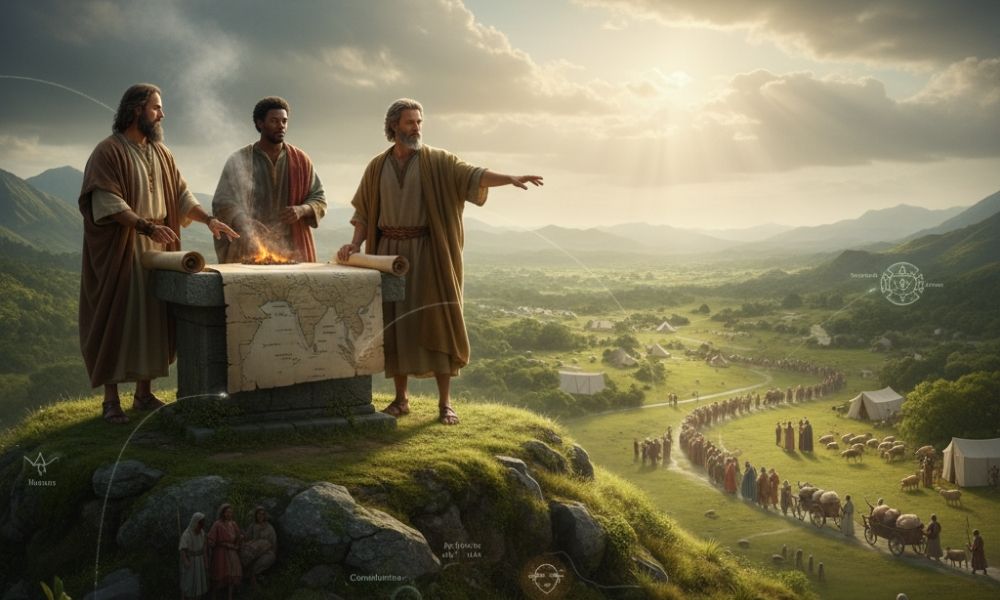
The Table of Nations in Genesis 10 records the descendants of Noah’s three sons — Shem, Ham, and Japheth — and shows how the nations of the earth were formed after the Flood. It is one of the oldest and most detailed ethnological records in human history, revealing how all peoples share a common origin. This chapter bridges the story of the Flood and the rise of nations, highlighting God’s providence in human history and His plan for all peoples to be blessed through Abraham’s lineage.
Quick Facts
Event Name: The Table of Nations
Location: Post-Flood world (Genesis 10)
Key Figures: Noah’s sons — Shem, Ham, and Japheth
Number of Nations Listed: 70 (symbolizing completeness)
Key Scripture: Genesis 10:32 — “From these the nations spread out over the earth after the flood.”
Purpose: To trace the origin of all nations and the spread of humanity across the earth
Symbolism: Unity of the human race under God, diversity of peoples, and the fulfillment of God’s command to “fill the earth” (Genesis 9:1)
Meaning of the Event
The Table of Nations is not just a genealogy; it is a map of humanity’s beginnings. After the Flood, as Noah’s sons and their descendants multiplied, they spread into various lands and regions, forming tribes, languages, and nations. This record shows both the unity of humankind — all from one family — and the diversity that fulfills God’s creative plan for the world.
Biblical Era / Timeline
Era: Early Post-Flood Period (After Genesis 9, before the Tower of Babel in Genesis 11)
Context: Humanity began to repopulate the earth following the Flood, spreading across regions that would later become the ancient world — from the Middle East to Africa, Europe, and Asia.
The Story
1. The Descendants of Japheth (Genesis 10:2–5)
- Japheth’s line spread north and west, forming the Indo-European nations — peoples of Europe and parts of Asia Minor.
- His descendants include Gomer, Magog, Madai, Javan, Tubal, Meshech, and Tiras.
- Javan’s descendants, such as Elishah and Tarshish, are associated with maritime peoples and coastal regions.
- Japheth’s lineage represents expansion, trade, and exploration — nations dwelling in “the coastlands.”
2. The Descendants of Ham (Genesis 10:6–20)
- Ham’s line settled primarily in Africa and parts of the Middle East.
- His sons were Cush, Mizraim (Egypt), Put, and Canaan.
- From Cush came Nimrod, the mighty hunter and founder of kingdoms such as Babel, Nineveh, and Assyria — the roots of great ancient empires.
- Canaan’s descendants settled in the land that would later bear his name, eventually becoming rivals to Israel.
- Ham’s lineage represents earthly power, civilization, and ambition — yet also rebellion, as seen in Babel’s founding.
3. The Descendants of Shem (Genesis 10:21–31)
- Shem’s line is the Semitic lineage, from which came the Hebrews, Arabs, and Assyrians.
- His sons were Elam, Asshur, Arphaxad, Lud, and Aram.
- From Arphaxad came Eber, the ancestor of the Hebrews.
- Shem’s descendants are associated with spiritual blessing, for through them would come Abraham, Israel, and ultimately the Messiah, Jesus Christ.
4. The Division of the Nations (Genesis 10:32)
“These are the clans of Noah’s sons, according to their lines of descent, within their nations. From these, the nations spread out over the earth after the Flood.”
This verse summarizes the beginning of ethnic, linguistic, and geographic diversity among humanity — the fulfillment of God’s command to fill the earth.
Symbolism & Meaning
| Symbol | Meaning |
|---|---|
| Three Sons of Noah | Unity and diversity of humanity |
| Seventy Nations | Completeness of human division under God’s plan |
| Nimrod’s Kingdoms | Human ambition and rebellion against divine rule |
| Shem’s Line | Covenant lineage leading to salvation |
| Japheth’s Expansion | Widening of humanity’s reach across the earth |
Theological Significance
- Unity in Creation: All nations share a common origin in Noah, showing that all humanity is one family before God.
- Diversity in Purpose: God ordained nations and languages to fulfill His plan for the earth.
- God’s Sovereignty: The rise and boundaries of nations are under God’s control (Acts 17:26).
- Messianic Line: Through Shem’s lineage came the promise of redemption that would bless all nations (Genesis 12:3).
Key Lessons
- All peoples originate from one Creator and share equal worth before God.
- Diversity is part of God’s design, not a result of chaos.
- Human civilization develops under both divine blessing and accountability.
- God’s redemptive plan encompasses every nation and people.
- True unity is restored in Christ, who gathers all nations into one kingdom (Revelation 7:9).
Legacy & Impact
- The Table of Nations remains a foundational document for understanding the spread of humanity and the origins of ancient peoples.
- It connects biblical history with world history, linking early civilizations to Noah’s family.
- It anticipates the Tower of Babel, where human pride sought to defy God’s order, leading to linguistic division.
- Ultimately, it looks forward to the redemption of all nations through Christ — reversing the divisions caused by sin.







Leave a Reply