
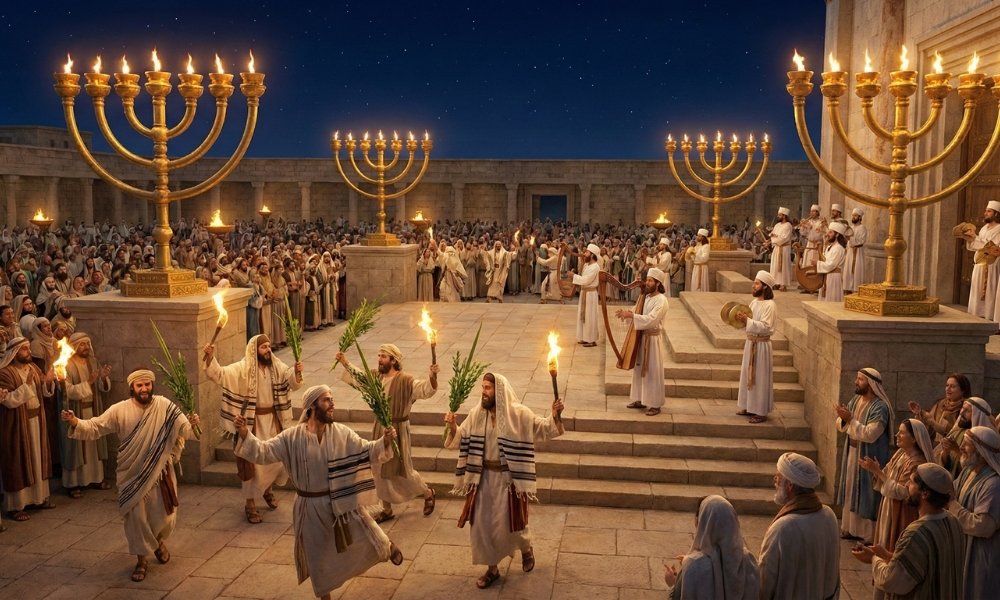
The Feast of Tabernacles, known in Hebrew as Sukkot, is the final and most joyous of the biblical Fall Feasts. Often called the “Season of Our Joy,” it is a week-long festival that commemorates God’s shelter and provision during the Israelites’ forty years of wandering in the wilderness. It also celebrates the final harvest of the year (the Ingathering). Prophetically, it points toward the Messianic Kingdom—the ultimate “tabernacling” of God with humanity—where all nations will gather to worship the King in Jerusalem.
Quick Facts
- Name: Feast of Tabernacles (Sukkot), Feast of Booths, Feast of Ingathering
- Meaning: “Booths,” “Huts,” or “Temporary Shelters”
- Instituted By: God (Yahweh)
- Scripture Reference: Leviticus 23:33–43; Deuteronomy 16:13–15; Zechariah 14:16–19
- Date: 15th–21st of Tishrei (Sept/Oct), starting 5 days after Yom Kippur
- Duration: 7 days (plus an 8th day assembly called Shemini Atzeret)
- Key Rituals: Building/dwelling in a Sukkah, waving the Lulav and Etrog
- Theme: Joy, Provision, Divine Presence, The Millennial Kingdom
- New Testament: Jesus teaches on “Living Water” and “Light of the World” during this feast (John 7–8)
Name Meaning
Sukkot: Plural of Sukkah, meaning a temporary shelter, booth, or hut. It refers to the fragile dwellings the Israelites lived in during the Exodus, reminding them that God is their true shelter.
Feast of Ingathering: (Chag HaAsif) refers to the agricultural aspect, as it marks the end of the fruit and olive harvest before the winter rains.
Origin / Historical Background
Wilderness Wandering: God commanded Israel to live in booths for seven days annually to remind future generations that He made them dwell in booths when He brought them out of Egypt (Leviticus 23:42–43).
Temple Dedication: King Solomon dedicated the First Temple during the Feast of Tabernacles (1 Kings 8:2), marking it as a time of immense national celebration and God’s glory filling the house.
Biblical Era / Context
Time: Late Autumn (Tishrei), immediately following the solemn days of Rosh Hashanah and Yom Kippur.
Setting: Families moved out of their permanent homes into temporary structures roofed with branches/foliage.
Cultural Context: In an agrarian society, this was the “paycheck” of the year—the final gathering of crops. It was one of the three “Pilgrimage Festivals” (Shalosh Regalim) requiring all Jewish males to appear before the Lord in Jerusalem.
Major Roles / Purpose
Remembrance: To recall the fragility of life in the desert and God’s supernatural protection (the Pillar of Cloud and Fire).
Thanksgiving: To express gratitude for the year’s harvest and material blessings.
Unity: Rich and poor alike dwelt in similar simple structures, erasing social distinctions.
Prophetic Hope: To anticipate the Millennial Kingdom when God will dwell permanently among His people.
Key Characteristics
The Sukkah: A three-sided structure with a roof made of organic material (schach), sparse enough to see the stars, symbolizing reliance on Heaven.
The Four Species (Arba Minim): A ritual involving waving four plants together: the Etrog (citron), Lulav (palm branch), Hadas (myrtle), and Aravah (willow). These represent the diversity of God’s people or the fruitfulness of the land.
Joy: It is the only feast where God explicitly commands His people to “be joyful” (Deuteronomy 16:14).
Water Libation: In the Second Temple era, priests poured water from the Pool of Siloam onto the altar daily to pray for rain, a ceremony called Simchat Beit HaShoevah.
Main Events Associated with the Feast
Solomon’s Temple: The Ark of the Covenant was brought into the Temple during this feast (2 Chronicles 5:3).
Ezra’s Reading: Upon returning from Babylon, the Israelites rediscovered the command to dwell in booths and celebrated Sukkot with a joy not seen since Joshua’s days (Nehemiah 8:13–17).
Jesus at the Feast:
- Living Water: On the “last and greatest day of the festival” (likely the 7th day, Hoshana Rabbah), as the water libation occurred, Jesus stood and cried out, “Let anyone who is thirsty come to me and drink” (John 7:37).
- Light of the World: Against the backdrop of the massive candelabras lit in the Temple courts during Sukkot, Jesus declared, “I am the light of the world” (John 8:12).
Major Relationships
God as Shelter: The Sukkah represents the “Clouds of Glory” that protected Israel.
The Nations: Uniquely, 70 bulls were sacrificed during Sukkot in the Temple, which tradition says corresponded to the 70 nations of the world, making it a festival with universal significance.
Messiah: The Transfiguration (Peter suggesting building three “tabernacles”) connects Jesus’ glory to this feast.
Notable Passages
Leviticus 23:42: “Live in temporary shelters for seven days: All native-born Israelites are to live in such shelters.”
Zechariah 14:16: Prophecy that in the end times, “the survivors from all the nations that have attacked Jerusalem will go up year after year to worship the King, the LORD Almighty, and to celebrate the Festival of Tabernacles.”
Revelation 21:3: “Look! God’s dwelling place [tabernacle] is now among the people, and he will dwell with them.”
John 1:14: “The Word became flesh and made his dwelling [literally: tabernacled] among us.”
Legacy & Impact
Thanksgiving Holiday: Many historians believe the American holiday of Thanksgiving was inspired by the biblical Sukkot, as the Pilgrims looked to the Bible for precedents of harvest celebrations.
Hospitality: The custom of Ushpizin invites symbolic guests (Abraham, Isaac, Jacob, etc.) and real guests (especially the poor) into the Sukkah, emphasizing charity.
Ecclesiastes: The book of Ecclesiastes is traditionally read during Sukkot to remind people that earthly possessions are fleeting (“vanity of vanities”), fitting the theme of temporary dwellings.
Symbolism / Typology
The Incarnation: Jesus “tabernacling” among men (John 1:14) is the ultimate fulfillment of God pitching His tent with humanity.
The Millennium: Sukkot is widely viewed as a type of the 1,000-year reign of Christ—a time of rest, peace, and God’s physical presence on earth.
The Fragility of Life: The temporary booth reminds believers that their earthly bodies are “tents” (2 Corinthians 5:1) and their true home is eternal.







Leave a Reply