
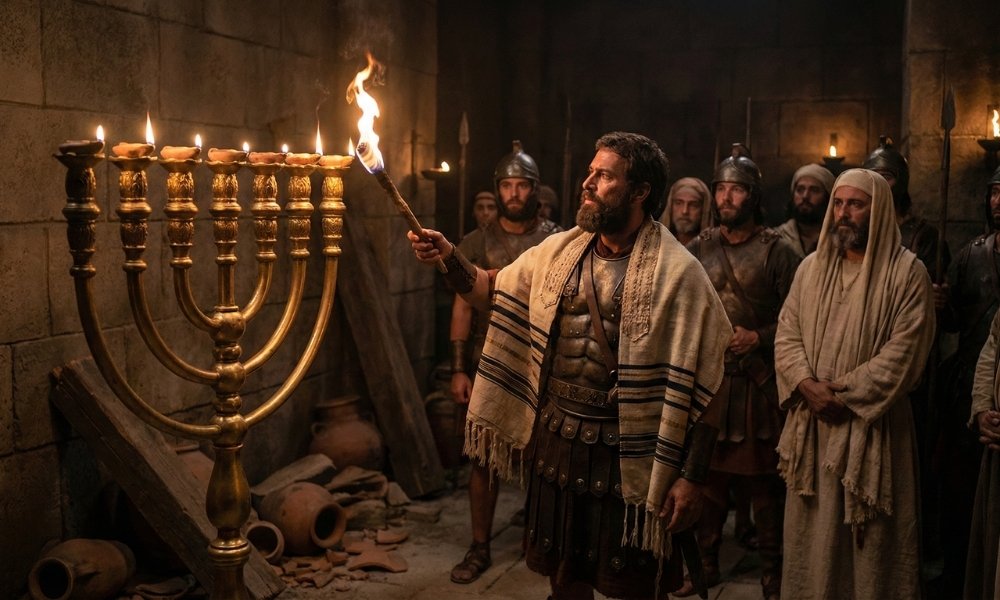
Hanukkah, also known as the Feast of Dedication or the Festival of Lights, is an eight-day winter celebration commemorating the military victory of the Jewish Maccabees over the Seleucid Greek Empire and the rededication of the Second Temple in Jerusalem. Unlike the major festivals of Moses (Passover, Shavuot, Sukkot), Hanukkah is not commanded in the Hebrew Bible (Old Testament) but is recorded in the historic books of the Maccabees. It stands as a profound testament to the survival of faith against forced assimilation and the triumph of light over darkness.
Quick Facts
- Name: Hanukkah (Hebrew: Chanukah)
- Meaning: “Dedication”
- Alternate Names: Feast of Dedication, Festival of Lights
- Historical Date: 164 BCE (25th of Kislev)
- Scripture Reference: 1 & 2 Maccabees (Apocrypha); John 10:22
- Key Figures: Judas Maccabeus, Mattathias, Antiochus IV Epiphanes
- Key Ritual: Lighting the Hanukkiah (9-branched candelabrum)
- Theme: Religious Freedom, Purity, Divine Intervention, Light
- Modern Customs: Eating fried foods (latkes, sufganiyot), playing dreidel, giving gelt (coins)
Name Meaning
Hanukkah: Derived from the Hebrew verb meaning “to dedicate.” It shares a root with the word Chinukh (education). The name specifically refers to the rededication of the Altar in the Temple after it had been defiled by pagan idolatry.
Origin / Historical Background
The Greek Threat: In the 2nd century BCE, the Seleucid King Antiochus IV Epiphanes sought to hellenize the Jews by force. He outlawed the Sabbath, circumcision, and Torah study.
The Abomination of Desolation: Antiochus seized the Jewish Temple, erected a statue of Zeus, and sacrificed a pig on the holy altar, fulfilling Daniel’s prophecy of the “abomination that causes desolation” (Daniel 11:31).
The Revolt: A priestly family known as the Hasmoneans (led by the father Mattathias and his son Judas “The Hammer” Maccabeus) launched a guerrilla war against the mighty Greek army. Against all odds, the small band of Jewish fighters drove the Greeks out of Jerusalem.
Biblical Era / Context
Time: The Intertestamental Period (the “400 Silent Years” between Malachi and Matthew).
Setting: Jerusalem and the Judean hill country.
Cultural Context: This was a clash of civilizations: Hebraism (centered on holiness and God’s law) versus Hellenism (centered on humanism, aesthetics, and philosophy).
Major Roles / Purpose
Rededication: The primary purpose was to cleanse the Temple of pagan idols and restore the service of God.
The Miracle of the Oil: According to the Talmud (Shabbat 21b), when the Jews recaptured the Temple, they found only one small jar of consecrated olive oil to light the Menorah. Though it was enough for only one day, it miraculously burned for eight days until new oil could be prepared.
Assertion of Identity: Hanukkah celebrates the refusal to conform to secular culture at the expense of biblical truth.
Key Characteristics
The Hanukkiah (Menorah): While the Temple Menorah had seven branches, the Hanukkah Menorah has nine: eight for the eight days of the miracle, and one “helper” candle (Shamash) used to light the others.
Publicizing the Miracle: The lights are placed in a window or doorway to “publicize the miracle” (Pirsumei Nisa) to the outside world.
Foods: Fried foods are eaten to commemorate the miracle of the oil.
The Dreidel: A spinning top game. Tradition says that during the persecution, Jews would study Torah in secret; when soldiers appeared, they would hide the scrolls and pretend to be playing a gambling game.
Main Events
The Spark: In the town of Modi’in, Mattathias refused to sacrifice to Greek gods and killed a fellow Jew who attempted to do so, sparking the revolt (1 Maccabees 2).
Guerrilla Warfare: Judas Maccabeus led tactical strikes, defeating larger, better-equipped Greek armies through knowledge of the terrain and spiritual zeal.
The Cleansing: Upon recapturing Jerusalem (164 BCE), they removed the defiled stones of the altar, built a new one, and relit the Menorah.
Jesus at Hanukkah: The Gospel of John records that Jesus was in Jerusalem for the “Feast of Dedication” (Hanukkah). It was winter, and He was walking in Solomon’s Colonnade (John 10:22–23).
Major Relationships
Judas Maccabeus vs. Antiochus IV: The archetypal battle between the “Man of Faith” and the “Antichrist figure.”
God & His People: Even in the “silent” years when no prophets were speaking, God was active in preserving His people so that the Messiah could eventually be born in a Jewish Bethlehem, not a Greek pagan city.
Notable Passages
Daniel 11:31–32: Prophecy of the event: “His armed forces will rise up to desecrate the temple fortress… With flattery he will corrupt those who have violated the covenant, but the people who know their God will firmly resist him.”
John 10:22–23: “Then came the Festival of Dedication at Jerusalem. It was winter, and Jesus was in the temple courts walking in Solomon’s Colonnade.”
1 Maccabees 4:59: “Then Judas and his brothers and the entire congregation of Israel decreed that the days of the dedication of the altar should be observed… for eight days a year.”
Legacy & Impact
Preservation of Monotheism: Without the Maccabean victory, Judaism might have been swallowed by Hellenism, meaning there would have been no Jewish community for Jesus to be born into two centuries later.
Religious Liberty: It is often cited as the first recorded war fought for the principle of religious freedom rather than territory or resources.
Zionism: The Maccabees became symbols of Jewish strength and self-determination, inspiring modern Zionism.
Symbolism / Typology
Light in Darkness: Hanukkah falls during the darkest time of the year (near the winter solstice), symbolizing that even a little light dispels much darkness.
The Servant Candle: The Shamash (servant candle) is the source of light for all other candles but is set apart. This is often seen by Messianic believers as a type of Messiah (the Suffering Servant) who gives light to the world.
Dedication of the Body: As the Temple was rededicated, believers are reminded that their bodies are temples of the Holy Spirit, requiring constant cleansing from worldly influence.







Leave a Reply