
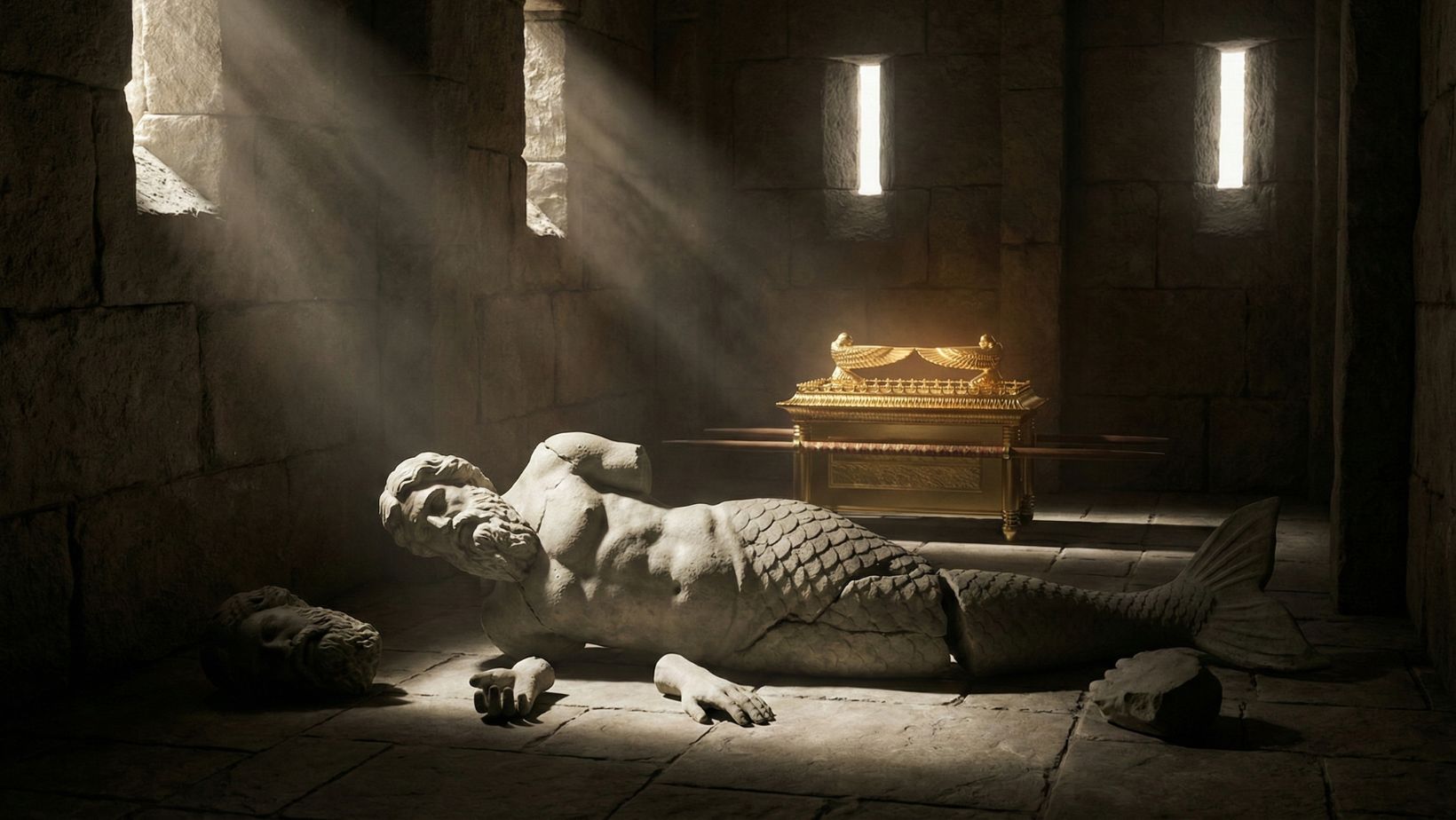
Ashdod was a formidable stronghold and one of the five principal cities of the Philistines. Located midway between Joppa and Gaza, it served as a primary center for the worship of the Philistine god Dagon. In biblical history, Ashdod is most famous for the dramatic confrontation between the Ark of the Covenant and the idol of Dagon, proving the supremacy of the God of Israel. It remained a significant city throughout the Old Testament, representing military might and cultural resistance to Israel, before reappearing in the New Testament under the Greek name Azotus, where Philip the Evangelist preached the Gospel.
Quick Facts
- Name: Ashdod (Hebrew: Ashdod; Greek: Azotus)
- Region: Philistia (Southern Coastal Plain)
- Political Status: Capital city of the Philistine Pentapolis
- Primary Deity: Dagon (the grain/fish god)
- Key Biblical Events: The Ark toppling Dagon; Nehemiah’s reforms; Philip’s preaching
- Modern Location: Modern-day city of Ashdod, Israel (a major port)
- Symbol: The Toppled Idol / The Stronghold
Name Meaning
Ashdod: derived from a root meaning “stronghold,” “fortress,” or “ravager.” The name reflects the city’s role as a heavily fortified military center that withstood numerous sieges throughout antiquity, including a 29-year siege by the Egyptian Pharaoh Psamtik I (according to Herodotus).
Geography / Historical Context
Location: Situated about 3 miles (5 km) inland from the Mediterranean Sea on the Via Maris trade route. Unlike Ashkelon, which was directly on the water, Ashdod controlled the inland road and had a separate port district (Ashdod-Yam).
The Pentapolis: It was often considered the primary religious capital among the five Philistine cities (Ashdod, Ashkelon, Ekron, Gath, and Gaza).
Major Roles / Identity
The Religious Center: It housed the supreme temple of Dagon, the national god of the Philistines.
The Cultural Corruptor: In the post-exilic period, Ashdod symbolized the threat of assimilation. The “language of Ashdod” became a specific point of contention for Nehemiah, representing the loss of Jewish identity.
The Targeted Fortress: Because of its strength, it was a key target for Assyrian conquests. The prophet Isaiah specifically dates a prophecy to the year the Assyrian commander captured Ashdod (Isaiah 20:1).
Key Biblical Events
The Ark vs. Dagon: After capturing the Ark of the Covenant in battle, the Philistines placed it in the temple of Dagon in Ashdod as a trophy. The next morning, the statue of Dagon was found fallen on its face. The following day, it was fallen again, with its head and hands broken off. The people of Ashdod were then struck with tumors/plague, forcing them to send the Ark away (1 Samuel 5).
Uzziah’s Conquest: The Judean King Uzziah successfully breached the walls of Ashdod and built Judean towns in their territory, temporarily subduing the city (2 Chronicles 26:6).
Intermarriage Crisis: After the Babylonian exile, Nehemiah was furious to find that Jewish men had married women from Ashdod and that their children “spoke the language of Ashdod” and could not speak Hebrew (Nehemiah 13:23–24).
Philip the Evangelist: In the New Testament, after baptizing the Ethiopian eunuch, Philip was “snatched away” by the Spirit and appeared at Azotus (Ashdod), preaching the gospel there as he traveled north to Caesarea (Acts 8:40).
Notable Passages
1 Samuel 5:3–4: “When the people of Ashdod rose early the next day, there was Dagon, fallen on his face on the ground before the ark of the LORD! … But the following morning when they rose, there was Dagon, fallen on his face… with his head and hands broken off…”
Isaiah 20:1: “In the year that the supreme commander, sent by Sargon king of Assyria, came to Ashdod and attacked and captured it…”
Nehemiah 13:24: “Half of their children spoke the language of Ashdod or the language of one of the other peoples, and did not know how to speak the language of Judah.”
Acts 8:40: “Philip, however, appeared at Azotus and traveled about, preaching the gospel in all the towns until he reached Caesarea.”
Legacy & Impact
The Sovereignty of Yahweh: The account of Dagon falling before the Ark is one of the clearest polemics in Scripture against idolatry, demonstrating that pagan gods are powerless before the presence of the True God.
Cultural Purity: “The language of Ashdod” remains a theological metaphor for worldly influence creeping into the church and diluting the language of faith and scripture.
Christian Continuity: The city’s transition from the center of Dagon worship (OT) to a site of evangelism by Philip (NT) shows the progression of God’s plan to reach the Gentiles.







Leave a Reply