
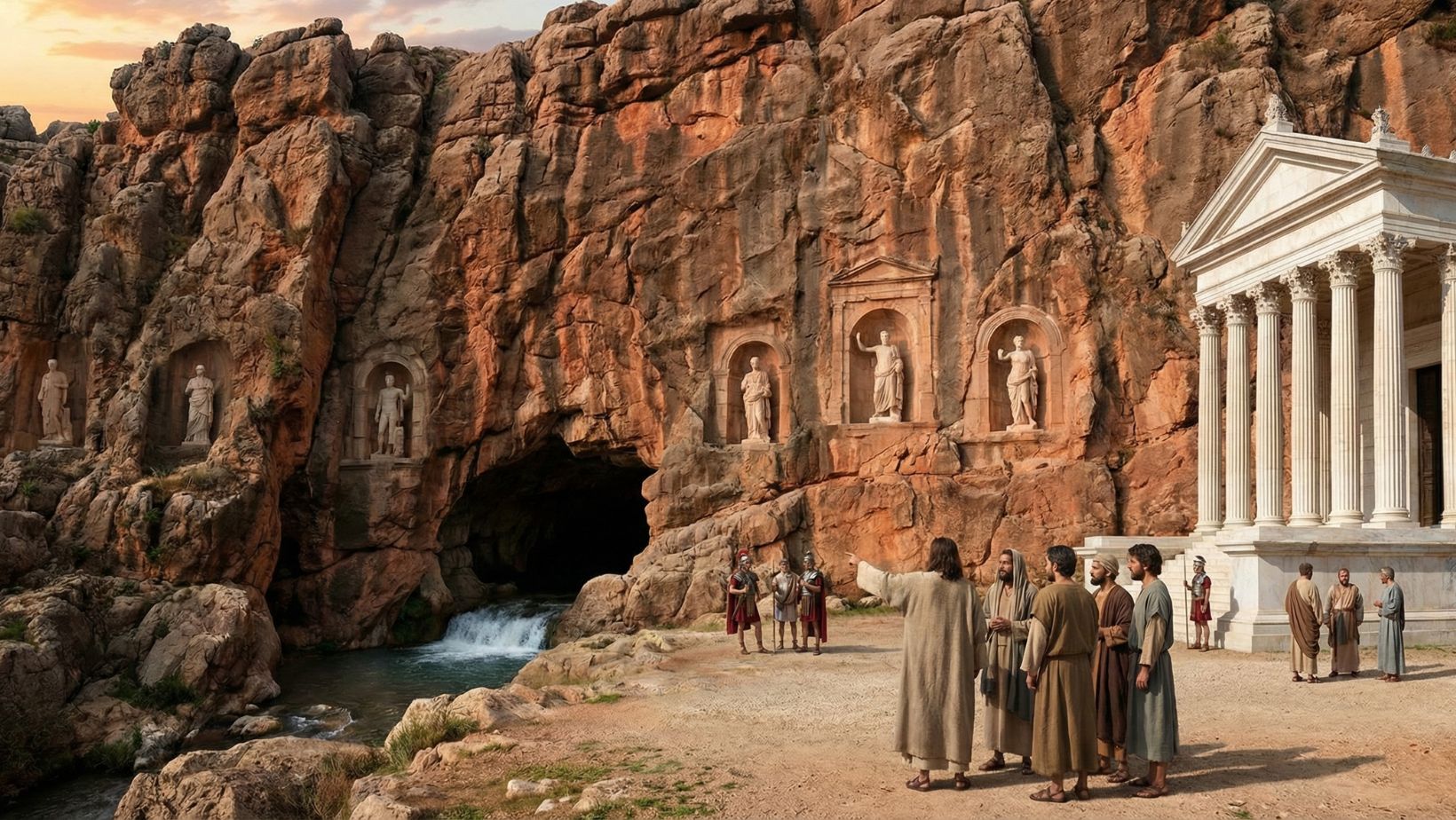
Caesarea Philippi is a site of immense theological drama, standing in stark contrast to the religious purity of Jerusalem. Located at the northernmost boundary of ancient Israel, at the foot of Mount Hermon, it was a center of pagan worship dedicated to the Greek god Pan—a place literally believed to contain the entrance to the underworld. It was against this backdrop of towering rock cliffs and idolatrous shrines that Jesus deliberately chose to ask His disciples the ultimate question: “Who do you say that I am?” By claiming to build His church on the “rock” at the very “gates of hell,” Jesus was declaring a militant offensive against the darkest powers of the spiritual world.
Quick Facts
- Name: Caesarea Philippi (originally Paneas; modern Banias)
- Location: 25 miles north of the Sea of Galilee, at the base of Mount Hermon
- Builder: Philip the Tetrarch (son of Herod the Great)
- Dedication: To Caesar Tiberius (to honor the Emperor) and Philip (to distinguish from the coastal Caesarea)
- Major Deity: Pan (half-man, half-goat god of nature/panic)
- Key Feature: The “Grotto of Pan”—a massive cave with a deep spring, considered a gateway to the underworld
- Key Event: Peter’s Confession of Christ (Matthew 16)
- Significance: The turning point of Jesus’ ministry; the first mention of the word “Church” (Ekklesia)
Name Meaning
Caesarea Philippi: A compound name. Caesarea honors the Roman Emperor (Caesar), and Philippi refers to Philip the Tetrarch, who expanded and renamed the city to secure his political standing.
Paneas / Banias: The ancient and modern name, derived from Pan, the goat-footed Greek god of shepherds, flocks, and rustic music, who was worshiped in the natural cave there.
Lineage / Origins
Ancient Roots: The site had been a center of Baal worship in the Old Testament era (Baal-Gad or Baal-Hermon).
Greek/Roman Era: When the Greeks conquered the region, they associated the lush water sources and caves with Pan. Herod the Great built a temple to Augustus there, and his son Philip later urbanized it into a Roman city.
Biblical Era / Context
Time: The climax of Jesus’ public ministry (approx. 6 months before the Crucifixion).
Setting: A lush, green area fed by the melting snows of Mount Hermon. It is one of the three main sources of the Jordan River.
Cultural Context: This was Gentile territory. It was filled with statues, niches carved into the rock face for idols, and temples. For a Jewish Rabbi (Jesus) to bring his students here was shocking—it was arguably the most pagan place in the region.
Major Roles / Identity
The Pagan Sanctuary: It represented the pinnacle of Gentile idolatry—sexualized worship, nature worship, and imperial cult worship (worship of the Emperor).
The Theological Classroom: Jesus used the physical geography (the massive rock cliff and the cave) as a visual aid to teach spiritual truth.
The Turning Point: Before Caesarea Philippi, Jesus focused on the multitudes and miracles. After this event, He focused on the disciples and His coming death.
Key Characteristics
The Rock Face: A massive limestone cliff dominates the site. In Jesus’ time, a white marble temple to Caesar stood atop this rock, and niches for Pan were carved into it.
The “Gates of Hell”: The Cave of Pan contained a spring of water that was incredibly deep. Ancient locals believed it was a bottomless pit that led directly to Hades (the underworld). This is the literal “Gate of Hades” Jesus referred to.
Isolation: Located far from Jerusalem and the Galilee religious hubs, providing privacy for intimate teaching.
Main Historical Events in Scripture
Peter’s Great Confession: Jesus asks, “Who do you say I am?” Peter answers, “You are the Messiah, the Son of the living God.” Jesus blesses him, stating that flesh and blood did not reveal this, but the Father (Matthew 16:13–17).
The Promise of the Church: Standing before the cave of the underworld, Jesus declares, “On this rock I will build my church, and the gates of hell shall not prevail against it” (Matthew 16:18).
The Prediction of Death: Immediately after this high point of faith, Jesus begins to explain that He must go to Jerusalem to suffer and die. Peter rebukes Him, and Jesus responds, “Get behind me, Satan!” (Matthew 16:21–23).
The Transfiguration: Six days after the confession, Jesus takes Peter, James, and John up a “high mountain” (likely Mount Hermon, which towers over Caesarea Philippi) and is transfigured before them (Matthew 17:1).
Major Relationships
Jesus & Peter: The dynamic shifts here. Peter is given the “keys of the kingdom,” affirmed as a leader, but also sharply corrected.
The “Rock” vs. The “Stone”: A famous wordplay. Jesus calls Simon Petros (a small stone/pebble) but says He will build His church on this Petra (massive bedrock/cliff).
- Interpretation: Protestants often view the “Petra” as Peter’s confession of faith or Christ Himself. Catholics view it as Peter’s office.
- Context: Visually, they were likely standing in the shadow of the massive Cliff of Banias, contrasting the small disciple with the massive foundation of Truth.
Notable Passages
Matthew 16:15–16: “‘But what about you?’ he asked. ‘Who do you say I am?’ Simon Peter answered, ‘You are the Messiah, the Son of the living God.’”
Matthew 16:18: “And I tell you that you are Peter, and on this rock I will build my church, and the gates of Hades will not overcome it.”
Legacy & Impact
The Concept of “Church”: This is the first time the word Ekklesia (Church/Assembly) appears in the Gospels. Jesus defines the Church as an offensive army that “Hell” cannot withstand.
Geography of Faith: It teaches that the Gospel is not afraid of paganism. Jesus planted the flag of His Kingdom right in the headquarters of the enemy.
Symbolism / Typology
The Gates of Hell: In ancient warfare, gates were defensive structures. When Jesus says the “gates of hell will not prevail,” He is picturing the Church attacking and storming the strongholds of evil, breaking them down. It is a picture of victory, not just survival.
Mount Hermon: Often associated with the “fallen angels” in Jewish tradition (Book of Enoch), making the Transfiguration there a sign of Jesus reclaiming the high places from cosmic darkness.







Leave a Reply