
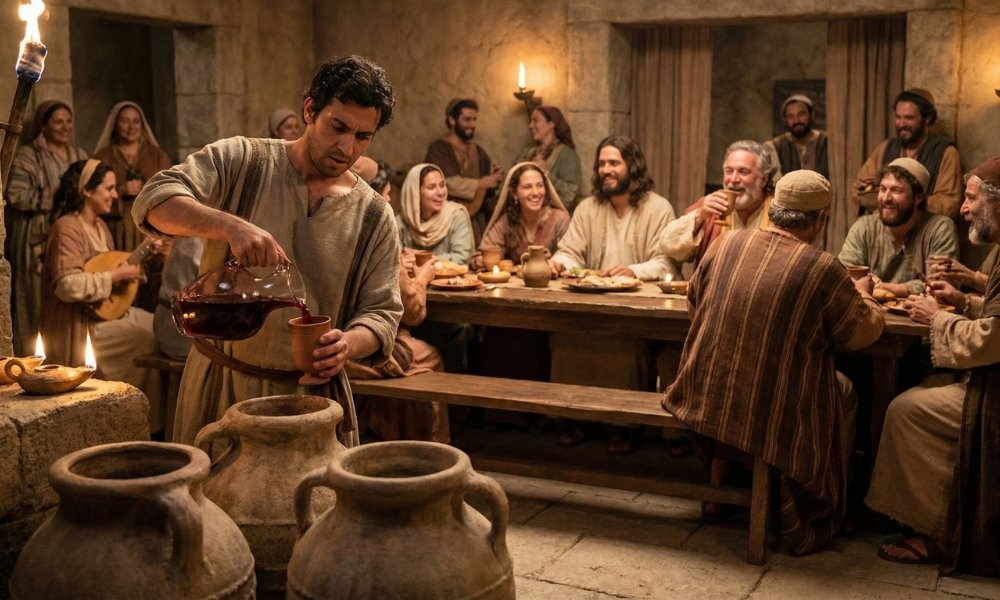
Cana (specifically “Cana of Galilee”) is a village immortalized in the Gospel of John as the setting for Jesus’ first public miracle—the turning of water into wine at a wedding feast. This event marked the beginning of His “signs,” where He first manifested His glory and His disciples believed in Him. Beyond this famous miracle, Cana was also the hometown of the disciple Nathanael and the location of Jesus’ second sign, the remote healing of a nobleman’s son.
Quick Facts
- Name: Cana (Hebrew: Qana)
- Meaning: “Place of Reeds” or “Reedy”
- Location: Lower Galilee (likely Khirbet Qana or Kafr Kanna)
- Region: Galilee (distinct from “Kanah” in Asher)
- Key Figures: Jesus, Mary, Nathanael (Bartholomew), the Royal Official
- Key Miracles: Turning Water into Wine (John 2); Healing the Official’s Son (John 4)
- Scripture Reference: John 2:1–11, John 4:46–54, John 21:2
Name Meaning
Qana: Derived from the Hebrew root for “reed” or “stalk.” This suggests the village was likely located near a marshy area, a riverbed, or a place where reeds grew abundantly.
Geography / Setting
Location Debate: The exact location is debated between two primary sites:
- Kafr Kanna: The traditional site (popular with pilgrims), located about 3.5 miles northeast of Nazareth.
- Khirbet Qana: A ruin located 9 miles north of Nazareth. Many modern archaeologists favor this site due to pottery dating to the Roman period and its isolation, which fits the biblical description better.
Proximity: Its closeness to Nazareth explains why Mary and Jesus were invited to a wedding there—likely involving friends or relatives.
Major Roles / Importance
The Launchpad of Glory: Cana is where Jesus transitioned from private life to public ministry. John 2:11 notes, “This beginning of signs Jesus did in Cana of Galilee, and manifested His glory.”
The Bookend of Galilean Ministry: In the Gospel of John, Jesus starts his ministry in Cana (John 2) and returns to Cana to perform his second sign (John 4), creating a literary cycle of His work in the north.
Hometown of a Disciple: John 21:2 identifies Nathanael as being “of Cana in Galilee,” suggesting Jesus had a personal network there through His disciples.
Main Events
The Wedding Feast (First Sign): During a wedding, the wine ran out—a major social humiliation in the Ancient Near East. Mary prompted Jesus to intervene. He commanded servants to fill six stone water jars (used for Jewish purification rites) with water, which He then transformed into the finest wine (John 2).
Healing the Nobleman’s Son (Second Sign): Later, Jesus returned to Cana. A royal official (possibly from Herod Antipas’ court) traveled from Capernaum (about 20 miles away) to beg Jesus to heal his dying son. Jesus simply spoke the word, “Go; your son lives.” The man believed, and the boy was healed at that exact hour (John 4).
Key Character Traits (Of the Miracles)
Transformation: The shift from “water for purification” to “wine for celebration” symbolizes the shift from the Old Covenant (ritual cleansing/Law) to the New Covenant (joy, blood, and grace).
Abundance: Jesus provided approximately 120–180 gallons of wine, far more than needed, symbolizing the overflowing grace of the Kingdom.
Distance: In the second miracle, Jesus demonstrated that His power was not limited by geography—He could heal from miles away.
Notable Passages
John 2:11: “What Jesus did here in Cana of Galilee was the first of the signs through which he revealed his glory; and his disciples believed in him.”
John 2:5: “His mother said to the servants, ‘Do whatever he tells you.’”
John 4:50: “Jesus replied, ‘You may go. Your son will live.’ The man took Jesus at his word and departed.”
Legacy & Impact
Sanctity of Marriage: By performing His first miracle at a wedding, Jesus is often viewed as giving divine blessing and validity to the institution of marriage.
Marian Intercession: In Catholic and Orthodox theology, Mary’s role at Cana (“They have no wine”) is a key scriptural basis for her role as an intercessor.
Stone Jars: Archaeological excavations in the region (especially at the site of Reineh and Kafr Kanna) have uncovered ancient stone vessels, confirming that Jewish purification laws regarding stone (which does not contract impurity) were strictly observed in this area during the first century.
Symbolism / Typology
The Third Day: John 2:1 mentions the miracle happened on “the third day,” foreshadowing the Resurrection, where the ultimate new wine would be poured out.
New Wine: In the Bible, wine is a symbol of joy and the Holy Spirit. Jesus providing “new wine” signifies the joy of the Messianic age replacing the “stale” water of legalism.







Leave a Reply