
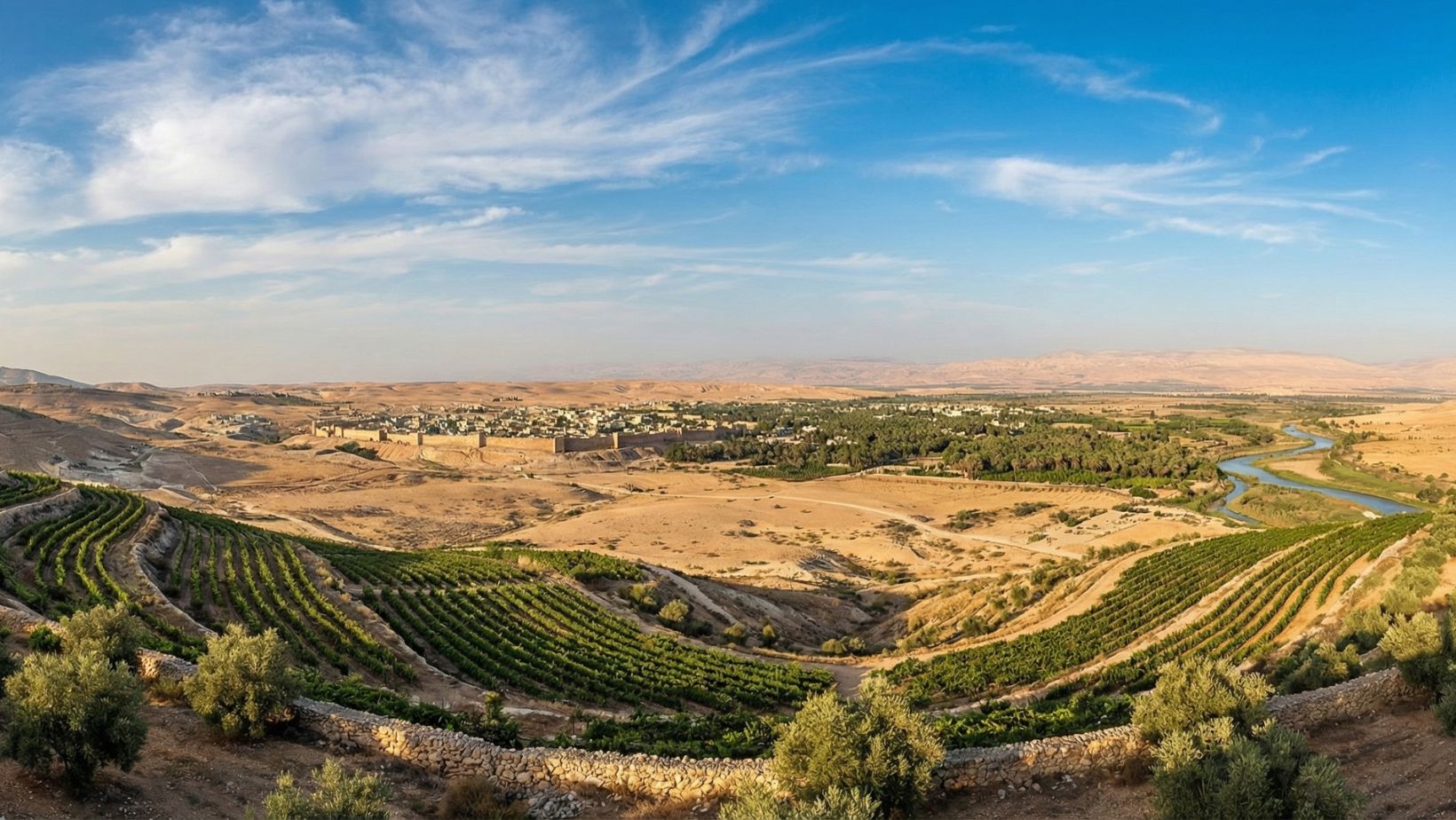
Canaan is the ancient biblical name for the region roughly corresponding to the modern-day Levant, encompassing Israel, the West Bank, Gaza, Jordan, and parts of Lebanon and Syria. In the biblical narrative, it is the land promised by God to Abraham and his descendants, described as a land “flowing with milk and honey.” Before the Israelite conquest under Joshua, it was inhabited by various city-states and nations (often collectively called Canaanites) known for their advanced mercantile culture, fortified cities, and polytheistic worship.
Quick Facts
- Name: Canaan (Hebrew: Kena’an)
- Meaning: “Lowlands,” “Subdued,” or “Land of Purple”
- Location: The Levant (between the Mediterranean Sea and the Jordan River)
- Key Cities: Jericho, Hazor, Megiddo, Shechem, Hebron
- Inhabitants: The “Seven Nations” (Hittites, Amorites, Canaanites, etc.)
- Major Resources: Purple dye, timber (cedars), grapes, olives
- Biblical Role: The Promised Land; the setting for the majority of the Old Testament
- Key Trade Route: The Via Maris (Way of the Sea) connecting Egypt and Mesopotamia
Name Meaning
The name Canaan likely derives from a Semitic root meaning “low” or “humble,” referring to the coastal lowlands where the original Canaanites settled (in contrast to the highlands of Lebanon).
Alternatively, it is linked to the Hurrian term Kinahhu, meaning “purple,” a reference to the region’s famous production of Tyrian purple dye derived from murex snails—a major export that later gave the Phoenicians (Greek for “purple people”) their name.
Geography / Borders
Biblical Boundaries: Defined in Numbers 34, the land extended from the “River of Egypt” (Wadi el-Arish) in the south to Lebo-Hamath in the north, and from the Mediterranean Sea in the west to the Jordan River in the east. Terrain: A land of diverse geography, featuring the fertile coastal plain, the central hill country (where Jerusalem sits), the Jordan Rift Valley (the lowest point on earth), and the Negev desert in the south. Strategic Position: Canaan served as a land bridge between the great superpowers of the ancient world: Egypt to the southwest and Mesopotamia (Assyria/Babylon) to the northeast. This made it a constant battleground for control of trade routes.
Inhabitants: The Seven Nations
Before the Israelite conquest, the land was occupied by seven distinct distinct groups (Deuteronomy 7:1) often collectively called “Canaanites”:
- Canaanites: Settlers of the coast and Jordan Valley.
- Amorites: “Highlanders” who lived in the mountains.
- Hittites: Migrants from Anatolia (modern Turkey).
- Jebusites: Inhabitants of Jerusalem (Jebus).
- Hivites: Dwellers of the northern hill country (Shechem/Gibeon).
- Perizzites: Villagers living in open, unwalled towns.
- Girgashites: A lesser-known group, possibly from the east.
Biblical Era / Context
Time: Middle to Late Bronze Age (Patriarchs) through the Iron Age (Israelite Monarchy). Political Structure: Unlike the unified nation of Israel, Canaan was a loose collection of independent city-states (like Hazor and Jericho), each ruled by a petty king who often paid tribute to Egypt. Religious Context: The region was dominated by the worship of Baal (storm/fertility god), Asherah (mother goddess), and El (supreme deity). Their religious practices, which sometimes included child sacrifice (to Molech), were strictly condemned in the Torah.
Key Cities & Regions
Jericho: The “City of Palms,” one of the oldest fortified cities in the world and the first to fall to Joshua. Hazor: The largest and most powerful Canaanite city in the north; the “head of all those kingdoms” (Joshua 11:10). Megiddo: A strategic chariot city overlooking the Jezreel Valley; the site of many historical battles (and the origin of the word Armageddon). Shechem: A central religious site where Abraham first received God’s promise and where Joshua renewed the covenant. Hebron: A major city in the Judean hills, burial place of the Patriarchs (Cave of Machpelah).
Main Historical Events
The Patriarchal Sojourn: Abraham, Isaac, and Jacob lived in Canaan as nomads, dwelling in tents near major cities but owning no land except a burial cave. The Spy Mission: Moses sent 12 spies into Canaan. They returned reporting a land of “milk and honey” but also terrified of the “giants” (Anakim) and fortified walls (Numbers 13). The Conquest: Under Joshua, the Israelites entered Canaan, crossing the Jordan River and conducting campaigns in the center, south, and north to dismantle the Canaanite coalition. The Judges Era: A period of incomplete conquest where Israelites and Canaanites coexisted, leading to cycles of idolatry and oppression.
Legacy & Impact
The Holy Land: Canaan became Eretz Yisrael (The Land of Israel), the physical theater for God’s redemptive plan. Cultural Influence: The Canaanite alphabet is the ancestor of the Hebrew, Greek, and Latin alphabets. Theology of Land: The shift from “Canaan” (a land of idolatry) to “Israel” (a land of covenant) represents the sanctification of the earth. It taught that land is a gift from God, contingent on obedience.
Symbolism / Typology
The Promised Rest: In the New Testament (Hebrews 4), entering Canaan symbolizes entering God’s spiritual rest and salvation. Spiritual Warfare: The conquest of Canaan is often viewed as a type of the believer’s battle against the “flesh” and spiritual strongholds. Milk and Honey: Represents the abundance and provision of God, in contrast to the “leeks and onions” of Egyptian slavery.
Extra-Biblical References
The Amarna Letters: A cache of clay tablets from the 14th century BCE found in Egypt. They contain desperate letters from Canaanite kings (like the king of Jerusalem) asking the Pharaoh for help against invading “Habiru” (potentially the Hebrews). Merneptah Stele: An Egyptian inscription (c. 1208 BCE) that contains the earliest non-biblical mention of “Israel” as a people group existing within the region of Canaan.







Leave a Reply