
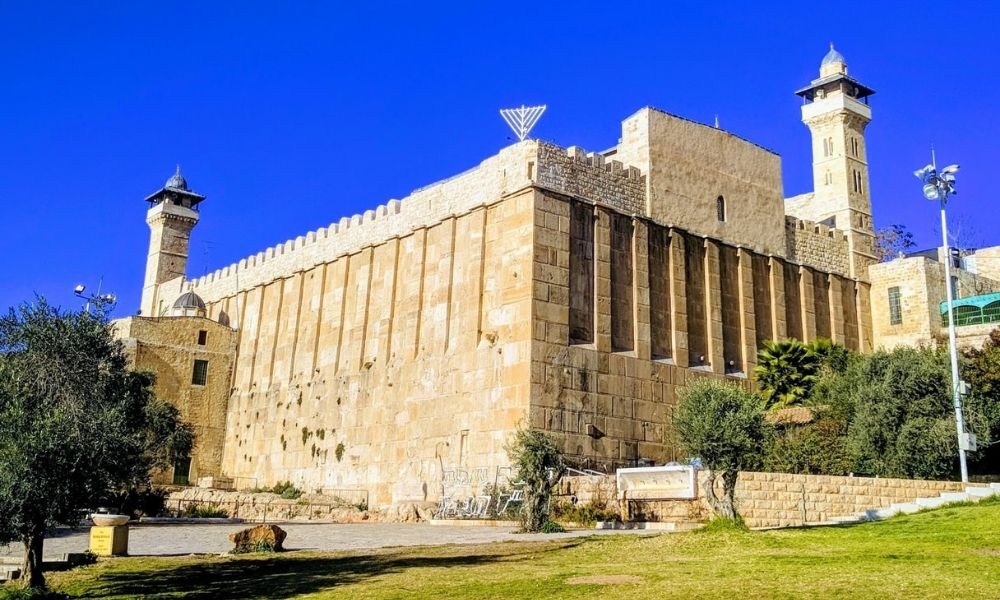
The Cave of Machpelah, known in Hebrew as Me‘arat ha-Makhpelah and in Arabic as Al-Haram al-Ibrahimi (“The Sanctuary of Abraham”), is one of the most sacred and historically significant sites in the world.
It is traditionally regarded as the burial place of Abraham, Sarah, Isaac, Rebekah, Jacob, and Leah — the patriarchs and matriarchs of Israel — making it the second holiest site in Judaism after the Temple Mount, and a revered place of worship in Christianity and Islam alike.
Quick Facts
Name: Cave of Machpelah (Me‘arat ha-Makhpelah — “Cave of the Double Tomb”)
Also Called: The Cave of the Patriarchs (Al-Haram al-Ibrahimi, “Sanctuary of Abraham”)
Location: Hebron (ancient Kiriath-Arba), southern West Bank, ~30 km south of Jerusalem
Coordinates: 31.5241° N, 35.1107° E
First Biblical Mention: Genesis 23
Purchased By: Abraham from Ephron the Hittite for 400 shekels of silver
Buried There: Abraham, Sarah, Isaac, Rebekah, Jacob, and Leah
Not Buried There: Rachel (buried near Bethlehem)
Structure Above: Herodian stone enclosure (~1st century BCE)
Significance: Burial site of the patriarchs; symbol of covenant promise and resurrection faith
Biblical Background
The Purchase (Genesis 23)
After the death of Sarah, Abraham sought a permanent burial place within the land God had promised him.
He purchased the field of Machpelah near Mamre (Hebron) from Ephron the Hittite, paying the full price — 400 shekels of silver — to ensure clear and lasting ownership.
This marked the first piece of the Promised Land ever legally owned by Abraham or his descendants, symbolizing faith in God’s covenant even before its fulfillment.
“And after this, Abraham buried Sarah his wife in the cave of the field of Machpelah before Mamre (that is, Hebron) in the land of Canaan.”
— Genesis 23:19
Subsequent Burials
The cave became the ancestral tomb of the patriarchal family:
| Name | Relation | Biblical Reference |
|---|---|---|
| Sarah | Wife of Abraham | Genesis 23:19 |
| Abraham | Patriarch | Genesis 25:9–10 |
| Isaac | Son of Abraham | Genesis 35:27–29 |
| Rebekah | Wife of Isaac | Genesis 49:31 |
| Jacob (Israel) | Son of Isaac | Genesis 50:13 |
| Leah | Wife of Jacob | Genesis 49:31 |
Only Rachel is buried elsewhere — near Bethlehem — symbolizing her own unique role in Israel’s story (Genesis 35:19–20).
Theological and Spiritual Significance
1. Faith in God’s Promise
Abraham’s purchase of Machpelah demonstrated faith in God’s covenant promise of the land, even though he possessed none of it at the time. It was an act of trust and foresight.
2. Symbol of the Covenant
The site stands as a memorial to God’s everlasting covenant with Abraham and his descendants — a promise of both land and life.
3. Hope of Resurrection
For many believers, the cave represents the hope of eternal life, as the patriarchs’ faith looked beyond death toward God’s ultimate fulfillment of His promises (cf. Hebrews 11:9–16).
4. Unity of the Faithful
Machpelah brings together the shared heritage of Jews, Christians, and Muslims, all of whom trace spiritual lineage to Abraham (Ibrahim) as a father of faith.
Archaeological and Historical Overview
1. Ancient Origins
The actual underground caves are not accessible today, but historical records and limited surveys suggest the presence of double-chambered caves beneath the structure — matching the name Machpelah (“double”).
2. Herodian Enclosure
The large rectangular stone structure above the caves was built by Herod the Great (~1st century BCE). It closely resembles Herod’s architectural style at the Temple Mount — with massive ashlar stones and finely cut margins.
- Dimensions: ~60 x 34 meters
- Wall Height: ~12 meters
- Made of: Large limestone blocks (some over 7 meters long)
3. Byzantine and Islamic Eras
- 4th century CE (Byzantine period): A church was built over the site.
- 7th century CE (Islamic conquest): The site became a mosque known as Al-Haram al-Ibrahimi.
- 12th century CE (Crusader rule): Reconverted into a Christian church, then back into a mosque under Saladin in 1188 CE.
4. Modern Structure and Access
Today, the complex includes:
- Mosques and cenotaphs (symbolic tombs) for each patriarch/matriarch.
- Restricted access:
- Jewish and Muslim areas are separated.
- Only on specific holy days (e.g., Passover and Eid al-Adha) is full access granted to both communities.
Archaeological Insights
- The actual burial chambers remain sealed beneath the Herodian structure and are rarely accessed.
- A few exploratory attempts were made — notably in 1119 CE (Crusader period) and 1967 CE (after the Six-Day War), when Moshe Dayan briefly investigated a narrow shaft leading below.
- These explorations confirmed the presence of natural limestone caves — likely ancient burial chambers.
Though little physical evidence is available, the site’s continuity of veneration for over 3,000 years affirms its ancient authenticity and sacred status.
Modern Religious and Political Significance
1. Judaism
- Regarded as second only to the Temple Mount in holiness.
- A place of pilgrimage and prayer, especially for descendants of Abraham.
- Associated with the reading of Parashat Chayei Sarah (Genesis 23), commemorating Abraham’s purchase.
2. Islam
- Known as Al-Haram al-Ibrahimi, it honors Prophet Ibrahim and his family.
- Muslims regard the site as the fourth holiest place in Islam after Mecca, Medina, and Jerusalem.
3. Christianity
- Revered as the burial site of the patriarchs and matriarchs who are ancestors of faith.
- Seen as a link between the Old and New Covenants — Abraham being the father of all who believe (Romans 4:16).
4. Political Context
- Located in Hebron, within the West Bank, the site lies at the heart of Israeli-Palestinian tensions.
- Divided since 1994 after the tragic Cave of the Patriarchs massacre, the area is now heavily secured, with separate entrances for Jewish and Muslim worshipers.
Symbolism and Legacy
- Faith in unseen promises: Abraham purchased the land in faith — a lesson in trusting God’s word before its fulfillment.
- Continuity of covenant: The tombs unite generations under God’s promise.
- Common spiritual ancestry: Revered by all three Abrahamic faiths, Machpelah stands as a reminder of shared origins and the hope of reconciliation.
- Hope beyond death: The patriarchs’ burial there prefigures the resurrection hope central to Christian belief.
Key Bible References
- Genesis 23: Abraham purchases the cave to bury Sarah.
- Genesis 25:9–10: Abraham is buried beside Sarah.
- Genesis 35:27–29: Isaac dies and is buried in Machpelah.
- Genesis 49:29–31; 50:13: Jacob instructs his sons to bury him there with Abraham, Isaac, Rebekah, and Leah.
Conclusion
The Cave of Machpelah is more than a burial site — it is a monument of faith, promise, and continuity.
From Abraham’s purchase to the prayers that echo through Hebron today, it tells the story of humanity’s longing for God’s covenantal presence and eternal life.
It stands as a shared spiritual heritage for billions, calling the faithful of all nations to remember the God of Abraham, Isaac, and Jacob — the One who fulfills His promises from generation to generation.







Leave a Reply